French Recipes

Tourtière landaise

A Landes/Gascon apple pastry made from hand-stretched paper-thin dough, layered with butter and sugar and scented with Armagnac.

French Recipes
Share
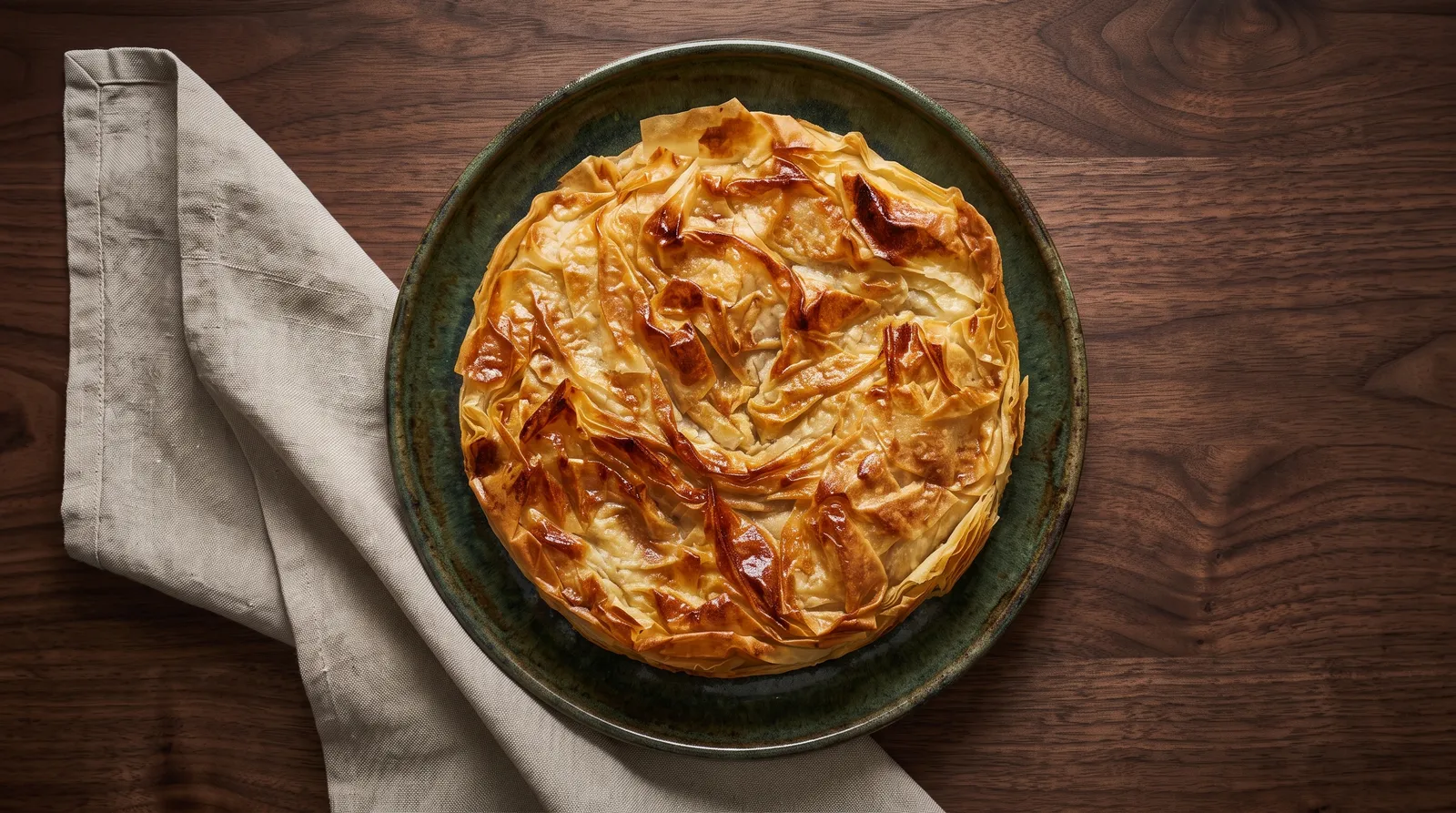
Tourtière landaise — served on a plate
Prep 60 minutes
Cook 45 minutes
Total 255 minutes
Yield 1 x 26 cm pastry, 8 slices
About this dish

Tourtière landaise — stretched-dough apple and Armagnac pastry

Tourtière landaise is a sweet stretched-dough pastry from the Landes/Gascon tradition, not the meat pie known as tourtière in Canada. The dough is worked until elastic, rested, then stretched over a cloth until it is almost translucent. Butter, sugar and Armagnac separate the layers around thin apple slices.

The demanding part is the dough rather than the filling. It needs enough kneading to become elastic, enough rest to relax, and a gentle centre-out stretching motion so it thins without tearing. A short surface dry makes the dough less tacky before it is brushed, sugared and folded into layers.

The finished pastry should be crisp and deeply golden with a fully cooked bottom, while the apple remains tender rather than turning into a wet compote. Cooling is also functional: the fruit syrup is extremely hot straight from the oven and needs time to settle before clean slices are safe and practical.
Success points

Success points

  • Give the dough its full knead and rest before stretching.
  • Stretch from the centre using gentle support from the backs of the hands.
  • Drain obvious apple maceration liquid before layering the fruit.
Ingredients

Ingredients

Stretched dough

  • 500 g plain wheat flour
  • 50 g whole egg, net weight — 1 large egg
  • 250 ml lukewarm water
  • 30 ml sunflower oil — 15 ml in dough + 15 ml to coat during rest
  • 3 g fine salt

Apple filling and finish

  • 450 g apples — peeled, cored and sliced paper-thin; about 3 medium apples prepared weight
  • 125 g unsalted butter — melted
  • 200 g caster sugar
  • 10 g vanilla sugar
  • 100 ml Armagnac
Method

Method

Develop and rest the dough

  1. Knead an elastic dough. Mix flour, egg, salt, 250 ml lukewarm water and 15 ml sunflower oil, then knead and work the dough until very elastic and non-sticky. Allow 40 minutes. The dough is smooth, supple and springs back slowly when pressed.

  2. Rest the oiled dough. Coat the dough with the remaining 15 ml oil and rest it covered in a cool place. Allow 60 minutes passive resting. The rested dough feels relaxed and stretches without immediately shrinking back.

Stretch, layer and bake

  1. Macerate the apples. Rest the prepared apple slices with 40 g of the sugar, vanilla sugar and 40 ml Armagnac for a short maceration. Allow 20 minutes passive resting. The apples are lightly glossy and have released only a small amount of juice. Alcohol may remain in the finished pastry.

  2. Thin the dough over the cloth. Stretch the dough over a clean cloth from the centre outward until almost translucent and large enough to cover a dining table area. Allow 15 minutes. The dough is paper-thin and translucent over most of its surface, with no large tears. Pull slowly to avoid tearing.

  3. Dry the stretched sheet. Rest the stretched sheet uncovered briefly so the surface loses tackiness. Allow 10 minutes passive resting. The dough surface feels dry rather than sticky but remains flexible.

  4. Layer pastry and fruit. Brush the sheet with melted butter, sprinkle with the remaining sugar and 40 ml Armagnac, fold into layers, line a buttered 26 cm pan, add the drained apples, cover with the remaining layers and crumple the top lightly. Allow 5 minutes. The apples are enclosed evenly and the top has loose crumpled folds rather than a flat lid. Hot butter and alcohol should be kept away from open flame.

  5. Bake with Armagnac. Drizzle the remaining 20 ml Armagnac over the top and bake until crisp and deeply golden. Use oven. Allow 45 minutes. Temperature: 180 °C. The top layers are crisp and deep golden, and the bottom pastry is fully cooked rather than doughy. Alcohol may remain despite baking.

  6. Let the pastry settle. Cool before slicing so the hot fruit syrup settles. Allow 60 minutes passive cooling. The pastry is warm to cool rather than steaming and the apple juices no longer run when a test cut is made.

Serving, storage and make-ahead

Practical

Serving, storage and make-ahead

Serve once the pastry has cooled enough for the apple syrup to settle. A brief gentle oven rewarm is possible, but avoid steaming it under a cover if crisp layers matter. The dough can rest for several hours chilled, then should return to a cool, pliable state before stretching. Cool the baked tourtière fully, cover and refrigerate within 2 hours. Apples can be exchanged for prunes in another documented regional version, but this recipe stays consistently apple-based. Armagnac is not assumed to evaporate completely during baking.

Troubleshooting

Troubleshooting

  • Dough keeps tearingIt was under-rested or pulled aggressively from the edge. Give it the full rest and work from the centre outward.
  • Bottom is doughyThe layers were too thick or the pastry was underbaked. Stretch thinner and bake until the base is fully cooked as well as the top.
Nutrition per serving

Nutrition per serving

  • Serving size1 of 8 slices
  • Calories520 kcal
  • Carbohydrate72 g
  • Protein6 g
  • Fat20 g
  • Fibre3 g
  • Sodium180 mg
Allergens and food safety

Allergens and food safety

Allergens: egg, milk, gluten, sulphites.

Handle hot butter, hot fruit syrup and oven steam carefully. Refrigerate the finished pastry within 2 hours once cooled to serving temperature. Armagnac is not assumed to evaporate completely; alcohol may remain.

FAQ

FAQ

Is puff pastry the same thing here?

No. The defining Landes pastry is made with stretched dough; puff pastry would be a shortcut adaptation with a different texture.

Does all the alcohol cook away?

No complete disappearance is assumed; some Armagnac may remain.

Closing

Closing

  • Result — crisp, fragile layers around tender apples with butter, sugar and Armagnac aroma.
  • Decisive technique — work and rest the dough until elastic, then stretch it almost translucent before layering.