French Recipes

Terrine de campagne

A coarse refrigerated pork terrine with shoulder, belly, liver, milk-soaked bread, egg, Madeira and herbs, baked to 71 °C and set under weight.

French Recipes
Share
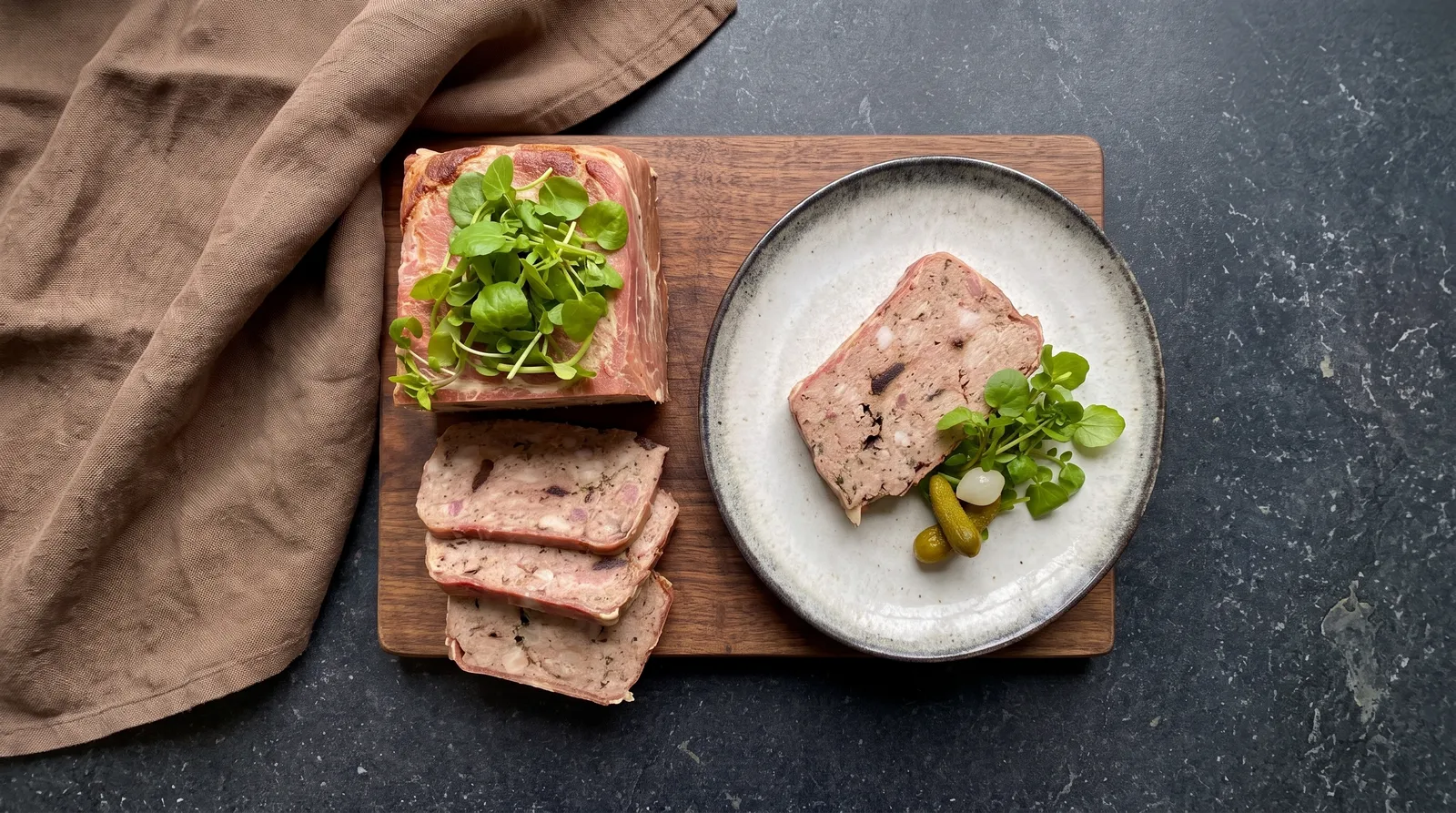
Terrine de campagne — arranged on a board
Prep 45 minutes
Cook 90 minutes
Total 2415 minutes
Yield about 1.35 kg cooked terrine in a 1.5 litre mould
Introduction and overview

Terrine de campagne — coarse French country pork terrine

Terrine de campagne should show the structure of its meat rather than the smoothness of a fine pâté. Pork shoulder supplies lean meat, belly supplies fat and tenderness, and a measured liver portion deepens the savoury character. The chilled mixture is passed through a 6–8 mm plate, then combined with a milk-soaked bread panade and pasteurised egg so the cooked loaf slices cleanly without becoming an emulsion.

Cold handling is essential. Warm fat smears through a grinder instead of remaining as a visible coarse mosaic, producing a dense greasy slice. Keep the meat and equipment at 4 °C or colder, mix only until the mass binds and never taste raw forcemeat. The mould is packed firmly, set in a water bath and baked at 160 °C until the geometric centre reaches 71 °C.

The long set is part of the recipe rather than an optional wait. After a short 30-minute initial cool, the terrine moves into refrigeration, chills thoroughly, then rests under a clean 1 kg weight for 24 hours. That cold period firms the fat and protein matrix, improves slicing and lets the seasoning settle. The result is a refrigerated charcuterie item; it is not suitable for home-canning or shelf-stable storage.
Success points

Success points

  • Keep meat, liver, bowl and grinder parts cold enough to prevent fat smearing.
  • Use the 6–8 mm plate and stop mixing once the coarse forcemeat binds.
  • Measure 71 °C at the geometric centre; colour alone is not a safety test.
  • Complete the rapid chill and full 24-hour weighted set before unmoulding.
Ingredients

Ingredients

Meat mixture

  • 700 g pork shoulder — commercially butchered; trimmed edible weight; buy about 760 g
  • 300 g pork belly — commercially butchered; skin and hard cartilage removed; edible weight; buy about 330 g
  • 200 g pork liver — commercially butchered; connective tissue trimmed; edible weight; buy about 230 g
  • 100 g white bread — crusts included, torn
  • 120 ml whole milk — pasteurised
  • 100 g pasteurised whole egg — beaten; net weight
  • 100 g shallots — peeled and finely chopped
  • 10 g garlic — peeled and finely chopped
  • 20 g flat-leaf parsley — finely chopped
  • 50 ml Madeira — Contains sulphites unless the label states otherwise; alcohol may remain.
  • 18 g fine salt
  • 3 g black pepper — freshly ground
  • 1 g ground allspice
  • 2 g dried thyme
Method

Method

Marinate and mix

  1. Season and marinate the meat. Combine the 700 g shoulder, 300 g belly and 200 g liver with Madeira, shallot, garlic, parsley, salt, pepper, allspice and thyme, cover and refrigerate. Timing: 12 hours. Temperature: 4 °C or colder. Cold marination distributes seasoning while keeping the forcemeat safely chilled. Keep all meat at 4 °C or colder; do not taste the raw mixture. The meat is thoroughly chilled and evenly coated with the measured seasoning after the 12-hour rest.

  2. Soften the panade. Soak 100 g bread in 120 ml milk until evenly soft while the meat remains cold. Timing: 5 minutes. Temperature: 4 °C or colder. The panade helps retain moisture in the cooked terrine. Keep milk refrigerated before use. The bread has absorbed the milk evenly with no dry centre.

  3. Grind and bind coarsely. Coarsely grind the chilled meat and liver through a 6–8 mm plate, then mix with the soaked panade and 100 g pasteurised egg until evenly bound without warming the mixture. Timing: 15 minutes. Temperature: 4 °C or colder. A coarse grind preserves the country-terrine texture. Keep the bowl over ice if needed and return the mixture to refrigeration if it warms; never taste raw forcemeat. The forcemeat is visibly coarse, evenly mottled with fat and holds together when pressed without becoming a smooth paste.

  4. Pack the terrine mould. Pack the forcemeat firmly into a 1.5 litre terrine mould, eliminating large air pockets and smoothing the top. Timing: 10 minutes. Firm packing produces even slices and even heat transfer. The mould is evenly packed with no visible large cavities and the top is level.

Bake and set

  1. Bake in a water bath. Set the covered terrine mould in a hot water bath and bake until the geometric centre reaches 71 °C. Timing: 90 minutes. Heat: 160 °C conventional oven. Temperature: 160 °C oven; 71 °C centre. A water bath moderates edge heat while the 71 °C centre temperature is the safety endpoint. Measure the centre with a clean probe; do not rely on colour alone. The centre reaches 71 °C, the loaf is set and clear juices collect around the edge rather than raw pink liquid.

  2. Drain and begin cooling. Remove the terrine from the water bath, carefully pour off and discard about 40 g separated surface fat, then cool for 30 minutes before moving it to refrigeration. Timing: 30 minutes. Keep off the heat. A short initial cool prevents prolonged heat loading in the refrigerator while staying within the 2-hour room-temperature limit. Hot fat and water can burn; handle the mould with dry oven gloves. The mould has stopped steaming vigorously and is safe to transfer after 30 minutes.

  3. Chill before weighting. Refrigerate uncovered until thoroughly cold, then cover and place a clean 1 kg weight over the terrine. Timing: 90 minutes. Temperature: 4 °C or colder. Rapid chilling before weighting limits warm holding and begins the set. Move the terrine to 4 °C or colder well within 2 hours of leaving the oven. The terrine is cold and firm enough to support the clean weight without forcing liquid over the rim.

  4. Set under weight. Keep the weighted terrine refrigerated to mature and set before unmoulding and slicing. Timing: 24 hours. Temperature: 4 °C or colder. The long cold set improves slicing and seasoning distribution. Keep continuously refrigerated; this is not a shelf-stable preserve. After 24 hours the terrine is firm, slices cleanly and retains a coarse mosaic rather than crumbling.

Serving

Practical

Serving

Unmould cold and cut into 12 slices. Serve chilled or cool, never after prolonged room-temperature holding.

Storage and reheating

Keep covered at 4 °C or colder and use within 4 days of baking. This terrine is served cold; reheating is not recommended because it melts the retained fat and damages the set. Freeze only if texture change is acceptable, tightly wrapped, for up to 1 month; thaw in the refrigerator.

Cognac for Madeira

Changes the aromatic profile and removes the wine-sulphite assumption if the spirit label contains no sulphites; use the same measured volume only as an adaptation.

Do not replace pork liver with more shoulder without relabelling the result

Removing the measured liver component changes the character of a country terrine.

Troubleshooting

Troubleshooting

  • Crumbly slicesCause: The forcemeat was not mixed enough to bind or the cold set was shortened. Correction: Mix until the coarse mass holds together, then complete the 24-hour weighted refrigeration.
  • Greasy, dense textureCause: The meat mixture became warm and smeared during grinding. Correction: Chill meat and grinder parts thoroughly and pause if the mixture rises above refrigerator temperature.
Nutrition per serving

Nutrition per serving

  • Serving size1 of 12 slices (about 112 g from a 1.35 kg cooked terrine)
  • Calories322 kcal
  • Carbohydrate7.5 g
  • Protein21.3 g
  • Fat22.0 g
  • Fibre0.6 g
  • Sodium708 mg
Allergens and food safety

Allergens and food safety

Allergens: Gluten (wheat), Milk, Egg, Sulphites.

Use commercially butchered pork and liver and keep the raw mixture at 4 °C or colder.

Never taste raw forcemeat.

Cook the geometric centre to 71 °C.

Cool for only 30 minutes at room temperature, then refrigerate; all meat terrine must be under refrigeration within 2 hours.

Store at 4 °C or colder and never use home-canning or shelf-stable storage methods for this recipe.

Madeira can contain sulphites and alcohol may remain.

Closing

Closing

  • Result: A coarse, sliceable country terrine with visible meat-and-fat texture, measured liver character and a firm cold set.
  • Decisive technique: Keep the forcemeat cold, cook the geometric centre to 71 °C, then complete the full 24-hour weighted refrigeration.