French Recipes

Steak-frites

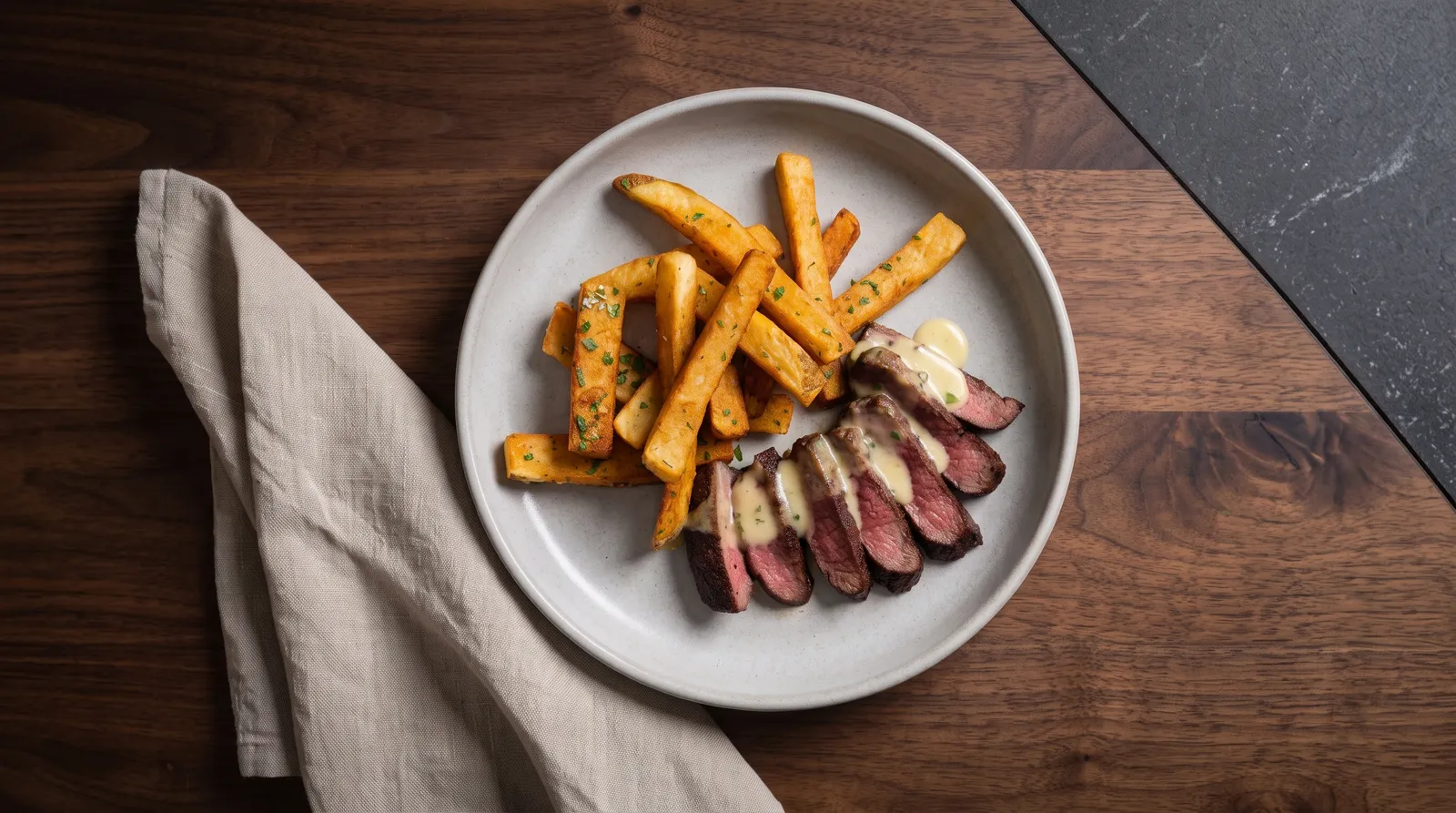
Whole seared steaks with crisp double-fried potatoes and a restrained shallot-Dijon pan sauce, timed so both reach the table together.

French Recipes
Share
Steak-frites — served on a plate
Prep 35 minutes
Cook 20 minutes
Total 68 minutes
Yield 4 complete plates
Introduction and overview

Steak-frites — French brasserie steak with double-fried potatoes

Steak-frites looks simple because the plate has only a few moving parts, but each one needs its own timing. The steak is cooked whole and measured to at least 63 °C before a three-minute rest. The potatoes are cut evenly, rinsed, dried and fried twice so the first stage cooks the centre and the second produces the crisp golden exterior associated with good brasserie fries.

The frying schedule is arranged around the steak rather than competing with it. The first fry happens before the meat goes into the pan. The potatoes then rest on a rack; while the steak rests after searing, the fries take their hotter second fry and the pan sauce is finished. That sequence gets both elements onto the plate in their best condition.

A small shallot-Dijon pan sauce adds acidity without turning the meal into a heavy sauced steak. Nutrition counts an estimated 80 g of oil retained by the entire kilogram of potatoes, not the full 1.5 litres needed to operate the fryer safely. That distinction prevents a frying-medium quantity from being mistaken for the amount actually eaten.
How to synchronise steak and fries

How to synchronise steak and fries

  • Dry the potatoes completely before the oil.
  • Use a measured two-stage fry at 150 °C and 180 °C.
  • Cook the steak to 63 °C and rest it for 3 minutes before plating.
Ingredients

Ingredients

Steaks

  • 720 g sirloin steaks — 4 × 180 g, about 2.5–3 cm thick, trimmed
  • 40 g unsalted butter
  • 4 g fine salt — for steaks
  • 2 g black pepper

Fries

  • 1000 g floury potatoes — peeled and cut into 10 mm batons
  • 1500 ml neutral frying oil — fryer charge; estimated retained oil 80 g for nutrition
  • 4 g fine salt — for fries

Shallot-mustard pan sauce

  • 60 g shallot — finely chopped
  • 20 g Dijon mustard
  • 30 ml red wine vinegar
  • 100 ml low-sodium beef stock — prepared with celery
Method

Method

Directions

  1. Rinse and dry the potatoes. Rinse the potato batons in cold water, drain them and dry every surface thoroughly. The potato surfaces feel dry and no visible water clings to the batons.

  2. First-fry the potatoes. Fry the potatoes at 150 °C for about 6 minutes in manageable batches. The fries are pale, flexible and cooked through at the centre without a brown crust.

  3. Rest the fries. Drain the fries on a rack and leave them for 10 minutes. The surface looks dry and the fries have firmed enough to handle without breaking.

  4. Prepare the steaks separately. On a separate raw-meat board, pat the steaks dry and season with 4 g salt and the pepper. The steak surfaces are visibly dry and evenly seasoned.

  5. Sear to temperature. Sear the steaks in half the butter for about 6 minutes total, checking the thickest part with a probe. A brown crust forms on both sides and the centre reaches at least 63 °C.

  6. Rest the steaks. Transfer the steaks to a warm plate for at least 3 minutes. The steaks remain juicy and the surface crust stays intact during the rest.

  7. Second-fry the potatoes. While the steaks rest, fry the potatoes at 180 °C for about 3 minutes and drain them well. The fries are crisp, evenly golden and rigid enough to hold their shape.

  8. Make the pan sauce. In the steak pan, cook the shallot in the remaining butter, add the vinegar and stock, reduce for about 5 minutes and whisk in the Dijon. The sauce is glossy and lightly thickened, with softened shallot and no harsh raw-vinegar smell.

  9. Plate immediately. Plate the whole steaks with the hot fries and a restrained amount of sauce. The fries remain crisp, the steak remains whole and the sauce is used as a restrained accent rather than a heavy covering.

Serving

Practical

Serving

Serve immediately, with the whole steak and fries sharing the plate so the fries can catch a little pan juice without being drowned in sauce.

Make-ahead

Cut, rinse and dry the potatoes shortly before frying. The first fry can be completed up to 1 hour ahead at room temperature on a rack; keep it separate from raw meat.

Storage and reheating

Refrigerate steak, sauce and fries within 2 hours and use within 3 days. Reheat leftovers to 74 °C. Fries regain more crispness in a hot oven or air fryer than in a microwave, but they will not match fresh frying.

Substitutions

Rib-eye can replace sirloin, increasing fat and changing cooking behaviour. A neutral high-smoke-point frying oil can be used; the nutrition estimate still assumes about 80 g total oil uptake across the 1 kg potatoes.

Troubleshooting

Troubleshooting

  • Greasy, limp friesThe oil temperature fell too far or the potatoes were wet. Dry them thoroughly, fry in smaller batches and restore 180 °C before the second stage.
  • Steak overcooks while fries finishThe two fry stages were not coordinated. Complete the first fry before searing the steaks, then use the steak rest for the second fry and sauce.
Nutrition per serving

Nutrition per serving

  • Serving size1 whole steak, one quarter of the fries and one quarter of the pan sauce
  • Calories820 kcal
  • Carbohydrate47.0 g
  • Protein45.7 g
  • Fat50.2 g
  • Fibre6.3 g
  • Sodium991 mg
Allergens and food safety

Allergens and food safety

Allergens: Milk, Mustard, Celery.

Hot oil is a serious burn and fire hazard; keep water away and never fill the fryer beyond its safe level. Cook whole steaks to at least 63 °C and rest for at least 3 minutes. Keep raw-meat tools away from cooked fries and sauce. Refrigerate leftovers within 2 hours and reheat to 74 °C.

FAQ

FAQ

Why fry the potatoes twice?

The first lower-temperature fry cooks the centre; the second hotter fry dries and browns the exterior.

Why is only 80 g oil counted in nutrition?

The fryer needs much more oil to operate, but only an estimated fraction is retained by the potatoes and eaten.

Closing

Closing

  • Result: A complete brasserie plate with juicy whole steak, crisp fries and restrained pan sauce.
  • Decisive technique: Double-fry completely dry potatoes and use the steak rest to finish fries and sauce.