French Recipes

Soupe au fromage

Aveyron-style stale bread, aged cheese, cabbage and onion layered with hot broth and baked into a dense, fork-eaten regional soup.

French Recipes
Share
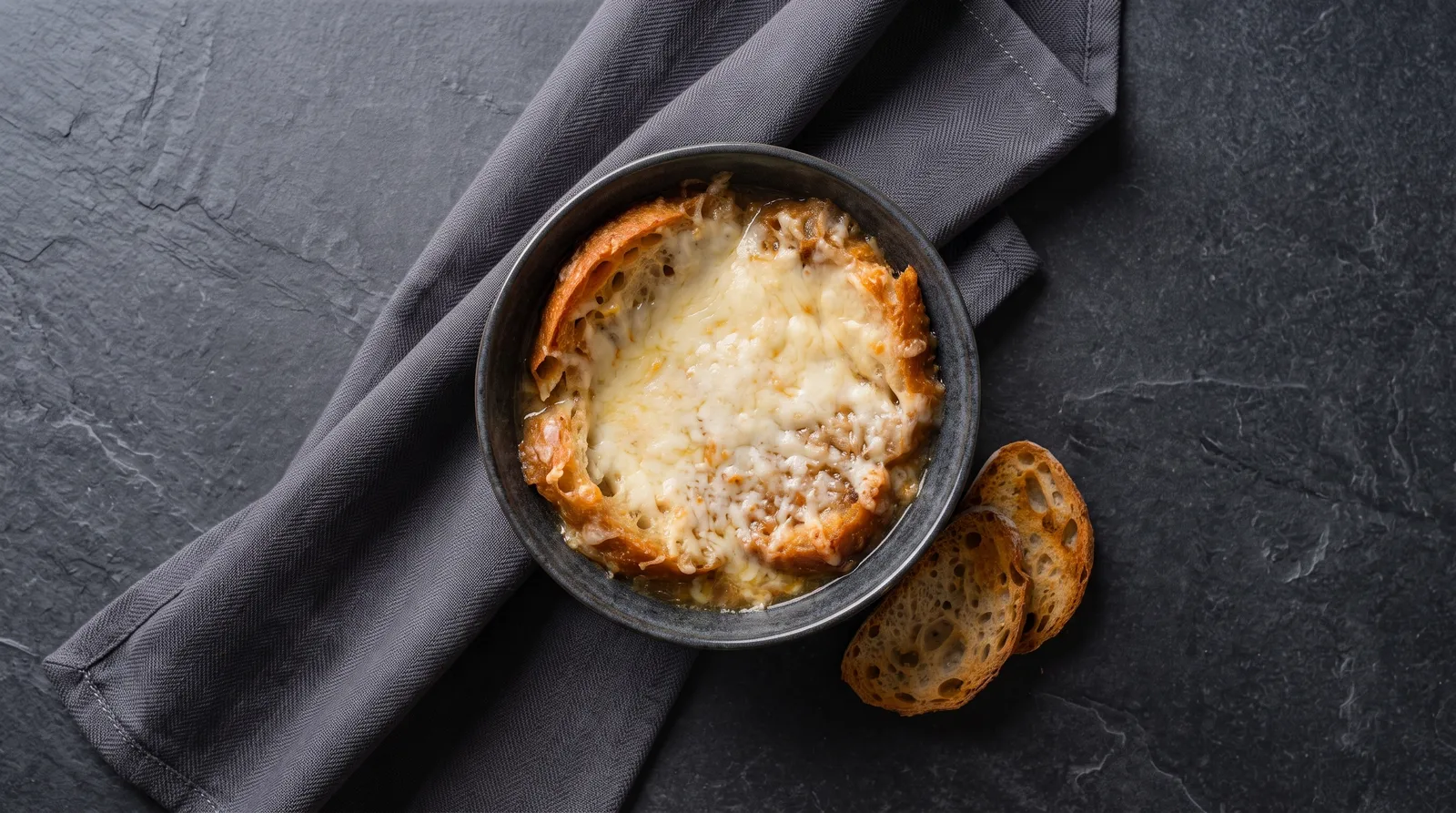
Soupe au fromage — served in a bowl
Prep 30 minutes
Cook 105 minutes
Total 145 minutes
Yield 1 deep 4 litre baking dish, 6 portions
Introduction and overview

Soupe au fromage — Aveyron layered bread and cheese soup

Aveyron and Aubrac soupe au fromage is not a blended cheese soup. It is a dense, rustic layered preparation in which stale country bread and aged cheese are moistened with a hot onion-and-cabbage broth, then baked until the bread is fully saturated and the cheese has melted through the dish. Regional descriptions often note that it can be eaten more readily with a fork than a spoon.

This household version keeps the cabbage form documented in Aveyron cooking. The cabbage is softened before it meets the bread, and the onion is browned in duck fat to give the broth depth. A small amount of dry white wine is reduced before the beef stock is added, so the liquid tastes integrated rather than sharply alcoholic.

The assembly should still look layered before it enters the oven. Stale bread absorbs the broth during a short stand, while the cheese and vegetables remain distributed through the dish. Baking completes the saturation and creates a browned top without turning everything into a featureless paste.
How to keep the layered texture

How to keep the layered texture

  • Use truly stale bread so it absorbs broth without collapsing instantly.
  • Keep the cabbage in visible strips rather than blending it.
  • Pour broth evenly across the whole dish before the soak.
Ingredients

Ingredients

Broth and vegetables

  • 40 g duck fat
  • 400 g yellow onions — thinly sliced
  • 300 g green cabbage — shredded
  • 100 ml dry white wine — contains sulphites
  • 1500 ml low-sodium beef stock — prepared with celery
  • 3 g fine salt
  • 2 g black pepper

Layers

  • 600 g stale country bread — thinly sliced
  • 450 g Laguiole-style aged cheese — thinly sliced or coarsely grated; use Laguiole AOP only when the purchased cheese is actually certified
Method

Method

Directions

  1. Brown the onions. Heat the duck fat and cook the onions for about 15 minutes, stirring until well coloured. The onions are soft and well browned at the edges without burnt patches.

  2. Soften the cabbage. Blanch the cabbage for 15 minutes in water held around 95 °C, then drain it thoroughly. The cabbage is tender enough to bend easily but still has distinct strips.

  3. Reduce the wine. Add the cabbage to the onions, pour in the wine and cook for 5 minutes. The wine has reduced and no pool of sharp-smelling liquid remains in the pan.

  4. Simmer the broth. Add the stock, salt and pepper and keep at a gentle 90–95 °C simmer for 30 minutes. The broth is savoury and the cabbage and onions are fully tender but still visible.

  5. Build the layers. Build repeated layers of stale bread, cheese and cabbage-onion solids in the deep baking dish, ending with cheese. The bread and cheese are distributed in repeated layers rather than compressed into one solid mass.

  6. Soak the bread. Pour the hot broth evenly over the dish and leave it for 10 minutes before baking. The bread is fully moistened throughout but the layered structure is still visible.

  7. Bake the layered soup. Bake at 180 °C for 40 minutes. The top is browned, the cheese is fully melted and the bread is saturated without dissolving into a smooth purée.

Serving

Practical

Serving

Rest only long enough to make serving manageable, then spoon or lift portions into deep plates. The texture should be dense and saturated rather than liquid like a conventional soup.

Make-ahead

The broth and cabbage-onion mixture can be prepared one day ahead and refrigerated. Assemble with bread and cheese close to baking so the bread does not sit wet overnight.

Storage and reheating

Refrigerate leftovers within 2 hours and use within 3 days. Reheat covered until the centre reaches 74 °C, then uncover briefly if a drier top is wanted.

Substitutions

Cantal can replace Laguiole-style cheese in documented Aveyron variants, but the flavour changes. Vegetable stock changes the regional meat-broth profile and is not treated as identical.

Troubleshooting

Troubleshooting

  • Dry pockets of breadThe broth was not distributed evenly or the dish was packed too tightly. Pour slowly over the full surface and allow the 10-minute soak.
  • Featureless pasteThe bread was too fresh or the layers were aggressively stirred. Use stale slices and leave the structure intact during baking.
Nutrition per serving

Nutrition per serving

  • Serving size1 deep bowl or plate, about one sixth of the baked dish
  • Calories716 kcal
  • Carbohydrate60.4 g
  • Protein34.4 g
  • Fat36.0 g
  • Fibre5.2 g
  • Sodium1449 mg
Allergens and food safety

Allergens and food safety

Allergens: Milk, Gluten (wheat), Celery, Sulphites.

The broth contains celery; bread contains gluten; cheese contains milk; wine contributes sulphites. Hot broth and the heavy baking dish are burn hazards. Refrigerate leftovers within 2 hours and reheat to 74 °C.

FAQ

FAQ

Is this meant to be liquid?

No. The bread absorbs most of the broth and the finished dish is deliberately dense and spoon-or-fork friendly.

Can the bread be fresh?

Stale bread is preferred because it absorbs hot broth while keeping more structure.

Closing

Closing

  • Result: Dense, saturated layers of bread, cheese, cabbage and onion with a browned top.
  • Decisive technique: Use stale bread, even layers and a measured broth soak before baking.