French Recipes

Savoyard Matafan

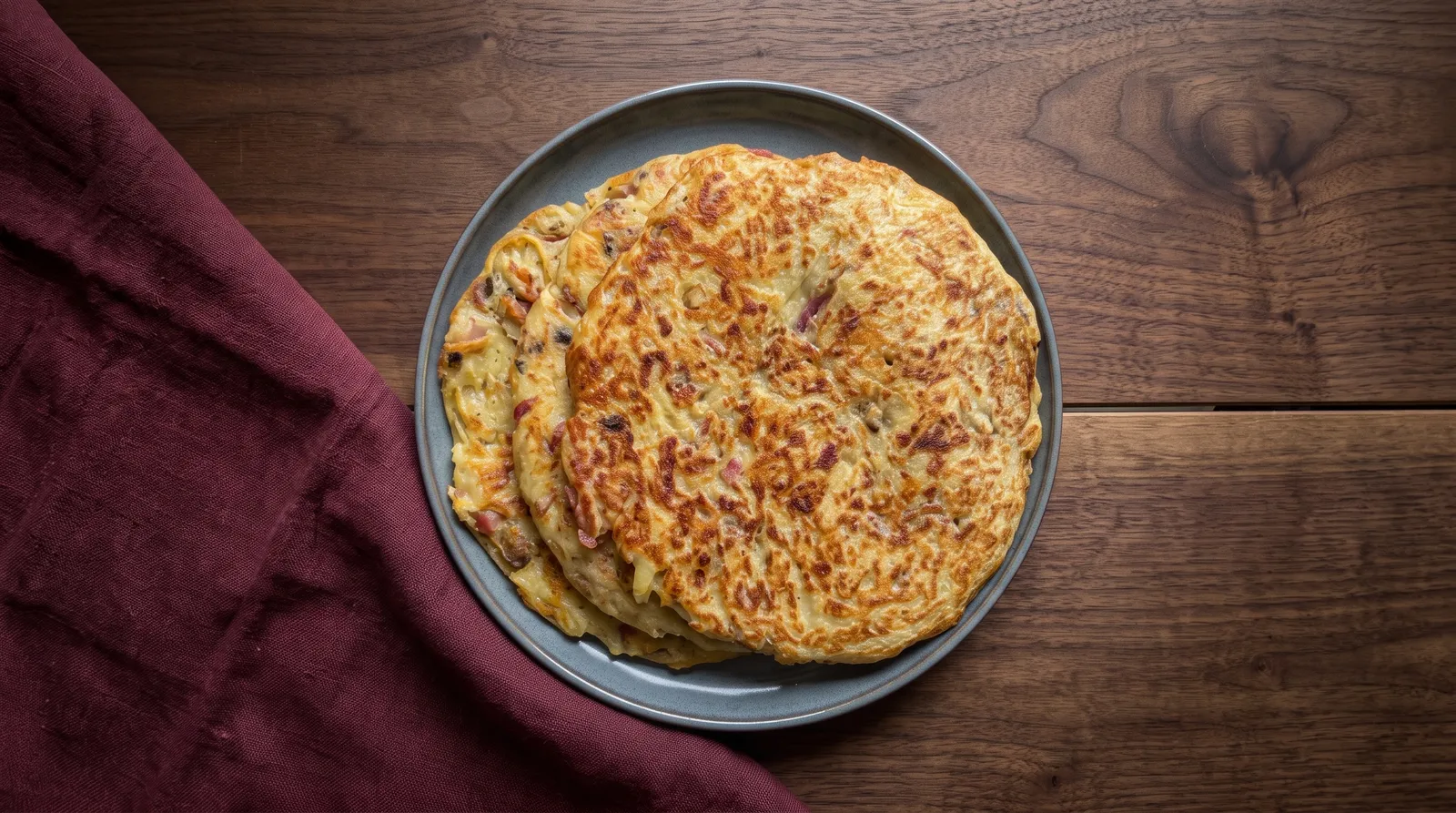
A thick savoury Savoyard matafan made with raw grated potato, egg, flour and milk, pan-cooked slowly on both sides and turned safely with a plate.

French Recipes
Share
Savoyard Matafan — served on a plate
Prep 25 minutes
Cook 24 minutes
Total 49 minutes
Yield 1 thick 28 cm galette, cut into 8 wedges
Introduction and overview

Savoyard Matafan Potato Pancake

Matafan, also encountered as matefaim, belongs to a family of substantial Franco-Provençal pancakes and galettes. Some are sweet and made with apple; others are savoury. The preparation here is firmly in the savoury Savoyard camp: raw grated potato is bound with egg, flour and milk and cooked as one thick 28 cm pancake. That structure distinguishes it both from an apple matafan and from rösti, which does not use this batter.

Potato moisture determines whether the centre sets cleanly. The peeled potatoes are coarsely grated and squeezed until they remain moist but no longer drip. Only then are they folded into the egg, flour and milk mixture. Salt is added at mixing rather than far in advance, because salted raw potato releases more water as it waits. The full batter goes straight into the pan as an even layer about 2 cm thick.

A matafan this thick needs moderate heat. The first side cooks until the outer area is structurally set and the base is deeply golden; then the galette is transferred to a flat plate and inverted back into the pan rather than flipped through the air. The second side cooks until a skewer meets completely tender potato in the centre. Crust colour is useful for flavour, but the tender centre is the decisive doneness cue.
Success points

Success points

  • Use firm potatoes and squeeze them rather than leaving free water in the batter.
  • Mix the potato into the batter only when the pan is nearly ready.
  • Keep the galette close to 2 cm thick across the whole pan.
  • Use a broad flat plate for the turn and keep hands clear of hot butter.
Ingredients

Ingredients

  • 950 g firm-fleshed potatoes — purchased weight; yields about 800 g peeled and 700 g after grating/squeezing
  • 200 g whole eggs — about 4 large eggs, without shell
  • 40 g plain wheat flour
  • 120 ml whole milk
  • 30 g unsalted butter — for the pan; about 20 g retained
  • 8 g fine salt
  • 1 g black pepper — ground
Method

Method

Directions

  1. Grate and squeeze. Peel 950 g potatoes to obtain about 800 g peeled potato, grate coarsely, then squeeze firmly in a clean cloth to about 700 g drained potato. Use Coarse grater, bowl and clean kitchen cloth. Time: 15 minutes. Temperature or condition: cool. Removing excess free water prevents a loose, steamed centre. Use the grater with a guard or stable hand position and keep fingertips clear. The grated potato is moist but no longer dripping, and about 700 g remains after squeezing.

  2. Mix the batter. Whisk the eggs, flour, milk, salt and pepper until smooth, then fold in the drained potato only when the pan is nearly ready. Use Large bowl and whisk. Time: 10 minutes. Temperature or condition: room temperature. Late mixing limits oxidation and excess water release from salted potato. Do not taste raw batter because it contains raw egg and flour. No dry flour pockets remain and the potato is evenly coated in a thick batter.

  3. Cook the first side. Melt half the butter in a 28 cm non-stick or well-seasoned frying pan, add the mixture and spread it to an even layer about 2 cm thick; cook over medium-low heat. Use 28 cm frying pan. Heat: medium-low. Time: 12 minutes. Temperature or condition: moderate pan heat. Moderate heat gives the raw potato time to soften before the crust burns. Hot butter can spit; keep the pan handle turned safely inward. The underside is deeply golden, the outer 2–3 cm are set and the centre no longer flows when the pan is gently shaken.

  4. Turn and finish. Slide the galette onto a flat plate, invert the pan over it and turn the galette back into the pan with the remaining butter; cook the second side. Use 28 cm frying pan and flat plate. Heat: medium-low. Time: 12 minutes. Temperature or condition: moderate pan heat. A plate turn is safer than trying to flip a heavy thick galette in the air. Use dry oven gloves or a firm grip and keep hands away from hot fat. Both faces are deeply golden and the centre potato is completely tender when pierced, with no raw crunch.

Serving, storage and substitutions

Practical

Substitutions and adaptations

- Water can replace the milk in equal volume if dairy must be avoided, but the flavour is leaner and the allergen profile changes; this is an adaptation. - Do not add cheese unless intentionally making a different supported Savoyard variation.

Troubleshooting

Galette breaks during the turn: the first face has not set sufficiently or the potato mixture is too wet.

Troubleshooting

Outside is dark while the centre stays firm: reduce the heat and give the interior more time; browning is not the only doneness cue.

Troubleshooting

Batter looks watery before cooking: the potato was not squeezed enough or sat salted for too long.

Nutrition per serving

Nutrition per serving

  • Serving size2 wedges, one quarter of the galette
  • Calories340 kcal
  • Carbohydrate48 g
  • Protein12 g
  • Fat11 g
  • Fibre5 g
  • Sodium810 mg
Allergens and food safety

Allergens and food safety

Allergens: Egg; Milk; Gluten (wheat).

Do not taste raw batter.

Cook until the centre potato is fully tender; brown crust alone is not enough.

Use care with the grater and hot butter during turning.

FAQ

FAQ

Is matafan the same as rösti?

No. This Savoyard preparation uses egg, flour and milk to form a thick batter around raw grated potato.

Does it need cheese?

Not in this preparation. Cheese belongs to some other supported variations, but it is not necessary for the selected potato-batter form.

Can the batter be tasted to check seasoning?

No. It contains raw egg and flour; judge seasoning by the measured quantities and taste only after cooking.

Closing

Closing

  • Result: Savoyard Matafan Potato Pancake with the intended regional structure, texture and portioning.
  • Decisive technique: Use firm potatoes and squeeze them rather than leaving free water in the batter.