French National Dishes

Angevin Eel Matelote

An Angevin Loire eel matelote marinated cold in red wine and Cognac, then braised with onions, garlic and prunes and lightly thickened with breadcrumbs.

French National Dishes
Share
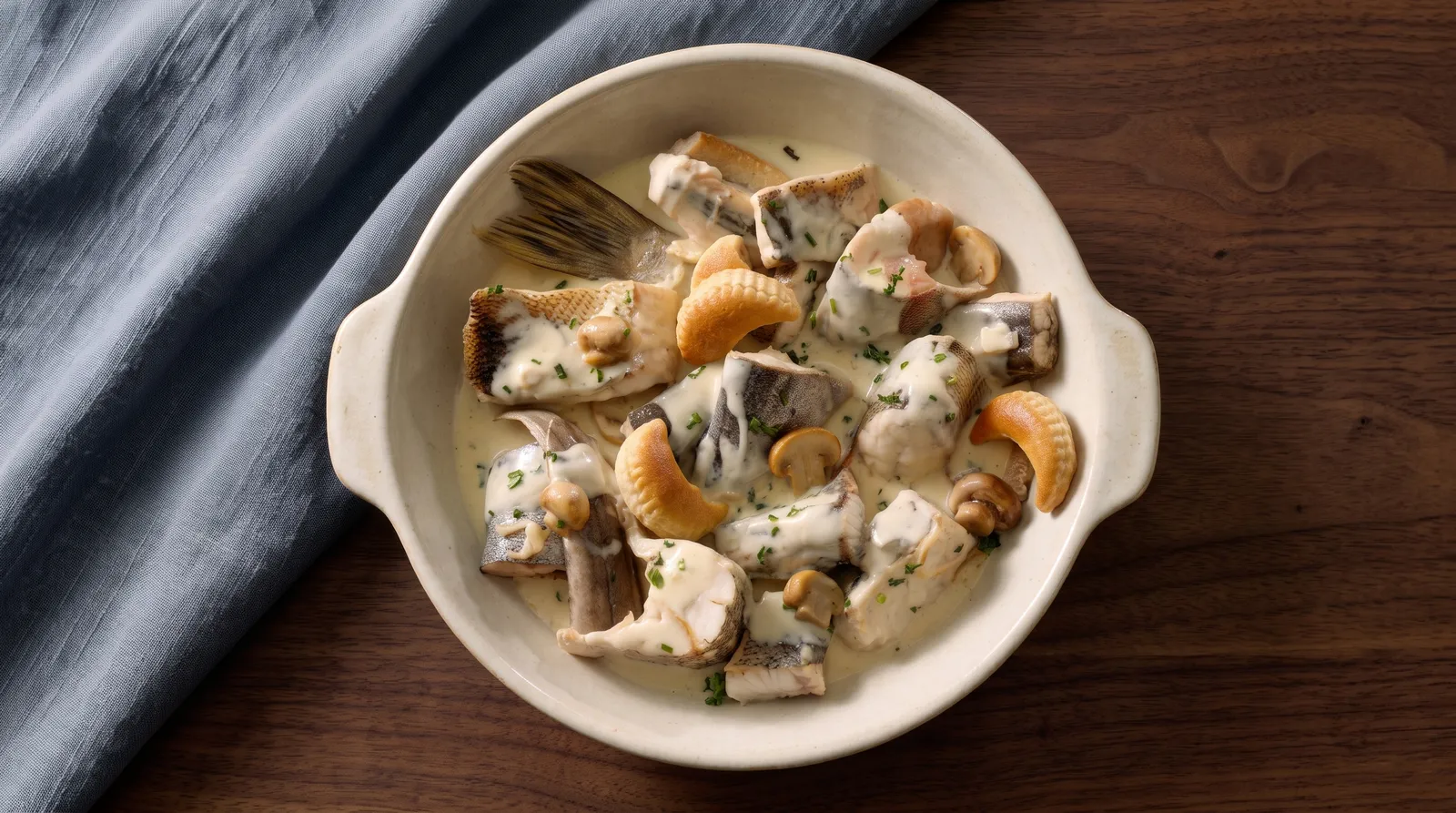
Angevin Eel Matelote — presented in a serving dish
Prep 25 minutes
Cook 60 minutes
Total 565 minutes
Yield 4 main-course portions with about 550 ml sauce
Introduction and overview

Matelote d’Anguille Angevine with Red Wine and Prunes

The Angevin eel preparation takes a different route from the Tourangelle matelote. Here the defining profile is red Anjou wine, a small amount of Cognac or grape eau-de-vie, onions, garlic and prunes. The eel marinates overnight under refrigeration, and that same liquid becomes the cooking sauce. Coarse breadcrumbs provide the final light thickening. There is no tomato-fumet Bourgueil base and no attempt to merge the two Loire traditions into one hybrid.

Only commercially dispatched, skinned and cleaned eel is used. Five-centimetre steaks are submerged in wine and spirit with the prunes for eight hours at 4 °C or colder. After draining, the marinade is retained rather than thrown away. The eel is browned briefly, the onions are softened, and the wine mixture is reduced before the fish returns. The spirit is not ignited, which removes an unnecessary flambé hazard while preserving its flavour contribution.

The final braise is gentle. Each thick eel steak must reach 63 °C and should yield from the central bone without collapsing. After the fish is cooked, the tied bouquet garni comes out and measured breadcrumbs tighten the sauce only enough to coat a spoon. Prunes remain in the finished dish, and the entire 550 ml sauce is portioned among four diners. Fine bones remain a practical concern at the table.
Success points

Success points

  • Marinate only under refrigeration, never on the counter.
  • Drain the eel for browning but retain every drop of marinade for the sauce.
  • Reduce the wine mixture before the eel returns so the fish is not boiled for an excessive time.
  • Use only enough breadcrumbs to lightly coat, not to turn the sauce into a paste.
Ingredients

Ingredients

  • 900 g commercially cleaned skinned eel — bone-in; cut into 5 cm steaks
  • 600 ml dry red Anjou wine — contains sulphites
  • 40 ml Cognac or grape eau-de-vie
  • 120 g pitted prunes
  • 150 g small onions — peeled and halved if large
  • 10 g garlic — finely chopped
  • 30 g unsalted butter
  • 80 g country bread — dried and ground to coarse breadcrumbs
  • 1 bouquet garni — tied securely
  • 6 g fine salt
  • 1 g black pepper — ground
Method

Method

Directions

  1. Marinate under refrigeration. Place the commercially cleaned eel steaks in a non-reactive container with the Anjou wine, Cognac and prunes; cover and marinate under refrigeration. Use Non-reactive covered container. Time: 480 minutes refrigeration. Temperature or condition: 4 °C or colder. A cold overnight soak flavours both eel and fruit while keeping the seafood safe. Marinate only in the refrigerator; do not process live or whole eel at home. The eel is fully surrounded by the red-wine marinade and remains refrigerator-cold; the prunes are visibly plumped.

  2. Drain and prepare. Drain the eel over the container so all marinade is retained, prepare onions and garlic, and tie the bouquet garni securely. Use Colander, bowl and chilled tray. Time: 15 minutes. Temperature or condition: cold. Draining supports browning while preserving the liquid for the braise. Keep eel chilled until the pan is ready. The eel surfaces are drained but still moist, all marinade is retained, and the bouquet garni tie is secure.

  3. Brown the eel. Melt half the butter and brown the eel steaks briefly on both cut faces; remove them to a clean plate. Use Wide casserole. Heat: medium-high. Time: 8 minutes. Temperature or condition: hot pan. Brief browning adds depth before the long wine braise. Hot butter can spit; use a splatter guard if needed. The cut faces are lightly browned without the flesh beginning to break apart.

  4. Colour the onions. Add the remaining butter and the onions, cook until lightly coloured, then add garlic. Use Wide casserole. Heat: medium. Time: 10 minutes. Temperature or condition: steady sauté. Slow onion browning balances the wine and prune sweetness. Keep the garlic from burning. The onions are lightly golden and softened at the edges, and the garlic is fragrant but not scorched.

  5. Reduce the marinade. Pour in the retained wine-Cognac marinade with the prunes, add bouquet garni, salt and pepper, and reduce at a lively simmer. Use Wide casserole. Heat: medium-high. Time: 17 minutes. Temperature or condition: lively simmer. Early reduction concentrates the wine before the eel returns. Do not flambé; alcohol vapour remains flammable near an open flame. The liquid is reduced by roughly one third and the alcoholic aroma is less sharp.

  6. Braise the eel. Return the eel and braise gently until every thick steak reaches 63 °C and separates readily from the central bone without collapsing. Use Wide casserole and instant-read thermometer. Heat: low. Time: 20 minutes. Temperature or condition: 63 °C internal. Gentle braising limits breakage and toughening. Probe several pieces and handle cautiously because fine bones remain. Every thick eel steak reaches 63 °C and the flesh yields from the central bone while the steaks still hold their shape.

  7. Thicken lightly. Remove the bouquet garni, whisk in the coarse breadcrumbs and simmer just until the sauce lightly coats the eel and finishes near 550 ml. Use Wide casserole. Heat: low. Time: 5 minutes. Temperature or condition: gentle simmer. Breadcrumbs provide the documented household thickening without a separate roux. Confirm all tied herbs are removed before serving. The sauce lightly coats a spoon without becoming pasty, and all bouquet-garni string and stems are removed.

Serving, storage and substitutions

Practical

Substitutions and adaptations

- A dry red wine from the wider Anjou/Loire area can stand in for a specific appellation; the wine character will change. - Do not omit the prunes if the goal is this selected Angevin profile; doing so moves the dish toward a more generic red-wine matelote.

Troubleshooting

Sauce turns pasty: too much breadcrumb was added or the liquid was over-reduced; aim for a light spoon-coating consistency.

Troubleshooting

Eel steaks split during service: the final simmer was too vigorous or transfer utensils were too narrow.

Troubleshooting

Alcohol aroma remains harsh: the marinade needs a more complete reduction before the fish returns.

Nutrition per serving

Nutrition per serving

  • Serving sizeAbout 160 g edible eel with prunes and sauce
  • Calories620 kcal
  • Carbohydrate40 g
  • Protein34 g
  • Fat30 g
  • Fibre4 g
  • Sodium780 mg
Allergens and food safety

Allergens and food safety

Allergens: Fish; Gluten (wheat bread); Milk (butter); Sulphites (wine).

Use legally sourced, commercially dispatched, skinned and cleaned eel.

Marinate only under refrigeration.

Cook eel to 63 °C.

Warn diners about the central bone and numerous fine bones.

Do not ignite the spirit; alcohol may remain after cooking.

FAQ

FAQ

Why are prunes included?

They belong to a recognised Loire/Anjou bouilleture-matelote profile and deliberately distinguish this preparation from the Tourangelle Bourgueil-tomato version.

Should the Cognac be flambéed?

No. It is added to the cold marinade and later cooked down with the wine; not igniting it avoids a household flame hazard.

Can the marinade be discarded?

No. It forms the sauce, so discarding it would change both the method and the nutrition basis.

Closing

Closing

  • Result: Matelote d’Anguille Angevine with Red Wine and Prunes with the intended regional structure, texture and portioning.
  • Decisive technique: Marinate only under refrigeration, never on the counter.