French Recipes

Rognons de veau à la moutarde

Commercially butcher-cleaned veal kidneys trimmed only as needed, seared in two hot batches to 71 °C and returned briefly to a Dijon, white-wine and cream sauce.

French Recipes
Share
Rognons de veau à la moutarde — served on a plate
Prep 25 minutes
Cook 20 minutes
Total 45 minutes
Yield 4 main-course portions with about 250 ml mustard cream sauce
Introduction and overview

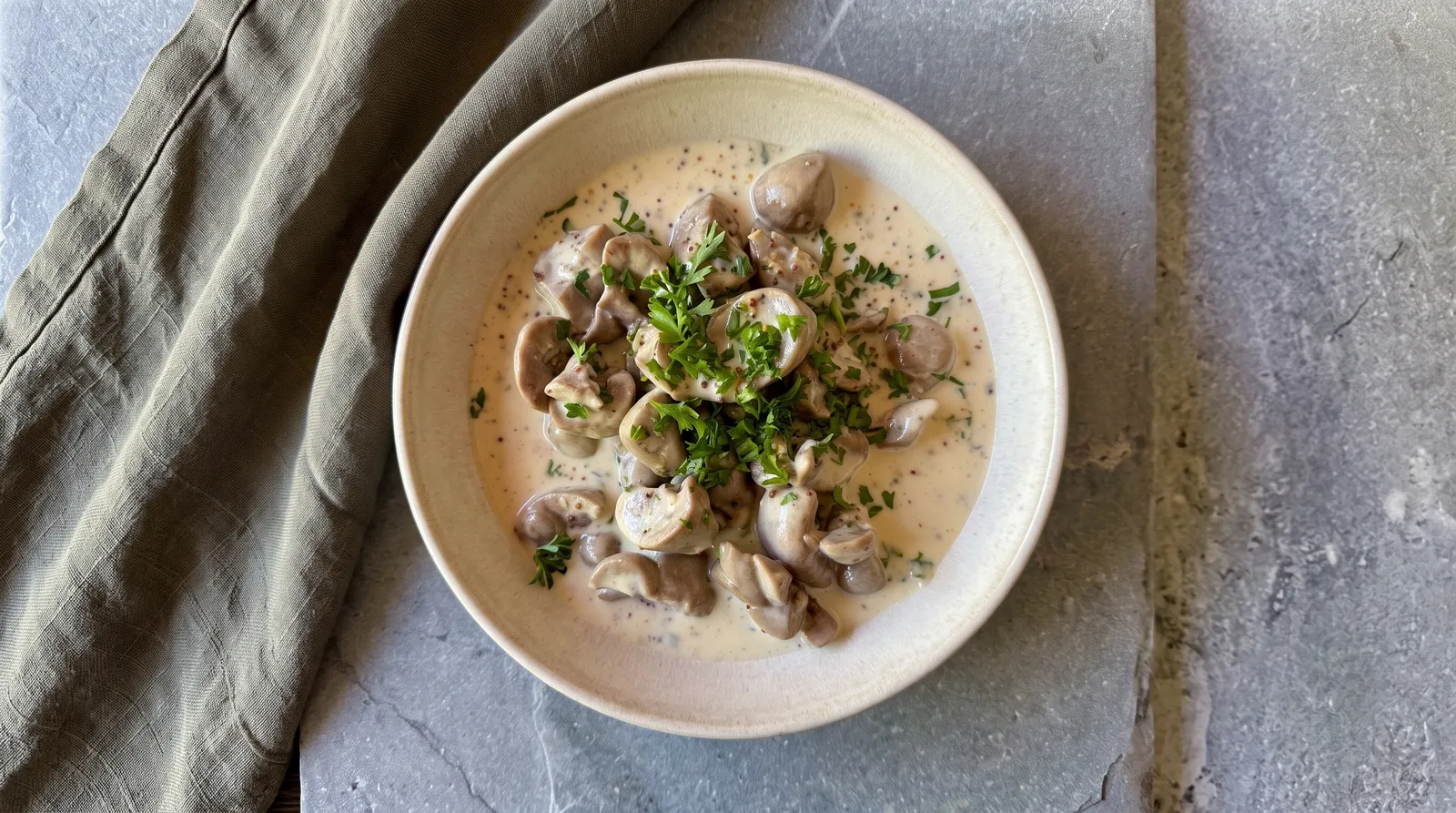
Rognons de veau à la moutarde — veal kidneys in Dijon cream sauce

Rognons de veau à la moutarde is a quick-cooked veal-kidney dish with a sharp, creamy bistro sauce. It is not liver, steak or a long offal stew. The kidneys need a short, hot sear followed by only a brief return to the finished sauce. Prolonged simmering makes them firm and intensifies the flavour, so most of the cooking control happens before the mustard and cream are even added.

Start with 800 g commercially butcher-cleaned veal kidneys and perform only minimal final trimming of any visible white central core or tough membrane. The target edible weight is about 650 g, cut into roughly 3 cm pieces. Keeping the kidneys cold and drying their surfaces helps them brown rather than release a pan full of liquid. They are seared in two batches with 20 g butter each so the pan stays hot and every thick piece can be checked at the required 71 °C endpoint.

The sauce is built after the kidneys leave the pan. Shallot softens in the browned fond, then 100 ml dry white wine reduces by about half for 5 minutes. Alcohol can remain after that reduction, so the dish should not be described as alcohol-free. Dijon mustard and cream are added at low heat and cooked only until smooth and spoon-coating. The kidneys go back for one minute—long enough to become evenly coated and hot, not long enough to boil in the dairy sauce.
Success points

Success points

  • Buy butcher-cleaned kidneys and remove only remaining visible core or tough membrane with dedicated clean tools.
  • Keep the kidney pieces around 3 cm and dry them well so they sear rather than steam.
  • Use two uncrowded batches and check the thickest pieces with a food thermometer at 71 °C.
  • Reduce the white wine before adding mustard and cream; this concentrates the pan fond and protects the dairy stage.
  • Once the cream is in, keep the heat low and return the kidneys only for the final minute.
Ingredients

Ingredients

  • 800 g commercially butcher-cleaned veal kidneys, purchased weight; trim only remaining visible central core to about 650 g edible lobes and cut into roughly 3 cm pieces
  • 40 g unsalted butter
  • 100 g shallot, finely chopped
  • 100 ml dry white wine, containing sulphites
  • 40 g Dijon mustard
  • 200 ml double cream
  • 4 g fine salt
  • 2 g black pepper
  • 10 g flat-leaf parsley, chopped
Method

Method

Directions

  1. Trim only what remains. Keep the butcher-cleaned kidneys cold, remove any remaining visible white core or tough membrane and cut the edible lobes into roughly 3 cm pieces, allowing about 20 minutes. The trimmed edible kidney weighs about 650 g and the pieces are roughly 3 cm with no large white core attached.

  2. Dry and season. Pat the kidney pieces dry and season with the 4 g salt and 2 g pepper, allowing about 5 minutes. The surfaces are dry enough to sear rather than steam.

  3. Sear the first half. Melt 20 g butter in a very hot wide frying pan and sear half the kidney pieces in one uncrowded layer for 4 minutes, turning quickly and checking the thickest pieces. The first batch is browned outside, reaches 71 °C in the thickest pieces and remains juicy rather than hard.

  4. Sear the second half. Add the remaining 20 g butter and repeat with the other half for 4 minutes. The second batch is browned outside, reaches 71 °C in the thickest pieces and remains juicy rather than hard.

  5. Soften the shallot. Lower the heat and cook the 100 g chopped shallot for 3 minutes in the browned pan. The shallot is translucent and soft, with the browned pan fond still visible.

  6. Reduce the wine. Pour in the 100 ml white wine, scrape up the fond and reduce over medium-high heat for 5 minutes. The wine has reduced by about half and the sharp raw-alcohol aroma has softened, though alcohol may remain.

  7. Finish the mustard cream. Lower the heat, whisk in the 40 g Dijon mustard and 200 ml cream and cook gently for 3 minutes. The sauce is smooth, glossy and coats the back of a spoon without boiling or splitting.

  8. Return the kidneys briefly. Add the cooked kidneys and any clean plate juices to the sauce, fold for 1 minute and finish with the 10 g parsley. The kidneys are evenly coated, remain tender and are at least 71 °C without the sauce boiling.

Serving, storage and make-ahead

Practical

Serving, storage and make-ahead

Serve immediately, dividing the cooked edible kidney and roughly 250 ml sauce among 4 plates. A side dish can be added separately, but it is not part of the quantities or nutrition here. The mustard cream should coat the kidney pieces rather than pool as a thin broth.

Serving, storage and make-ahead

For partial make-ahead preparation, the sauce can be taken through the wine-reduction stage earlier in the day and chilled promptly. The kidneys themselves are best trimmed cold and cooked near service. Holding them warm after they have reached 71 °C works against tenderness, so timing the sauce and searing close together gives the best result.

Serving, storage and make-ahead

Refrigerate leftovers within 2 hours at 4 °C or below and use within 2 days. Reheat quickly and gently to 74 °C, then stop; repeated heating makes the kidneys substantially firmer and can split the cream sauce. Cognac appears in other mustard-kidney preparations, but this composition uses dry white wine consistently rather than mixing two alcohol routes.

Troubleshooting

Troubleshooting

  • The kidneys are rubberythey stayed over heat too long after reaching 71 °C. Sear in two batches, remove immediately at temperature and return only for the final minute.
  • The sauce is watery and harshthe wine was not reduced enough or too much released kidney liquid entered the sauce. Reduce the wine by about half and keep the seared kidneys on a separate clean plate.
  • The cream sauce splitsthe pan is boiling after dairy was added. Lower the heat and keep the mustard-cream stage gentle.
Nutrition per serving

Nutrition per serving

  • Serving sizeabout 160 g cooked kidney with one-quarter of the mustard cream sauce
  • Calories450 kcal
  • Carbohydrate7.3 g
  • Protein30.6 g
  • Fat31.6 g
  • Fibre1.3 g
  • Sodium830 mg
Allergens and food safety

Allergens and food safety

Allergens: Milk; Mustard; Sulphites from the white wine.

Begin with legally sourced, commercially butcher-cleaned veal kidneys; no slaughter or primary offal-cleaning step belongs in this household preparation. Keep raw kidneys refrigerated and use dedicated clean tools. Veal kidneys must reach 71 °C in the thickest pieces, checked with a food thermometer. Do not hold them over heat once that point is reached. White wine may retain alcohol after reduction. Refrigerate leftovers within 2 hours and reheat to 74 °C.

FAQ

FAQ

Why are the kidneys cooked in two batches?

Crowding cools the pan and encourages the kidneys to release liquid and stew. Two batches maintain the high heat needed for quick browning while keeping the 71 °C check manageable.

Does the wine become alcohol-free after five minutes?

No. Reduction softens the raw alcohol character and concentrates flavour, but some alcohol can remain. The dish should still be treated as containing alcohol.

Closing

Closing

  • Result: Tender, quickly seared veal kidney pieces coated in a smooth Dijon cream sauce sharpened by reduced white wine and shallot.
  • Decisive technique: Sear in uncrowded batches to 71 °C, remove immediately and return the kidneys only for a final minute in the low-heat sauce.