French Recipes

Quiche lorraine

A deep 24 cm shortcrust tart filled with rendered pork lardons and a simple egg-and-cream custard, baked without cheese, onion or vegetables and rested before slicing.

French Recipes
Share
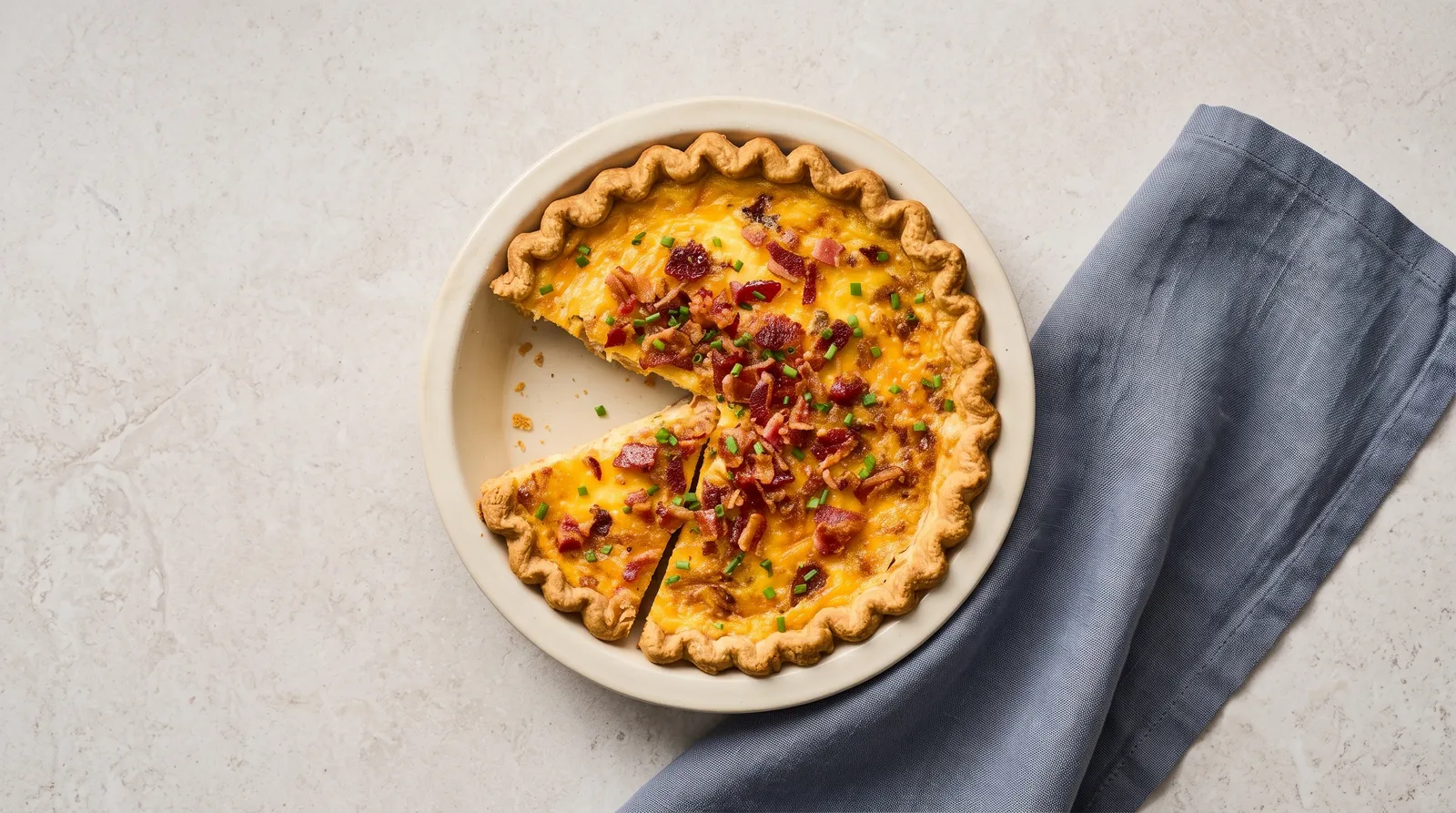
Quiche lorraine — shown with a cut section visible
Prep 40 minutes
Cook 53 minutes
Total 173 minutes
Yield 1 deep 24 cm quiche, 8 slices
Introduction and overview

Quiche lorraine — lardon and cream custard in shortcrust pastry

Quiche lorraine is at its clearest when the ingredient list stays disciplined: a short pastry shell, pork lardons and an egg-and-cream custard. Cheese is common in many modern quiches, but it is not added here; neither are onion, vegetables or smoked salmon. Those additions can make good tarts, but they change the composition and should be named as variations rather than folded into the classic Lorraine form without distinction.

The pastry is mixed with cold butter and only enough water to bring it together, then rested for a full hour. That rest matters because a freshly mixed shortcrust tends to shrink and fight the rolling pin. After rolling to about 3 mm, the 24 cm shell is blind-baked at 190 °C until the base looks dry. This gives the liquid custard a cooked platform instead of asking raw pastry and wet filling to finish at the same pace.

Lardons are rendered separately for 8 minutes. About 20 g of visibly released excess fat is drained, while the fat that remains on and inside the lardons stays part of the dish. The custard is simply 200 g egg and 300 ml cream with pepper and nutmeg. Bake until the centre reaches 71 °C and still moves only with a slight controlled wobble. A 20-minute rest then turns that hot custard into a slice that holds cleanly without becoming dry or rubbery.
Success points

Success points

  • Rest the pastry for the full hour before rolling so it stays cold and relaxes instead of shrinking aggressively.
  • Blind-bake until the base is dry and pale-golden before any custard is added.
  • Render the lardons and drain only about 20 g of visible excess fat; do not squeeze them dry.
  • Use 71 °C at the centre as the safety endpoint, then rely on the slight wobble as a texture cue rather than continuing to bake until rigid.
Ingredients

Ingredients

Shortcrust pastry

  • 250 g plain wheat flour
  • 125 g unsalted butter, cold and diced
  • 60 ml cold water
  • 2 g fine salt

Filling

  • 200 g pork lardons, edible weight
  • 200 g whole egg, about 4 large eggs without shells
  • 300 ml double cream
  • 1 g black pepper
  • 0.5 g ground nutmeg
Method

Method

Directions

  1. Mix the shortcrust. Rub the 125 g cold butter into the 250 g flour and 2 g salt, then add the 60 ml cold water and bring the dough together without kneading it like bread, allowing about 15 minutes. The dough holds together when pressed but is not elastic or greasy.

  2. Rest the pastry. Flatten the dough into a disc, wrap it and refrigerate for 60 minutes. The dough is firm, cold and easy to roll without sticking.

  3. Line the tin. Roll the pastry to about 3 mm, fit it into the deep 24 cm tart tin and trim the edge, allowing about 15 minutes. The pastry is an even 3 mm thick with no tears and sits against the base and sides.

  4. Blind-bake the shell. Line with baking paper and weights and bake at 190 °C for 20 minutes, removing the weights for the final few minutes. The base looks dry and pale-golden with no raw, translucent patches.

  5. Render the lardons. Cook the 200 g lardons in a dry frying pan over medium heat for 8 minutes. The lardons are lightly browned and about 20 g excess rendered fat has been drained.

  6. Whisk the custard. Combine the 200 g egg, 300 ml cream, 1 g black pepper and 0.5 g nutmeg for about 5 minutes without whipping in excessive air. The custard is homogeneous with only a light surface foam.

  7. Fill without overflowing. Scatter the rendered lardons evenly in the shell and pour in the custard, keeping it below the pastry rim. The lardons are evenly distributed and the custard sits below the pastry rim.

  8. Bake to a safe, tender set. Bake at 180 °C for 25 minutes and check the centre with a food thermometer. The centre reaches 71 °C and retains only a slight controlled wobble when the tin is nudged.

  9. Rest before slicing. Set the quiche on a rack for 20 minutes before cutting. A clean slice holds its shape and the filling no longer flows at the cut edge.

Serving, storage and make-ahead

Practical

Serving, storage and make-ahead

Serve warm after the 20-minute rest, or chill fully and serve later. Eight slices give a substantial first course or light main. The crust should stay distinct from the custard and the lardons should be spread through each slice rather than concentrated in the centre.

Serving, storage and make-ahead

The pastry can be mixed and refrigerated a day ahead. A blind-baked shell may also be prepared earlier the same day and cooled before filling. Once egg and cream are combined, keep the custard cold if there is any delay rather than leaving it on the counter.

Serving, storage and make-ahead

Refrigerate cooked quiche within 2 hours at 4 °C or below and use within 3 days. Reheat individual slices in a moderate oven until the centre reaches 74 °C; this preserves the crust better than long microwave heating. A microwave is possible for speed, but the pastry will soften. Do not add cheese, onion or vegetables while presenting the tart as this classic Lorraine composition.

Troubleshooting

Troubleshooting

  • The base is soggythe shell was under-baked before filling or the hot quiche was cut too soon. Blind-bake until the base is dry and give the finished tart its full rest.
  • The custard is rubberyit continued baking well beyond 71 °C. Remove the quiche after the safety temperature is reached while the centre still has only a slight wobble.
  • There are greasy pools on toptoo much rendered lardon fat stayed in the filling. Drain the documented excess after browning without stripping the meat of all its fat.
Nutrition per serving

Nutrition per serving

  • Serving size1 slice (1 of 8)
  • Calories502 kcal
  • Carbohydrate25.3 g
  • Protein11.3 g
  • Fat39.1 g
  • Fibre0.9 g
  • Sodium601 mg
Allergens and food safety

Allergens and food safety

Allergens: Egg; Milk; Wheat/gluten.

Do not taste raw pastry dough or uncooked egg custard. Bake the centre to at least 71 °C and use a thermometer rather than appearance alone for that safety check. Refrigerate the quiche within 2 hours at 4 °C or below. Reheat leftovers to 74 °C and avoid repeated heating and cooling cycles.

FAQ

FAQ

Does quiche lorraine need cheese?

Not in this composition. The filling is lardons with egg and cream. Cheese creates a different, common variation, but it is deliberately absent here.

Why blind-bake the pastry?

The custard is wet and cooks faster than a raw deep pastry base. A blind-baked shell starts dry and set, which reduces the risk of a pasty bottom.

Closing

Closing

  • Result: A crisp shortcrust shell holding savoury lardons and a tender, cleanly sliced cream custard with no cheese or vegetable additions.
  • Decisive technique: Blind-bake the crust, then stop the custard bake after the centre reaches 71 °C with only a slight controlled wobble.