French Recipes

Pôchouse

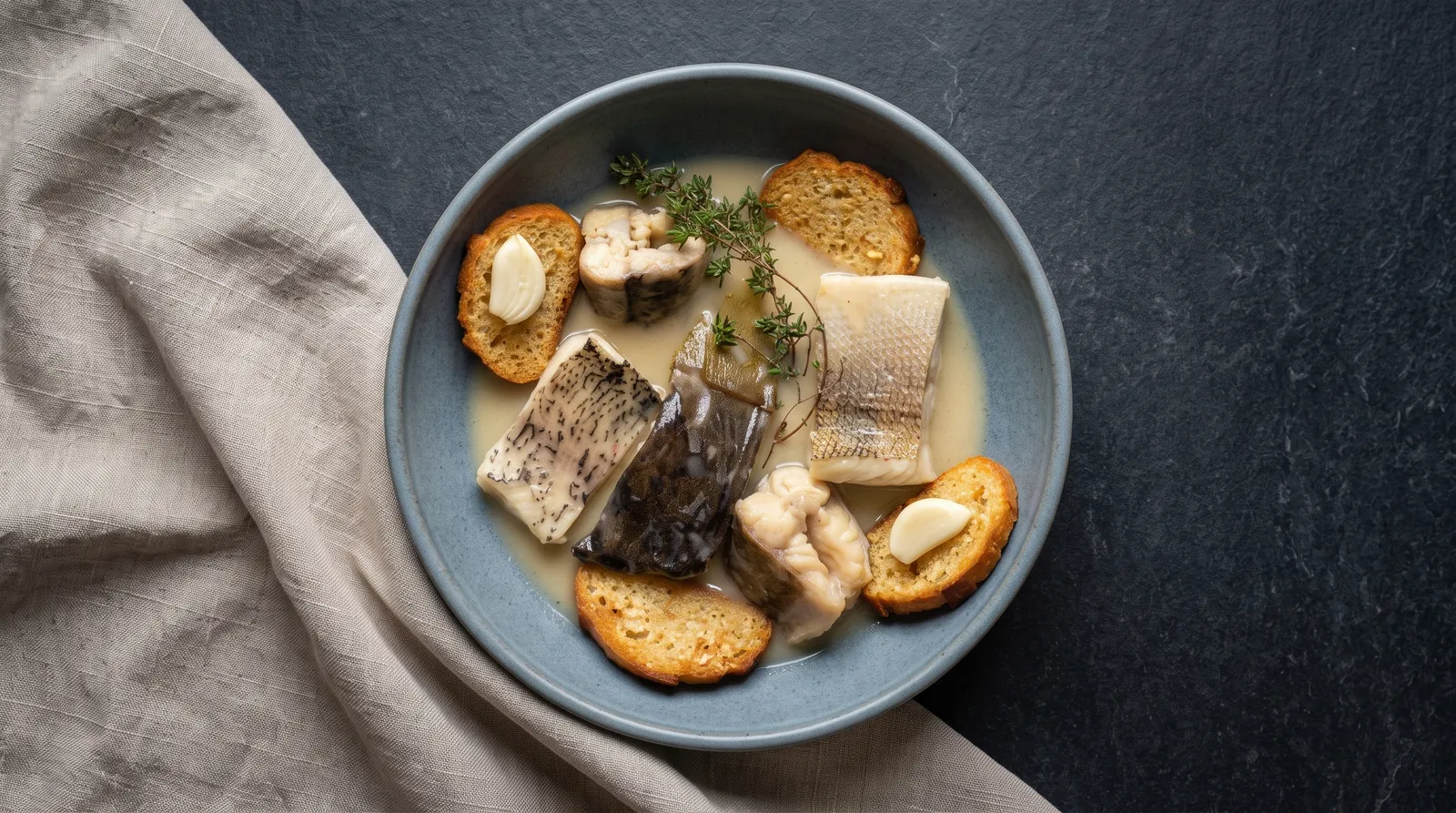
A Verdun-sur-le-Doubs-style mix of traceable freshwater fish poached in dry white wine, finished with a light butter-flour liaison and served with garlic croutons rather than turned into bouillabaisse or cream chowder.

French Recipes
Share
Pôchouse — served on a plate
Prep 25 minutes
Cook 35 minutes
Total 60 minutes
Yield 4 main-course servings
Introduction

Pôchouse — Burgundian river fish in white wine with garlic croutons

Pôchouse belongs to the river landscape around Verdun-sur-le-Doubs, where the Saône and Doubs meet. Its defining idea is a mixture of freshwater fish cooked in dry white wine. The fish combination is not a single immutable list: the useful structure is contrast, with firm lean species alongside richer fish, all handled gently enough that the serving still contains distinct pieces.

The mix here uses zander, perch, trout and carp, all purchased as traceable, pin-boned fillets. Zander and carp go into the wine base first because their pieces tolerate slightly longer cooking. Perch and trout follow. The pan never needs a rolling boil; each species is checked at 63 °C and lifted before the sauce is thickened.

The sauce begins pale, with softened onion, garlic, dry white wine and fish stock. After the fish comes out, softened butter and flour are mashed together and whisked in gradually. This gives a spoon-coating liaison without exposing cooked fish to aggressive whisking. There is no need to turn the dish into a cream soup to achieve body.

Garlic croutons are not a casual extra here. Two toasted baguette slices go with every serving and are counted in the nutrition. Their dry edges absorb wine sauce at the table while still keeping some crunch. The final check remains practical: intact fish, light sauce, hot croutons and no overlooked pin bones.
Success points

Success points

  • Use fish pieces of similar thickness and start the firmer species first.
  • Remove all cooked fish before thickening the sauce with butter and flour.
  • Verify 63 °C for each fish type and inspect every serving for small bones.
Ingredients

Ingredients

Freshwater fish

  • 300 g zander fillet — skinless, pin-boned, traceable farmed or legal commercial source; cut into 5 cm pieces
  • 250 g perch fillet — skinless, pin-boned, traceable commercial source; cut into 5 cm pieces
  • 300 g trout fillet — skinless, pin-boned, traceable farmed source; cut into 5 cm pieces
  • 250 g carp fillet — skinless, pin-boned, traceable farmed source; cut into 5 cm pieces

Wine sauce

  • 750 ml dry white Burgundy or Jura wine — Contains sulphites; alcohol may remain.
  • 300 ml unsalted fish stock — hot
  • 180 g onion — finely sliced
  • 20 g garlic — 15 g for sauce, 5 g for croutons
  • 80 g unsalted butter — softened; 20 g for aromatic base, 40 g for sauce liaison, 20 g for croutons
  • 40 g plain wheat flour
  • 3 g thyme
  • 15 g flat-leaf parsley — chopped
  • 5 g fine salt
  • 1 g black pepper

Garlic croutons

  • 200 g baguette — cut into 8 slices
Method

Method

Build the wine base

  1. Soften the aromatic base. Melt 20 g of the butter in a wide 4-litre casserole and soften the onion with half the salt for 5 minutes. Add 15 g garlic and thyme for the final minute. The onion is translucent and fragrant without browning. A pale aromatic base keeps the wine sauce clean rather than roasted. Keep butter from scorching and wipe any raw-fish drips from the work area separately.

  2. Reduce the wine broth. Pour in the 750 ml wine and 300 ml fish stock and simmer uncovered for 12 minutes. The liquid has reduced modestly and smells less sharply alcoholic while remaining plentiful enough to poach the fish. A brief reduction concentrates the wine before delicate fish enters the pan. Wine may retain alcohol after cooking; avoid leaning over vigorous steam.

Poach the fish by firmness

  1. Start the firm fish first. Add the firmer zander and carp pieces in one layer and poach at a bare simmer for 3 minutes. The outer surfaces have turned opaque while the centres remain underdone. Firm fish starts first so all species can finish together. Use a clean fish slice and avoid splashing hot wine broth.

  2. Add the tender fish and check temperature. Add the perch and trout, continue the bare simmer for 5 minutes and check the thickest pieces from each species for 63 °C. Lift all fish carefully to a warm platter. Every species reaches 63 °C and the pieces remain whole enough to lift without flaking apart in the liquid. Staged addition prevents tender fish from overcooking while firm fish catches up. Check for pin bones as the fish is transferred and remove any found before service.

Bind sauce and make croutons

  1. Bind the sauce away from the fish. Mash 40 g softened butter with 40 g flour to a smooth paste. Whisk small pieces of the paste into the simmering wine broth and cook for 2 minutes, then season with the remaining salt, pepper and parsley. The sauce lightly coats the back of a spoon without becoming gluey. A butter-flour liaison thickens the broth after the fish is removed, protecting the fish from rough whisking. Keep the sauce at a controlled simmer to prevent splashing.

  2. Toast the garlic croutons. Spread the baguette slices with the remaining 20 g butter and toast for 8 minutes in a 200 °C oven, then rub lightly with the remaining 5 g garlic. The croutons are dry at the edges and golden, with garlic aroma but no burnt surface. Dry croutons absorb sauce at the table without dissolving immediately. Use oven gloves and handle the cut garlic carefully on hot bread.

Assemble

  1. Coat and serve immediately. Return the fish to the sauce only long enough to coat, then divide fish and sauce among four warm bowls and add two garlic croutons to each. The fish is coated in sauce and remains in distinct pieces, with two crisp croutons per serving. Minimal final handling protects the fragile cooked fish. Give each portion a final visual check for small bones and state that freshwater fish can still contain them.

Serving, storage and make-ahead

Practical

Serving

Divide the mixed fish among four warm bowls, spoon over the sauce and add two garlic croutons to each serving.

Make-ahead

Prepare the butter-flour paste and slice the croutons early. Keep cut fish refrigerated and cook it close to service.

Storage and reheating

Fresh service gives the best texture. If needed, refrigerate within 2 hours for up to 2 days, reheat the sauce gently and warm the fish in it only briefly.

Fish substitutions

Another legal, traceable freshwater species can replace one component when the mix still contains both firm lean and richer fish and the pieces are cut to comparable thickness.

Why are the fish added in stages?

Zander and carp tolerate a little more cooking than perch and trout; staged addition makes a shared 63 °C finish more realistic.

Does all the wine alcohol cook away?

No. The wine simmers and reduces, but some alcohol can remain, so the dish should still be treated as containing alcohol.

Nutrition per serving

Nutrition per serving

  • Serving sizeabout 275 g mixed fish + 170 g sauce + 2 garlic croutons (50 g bread)
  • Calories715 kcal
  • Carbohydrate43 g
  • Protein61 g
  • Fat26 g
  • Fibre2 g
  • Sodium890 mg
Allergens and food safety

Allergens and food safety

Allergens: Fish, Gluten, Milk, Sulphites. - Use only legally sourced, traceable freshwater fish; no wild-catching instructions are provided. - Keep raw fish cold and separate from ready-to-eat foods. - Each species must reach 63 °C without relying on flaking alone. - Check carefully for small bones even in pin-boned commercial fillets. - Dry white wine contains sulphites and some alcohol may remain after cooking. - Refrigerate leftovers within 2 hours.

Use only legally sourced, traceable freshwater fish; no wild-catching instructions are provided.

Keep raw fish cold and separate from ready-to-eat foods.

Each species must reach 63 °C without relying on flaking alone.

Check carefully for small bones even in pin-boned commercial fillets.

Dry white wine contains sulphites and some alcohol may remain after cooking.

Refrigerate leftovers within 2 hours.

Closing

Closing

  • Result: several distinct freshwater fish in a lightly thickened white-wine sauce with garlic croutons that absorb the broth without disappearing.
  • Decisive technique: poach by firmness, remove the fish at 63 °C, then bind the sauce away from the delicate pieces.