French Recipes

Pithiviers fondant

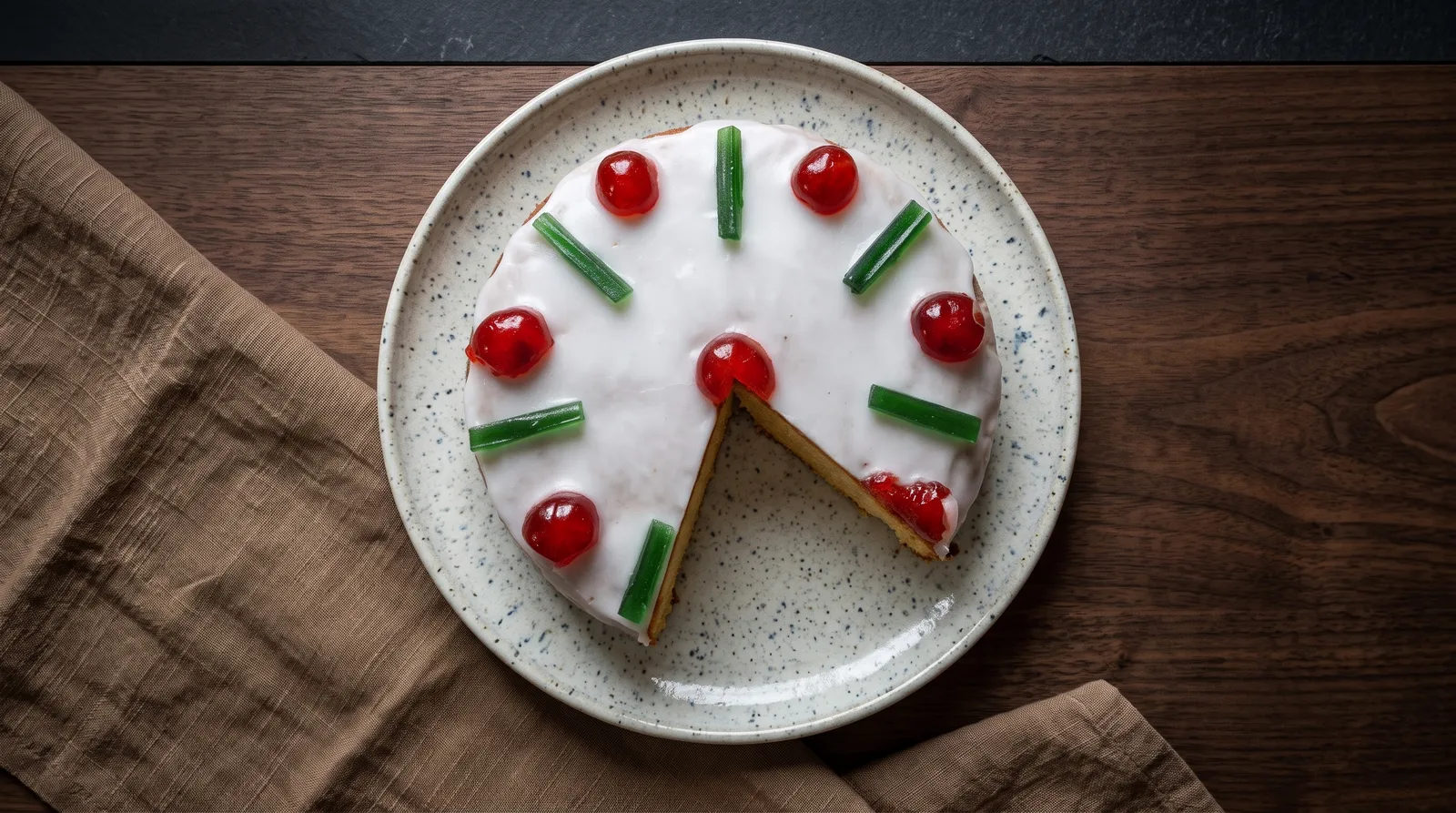
A dense round almond cake from Pithiviers, baked until fully set but moist, cooled completely, then covered with a thin white fondant and the characteristic candied cherry and angelica finish.

French Recipes
Share
Pithiviers fondant — shown with a cut section visible
Prep 30 minutes
Cook 35 minutes
Total 185 minutes
Yield 8 slices
Introduction

Pithiviers fondant — Orléanais almond cake with white fondant

Pithiviers fondant belongs to a different pastry family from the better-known puff-pastry Pithiviers feuilleté. There are no laminated pastry discs and no frangipane enclosed between them. The fondant form is a dense almond cake made from closely balanced quantities of ground almond, sugar, butter and egg, finished with a white coating and candied fruit.

The local Grand Pithiverais proportions are unusually direct: 200 g each of almonds, sugar and butter with four eggs and a little rum. The batter is therefore much denser than a sponge. Softened butter is important because melted butter would make the mixture greasier, while adding the egg gradually helps the batter stay homogeneous.

Baking is a balance between moisture and doneness. The cake should remain tender and compact, but “fondant” is not permission for raw egg batter in the centre. At 180 °C, the target after 35 minutes is an evenly golden cake whose centre is set; a skewer can carry moist crumbs but must not be coated in uncooked batter.

Cooling is part of the method, not an afterthought. A warm cake will absorb or melt the white fondant, producing a translucent glaze rather than the thin opaque finish intended here. Once fully cool, the cake is coated, decorated with candied cherry and angelica, and left long enough for the surface to set before cutting.
Success points

Success points

  • Keep the butter softened rather than melted and add egg in stages.
  • Bake until the centre is fully set even though the crumb remains moist.
  • Wait for complete cooling before spreading the thin white fondant.
Ingredients

Ingredients

Almond cake

  • 200 g blanched ground almonds
  • 200 g caster sugar
  • 200 g unsalted butter — softened; 10 g reserved for the mould and 190 g for batter
  • 200 g whole egg — 4 large eggs, beaten
  • 15 ml dark rum — Alcohol may remain after baking.

Finish

  • 180 g white baker’s fondant — softened until spreadable
  • 30 g candied cherries — drained and halved
  • 20 g candied angelica — cut into thin strips
Method

Method

Mix the almond batter

  1. Prepare the tin and almond base. Grease a 24 cm round cake tin with the reserved 10 g butter and line the base with baking paper. Mix the ground almonds and sugar, then beat in the remaining 190 g softened butter until evenly combined. The almond-sugar-butter mixture is uniform with no visible lumps of butter. Even fat distribution supports the dense, moist crumb associated with the fondant style. Do not taste the batter once egg has been added later.

  2. Add the egg gradually. Add the 200 g beaten egg in four additions, mixing fully after each, then mix in 15 ml rum just until homogeneous. The batter is dense, glossy and homogeneous without separated butter. Gradual egg addition reduces the chance of a greasy split batter. After egg is added, treat the batter as raw and do not taste it.

Bake until set

  1. Bake the dense cake through. Spread the batter evenly in the prepared tin and bake in a preheated 180 °C oven for 35 minutes. The cake is evenly golden, the centre is set rather than liquid and a skewer shows moist crumbs but no raw batter. The fondant texture should stay moist, but the egg-rich almond batter must be fully cooked. Use oven gloves and do not rely on a soft centre if raw batter remains on the skewer.

Cool and finish

  1. Cool completely. Cool in the tin for 20 minutes, turn onto a rack and continue cooling for 70 minutes passive cooling until completely cool. The cake is cool through the centre and no residual warmth softens the rack-side surface. Fondant applied to a warm cake will melt, turn translucent and run off. Keep the cooling cake away from raw ingredients and kitchen splash zones.

  2. Apply the white fondant. Spread the 180 g softened white fondant in a thin opaque layer over the top and upper edge. Arrange the candied cherries and angelica while the coating is still tacky. The coating is thin, white and even, with the candied fruit anchored before the surface firms. A restrained coating preserves the dense almond cake rather than creating a thick sugar shell. Use food-grade fondant and clean utensils.

  3. Set the finish before slicing. Leave to stand for 30 minutes, uncovered, before slicing the glazed cake into eight equal wedges. The fondant surface is dry to a light touch and cuts without dragging into the crumb. Setting time protects the finish and gives clean slices. Store promptly after the setting period rather than leaving the cake out for prolonged warm holding.

Serving, storage and make-ahead

Practical

Serving

Cut eight slim wedges and serve at room temperature. The cake is rich enough that a modest slice is appropriate.

Make-ahead

Bake and cool the cake one day ahead, wrap it once completely cool, and glaze on the day of service.

Storage

Keep covered in a cool room for 1 day or refrigerate for up to 4 days. Temper chilled slices briefly before serving. Freeze the unglazed cake rather than the finished fondant surface.

Flour note

This preparation follows a flourless local formula. Other recipes use a small amount of wheat flour, but adding it here would change the crumb and introduce gluten.

Is Pithiviers fondant a puff-pastry cake?

No. The fondant form is a dense almond cake; the puff-pastry form is a distinct Pithiviers feuilleté.

Why cool for so long before glazing?

The centre retains heat after unmoulding. Full cooling keeps the white fondant opaque and prevents it from running into the crumb.

Nutrition per serving

Nutrition per serving

  • Serving size1 of 8 slices including fondant and candied fruit
  • Calories545 kcal
  • Carbohydrate57 g
  • Protein10 g
  • Fat31 g
  • Fibre4 g
  • Sodium65 mg
Allergens and food safety

Allergens and food safety

Allergens: Almond, Egg, Milk. - Do not taste raw egg batter. - Bake at 180 °C until the centre is set and a skewer has moist crumbs but no raw batter. - Hot cake tins and sugar coatings can burn; use oven gloves and handle softened fondant carefully. - Rum alcohol is not assumed to disappear completely during baking.

Do not taste raw egg batter.

Bake at 180 °C until the centre is set and a skewer has moist crumbs but no raw batter.

Hot cake tins and sugar coatings can burn; use oven gloves and handle softened fondant carefully.

Rum alcohol is not assumed to disappear completely during baking.

Closing

Closing

  • Result: a moist, dense almond cake under a thin white coating with candied cherry and angelica.
  • Decisive technique: fully bake the egg-rich almond batter, then cool it completely before any fondant touches the surface.