French Recipes

Marmite Sarthoise

A quick Sarthe composition of chicken, rabbit, pork, mushrooms and separate vegetables, finished in a reduced Jasnières, veal-stock and cream sauce.

French Recipes
Share
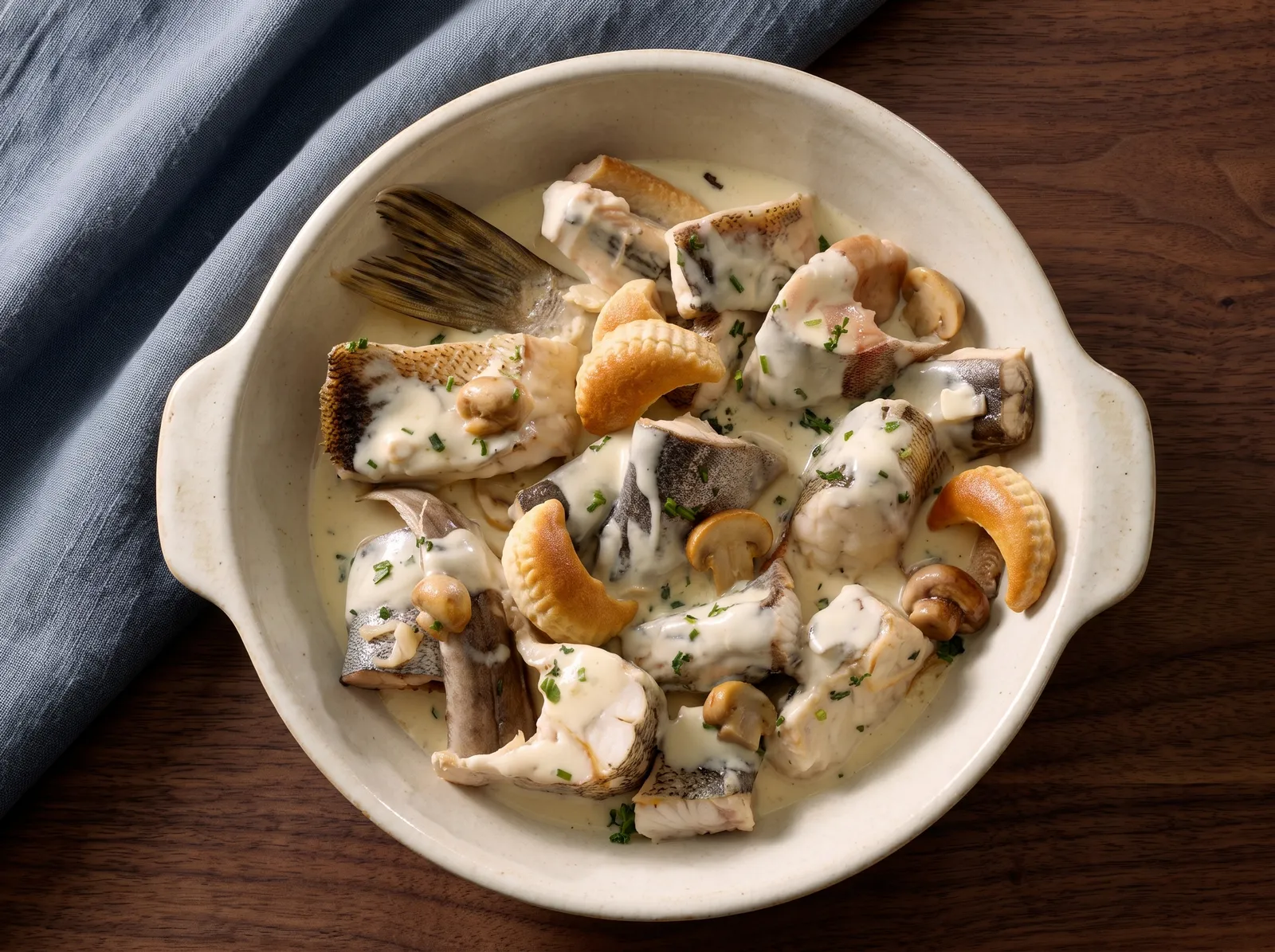
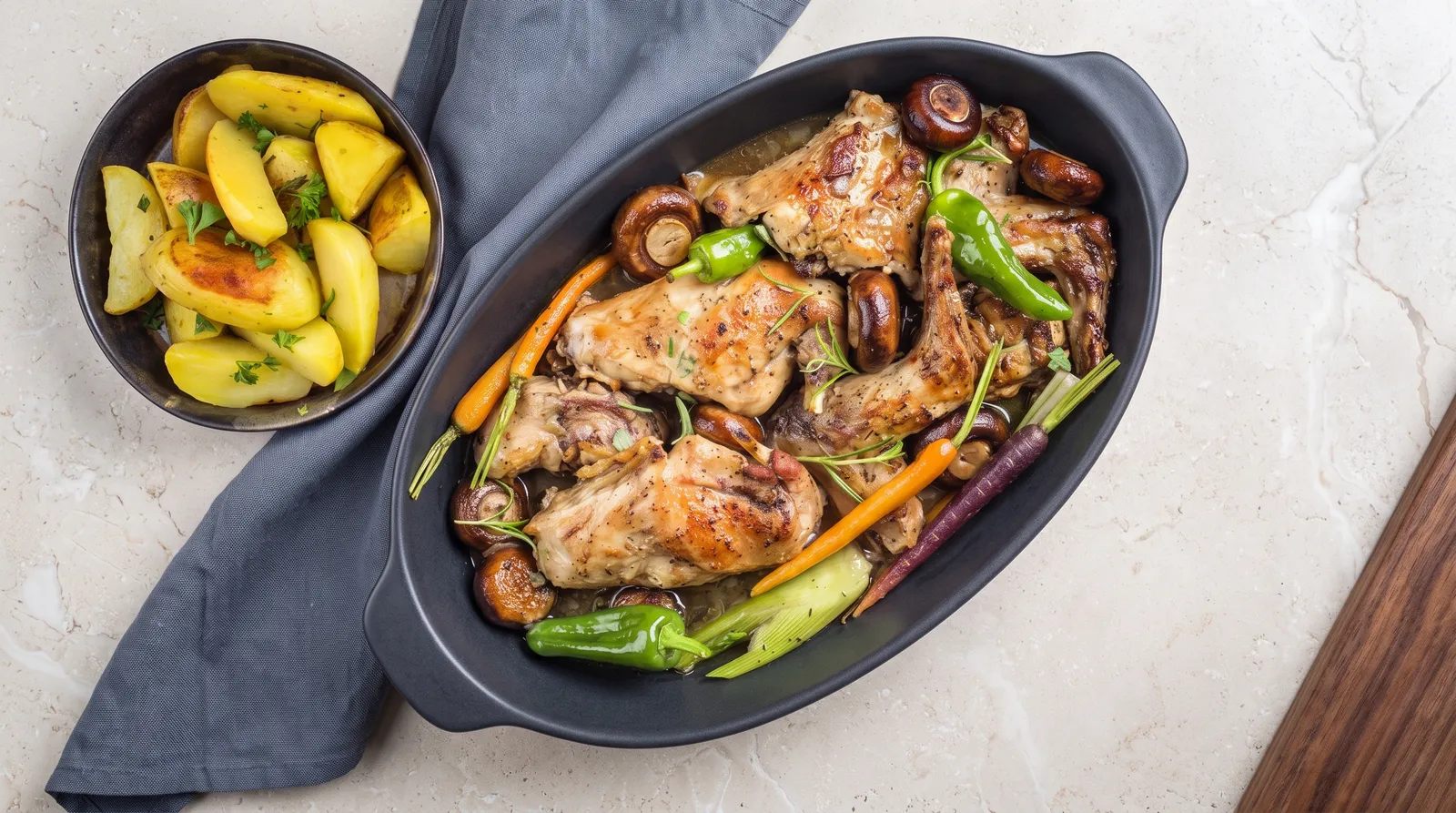
Marmite Sarthoise — arranged on a serving platter
Prep 35 minutes
Cook 48 minutes
Total 83 minutes
Yield 6 main-course portions
Introduction and overview

Marmite Sarthoise with Chicken, Rabbit and Jasnières

Marmite sarthoise is a relatively modern regional dish rather than an old, hours-long potée. Its character comes from bringing several Sarthe ingredients together in a fast restaurant-style composition: chicken—ideally Poulet de Loué—boned rabbit, pork, mushrooms, green cabbage, carrots and turnips, with Jasnières white wine, veal stock and cream. The meats and vegetables remain recognisable instead of disappearing into a long stew.

The workflow is deliberately split. Cabbage, carrots and turnips are cooked separately until just tender. Chicken and rabbit receive only a light dusting of flour before they are sautéed with the pork and mushrooms. After the meats come out, the Jasnières is reduced by about three quarters; stock and cream then rebuild the sauce. Everything is reunited only for the final few minutes, which protects lean chicken and rabbit from drying.

Because the dish contains two meats with distinct safety requirements, browning is not treated as proof of doneness. Chicken strips must reach 74 °C and rabbit strips 71 °C, checked in representative thick pieces. The wine reduction concentrates flavour but does not guarantee that all alcohol has disappeared. The full sauce is served, so the nutrition estimate counts the cream, stock, oils and reduced wine rather than treating them as discarded cooking liquid.
Success points

Success points

  • Cut the three meats to similar strip thicknesses but keep them identifiable.
  • Cook the vegetables separately so they retain shape and colour in the final bowl.
  • Reduce the Jasnières before cream is added; trying to reduce hard after dairy goes in risks splitting the sauce.
  • Check chicken and rabbit separately with a clean thermometer probe.
Ingredients

Ingredients

  • 700 g chicken breast — boneless; cut into 1.5 cm strips; Poulet de Loué when available
  • 120 g rabbit hindquarter meat — boneless; cut into 1.5 cm strips
  • 100 g pork belly — skin removed; cut into fine strips
  • 140 g button mushrooms — sliced
  • 500 g green cabbage — prepared leaves; cut into strips
  • 200 g carrots — peeled; cut into thin sticks
  • 120 g turnips — peeled; cut into thin sticks
  • 250 ml Jasnières dry white wine — contains sulphites
  • 250 ml veal stock — prepared; containing celery
  • 200 ml double cream or 35% cream
  • 15 g plain wheat flour — for light dusting of chicken and rabbit
  • 15 ml peanut oil
  • 15 ml walnut oil
  • 7 g fine salt
  • 2 g black pepper — freshly ground
Method

Method

Directions

  1. Cut the components. Cut the meats, mushrooms and vegetables to the specified strips and sticks; keep the raw meats chilled and separate. Use Knife, boards and chilled trays. Time: 25 minutes. Temperature or condition: cold. Uniform cuts make the short finishing simmer workable. Use separate equipment for raw meats and vegetables. Chicken, rabbit and pork strips are similar in thickness, and the vegetables are evenly cut.

  2. Dust and measure. Dust the chicken and rabbit lightly with the flour and measure the wine, stock, cream, oils and seasoning. Use Tray and measuring jug. Time: 10 minutes. Temperature or condition: cold. A light flour coating helps the sauce bind without becoming pasty. Keep cream refrigerated until the sauce stage. The flour forms only a thin dry film and no heavy coating remains.

  3. Steam the cabbage and roots. Steam or blanch the cabbage, carrots and turnips until just tender, then drain very well and keep them identifiable rather than mashing them together. Use Steamer or wide pot. Heat: medium-high. Time: 10 minutes. Temperature or condition: steam/boiling. Separate vegetable cookery preserves the characteristic composed texture. Protect hands from steam when lifting the lid. The vegetables are tender enough to bite through but still hold distinct strips and sticks.

  4. Sauté the meats. Heat the peanut and walnut oils and sauté the chicken and rabbit in controlled batches, then add pork and mushrooms, keeping the pieces separate enough to brown. Use Wide casserole. Heat: medium-high. Time: 10 minutes. Temperature or condition: pan hot. Fast sautéing builds flavour before the sauce while limiting overcooking. The meats are not yet considered safe solely because they are browned. The meat surfaces are lightly browned and the mushrooms have released most visible water.

  5. Reduce the Jasnières. Remove the meats, add the Jasnières and reduce it by about three quarters. Use Wide casserole. Heat: medium-high. Time: 18 minutes. Temperature or condition: vigorous simmer. A substantial reduction concentrates acidity and aroma before dairy is added. Alcohol vapour is flammable; keep the pan away from open flames. The wine volume is reduced to roughly one quarter and the raw alcoholic aroma is much softer.

  6. Build the cream sauce. Add the veal stock and cream and boil briefly to bring the sauce together. Use Wide casserole. Heat: medium. Time: 5 minutes. Temperature or condition: gentle boil. Stock and cream restore sauce volume after the wine reduction. Stir to prevent scorching at the base. The sauce is smooth, lightly coating and homogeneous, without curdling.

  7. Finish to safe temperatures. Return all meats and the drained vegetables and simmer just long enough for the chicken to reach 74 °C and the rabbit to reach 71 °C. Use Wide casserole and instant-read thermometer. Heat: low. Time: 5 minutes. Temperature or condition: 74 °C chicken; 71 °C rabbit. A short finish heats everything through without drying the lean meats. Verify both species with a clean thermometer probe; colour is not a safety test. Representative thick chicken strips reach 74 °C and rabbit strips reach 71 °C while the sauce remains fluid and the vegetables stay distinct.

Serving, storage and substitutions

Practical

Substitutions and adaptations

- Free-range chicken may replace Poulet de Loué without claiming the Loué identity. - Another dry Loire white may replace Jasnières; acidity and aroma will differ. - If walnut oil must be avoided for allergy reasons, replacing it materially changes the documented oil profile and should be treated as an adaptation rather than the same formulation.

Troubleshooting

Sauce is greasy: the casserole was crowded during sautéing or the mushrooms released too much water; use controlled batches and keep the pan hot enough to evaporate moisture.

Troubleshooting

Sauce is too thick: flour was heavy or the reduction went too far; loosen gradually with hot stock.

Troubleshooting

Chicken is dry: the final simmer continued well beyond the safety endpoint.

Nutrition per serving

Nutrition per serving

  • Serving size1 of 6 portions with all sauce
  • Calories690 kcal
  • Carbohydrate26 g
  • Protein59 g
  • Fat38 g
  • Fibre7 g
  • Sodium1100 mg
Allergens and food safety

Allergens and food safety

Allergens: Milk; Gluten (wheat); Celery (veal stock); Sulphites (wine); Peanut; Tree nuts (walnut).

Cook chicken to 74 °C and rabbit to 71 °C; verify with a food thermometer.

Alcohol from the reduced wine may remain.

Refrigerate perishable leftovers within 2 hours.

Avoid cross-contamination between raw chicken/rabbit and vegetables.

FAQ

FAQ

Must the chicken be Poulet de Loué?

It is the regional reference. Free-range chicken can be used as an adaptation, but it should not be described as Poulet de Loué unless it is that product.

Why are the vegetables cooked separately?

The technique keeps cabbage, carrot and turnip identifiable and prevents them from breaking down during the wine reduction.

Can another white wine replace Jasnières?

A dry Loire white can work, but the aroma and regional specificity change, and sulphites remain relevant.

Closing

Closing

  • Result: Marmite Sarthoise with Chicken, Rabbit and Jasnières with the intended regional structure, texture and portioning.
  • Decisive technique: Cut the three meats to similar strip thicknesses but keep them identifiable.