French Recipes

Lapin à la moutarde

Bone-in rabbit browned and gently braised with Dijon mustard, dry white wine and stock, then finished with cream for a smooth savoury sauce.

French Recipes
Share
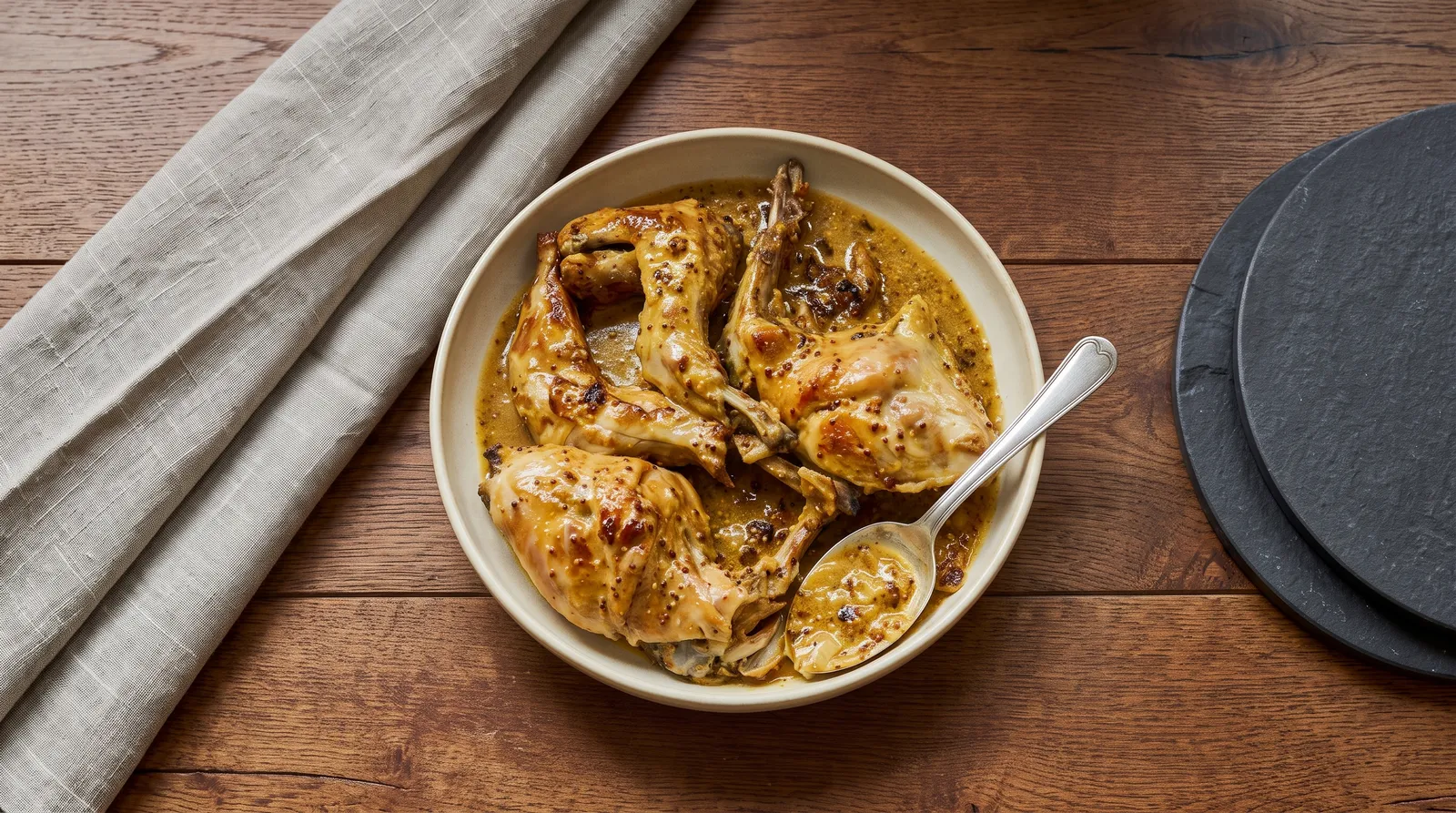
Lapin à la moutarde — served in a bowl
Prep 25 minutes
Cook 85 minutes
Total 110 minutes
Yield 6 main-course portions with about 1.05 kg cooked edible rabbit and 500 g sauce
Introduction and overview

Lapin à la moutarde with Dijon, white wine and cream

Lapin à la moutarde is a savoury French rabbit braise built around the sharpness of Dijon mustard rather than sweetness. Bone-in rabbit pieces are coated lightly in mustard, browned in batches, deglazed with dry white wine and then braised gently with stock until both safe and tender.

Rabbit is lean, so the method avoids a hard boil. The internal safety check is 71 °C in the thickest meat away from bone, but temperature is only one endpoint: after reaching that threshold, the joints still need to feel tender before the braise is finished. A long aggressive cook can dry the meat before the sauce is ready.

Cream and the final portion of Dijon mustard go in only after the rabbit is removed. The sauce is simmered gently until it lightly coats a spoon, then the meat returns just long enough to be covered. This order keeps the cream smooth, preserves the mustard’s savoury acidity and avoids reducing the sauce to excessive saltiness.
Success points

Success points

  • Brown in batches so the rabbit colours instead of steaming.
  • Measure 71 °C away from bone, then judge tenderness separately.
  • Finish the cream sauce over low heat and stop as soon as it lightly coats a spoon.
Ingredients

Ingredients

Rabbit

  • 1500 g commercially dressed bone-in rabbit — cut into 6–8 serving pieces — USDA yield basis gives about 1,050 g cooked edible meat after bone removal
  • 8 g fine salt
  • 2 g black pepper

Sauce

  • 80 g Dijon mustard — 60 g for braise, 20 g for finish
  • 250 ml dry white wine
  • 250 ml chicken stock containing celery — low-sodium
  • 200 ml cream — about 30% fat
  • 30 g unsalted butter
  • 15 ml neutral oil
  • 120 g shallots — finely chopped
  • 10 g garlic — finely chopped
  • 2 g fresh thyme leaves
Method

Method

Brown and braise

  1. Drying the commercially dressed. Pat the commercially dressed rabbit dry, separate it only at the already defined joints if needed, and season with the measured salt and pepper. Tool: separate raw-meat board, knife and tray. Time: 10 minutes. Temperature: chilled. The rabbit pieces are dry on the surface and evenly seasoned. A dry surface browns more efficiently. Do not perform slaughter, skinning or wild-game processing; keep raw rabbit away from ready-to-eat food.

  2. Coating the rabbit pieces. Coat the rabbit pieces with 60 g of the Dijon mustard in a thin even layer. Tool: tray and spoon. Time: 10 minutes. Temperature: chilled. The mustard forms a thin coating without thick clumps. A thin coating seasons the meat without scorching excessively during browning.

  3. Browning the butter and. Heat the butter and oil and brown the rabbit in batches, turning to colour all exposed sides; transfer browned pieces to a clean plate. Tool: heavy casserole and tongs. Heat: medium heat. Time: 20 minutes. Temperature: stovetop. The rabbit is browned in patches on all sides without burnt mustard on the pan base. Batch browning avoids steaming. Use a clean plate for browned meat; do not return it to the raw-meat tray.

  4. Softening the heat and. Lower the heat and cook the shallots, garlic and thyme in the same casserole until softened. Tool: heavy casserole. Heat: medium-low heat. Time: 5 minutes. Temperature: stovetop. The shallots are translucent and the garlic is fragrant without browning darkly. Gentle aromatics form the sauce base without bitterness.

  5. Deglazing in the white. Pour in the white wine and scrape up the browned fond, then simmer briefly. Tool: heavy casserole. Heat: medium heat. Time: 5 minutes. Temperature: gentle simmer. The browned fond has dissolved into the wine and the sharp raw-wine aroma has softened. Deglazing captures the browned flavours; some alcohol may remain.

  6. Braising the rabbit, add. Return the rabbit, add the celery-containing stock, cover partly and braise gently until the meat is tender and safe. Tool: covered heavy casserole. Heat: low simmer. Time: 45 minutes. Temperature: gentle simmer. The thickest rabbit meat reaches at least 71 °C away from bone and the joints feel tender when pierced. Temperature confirms safety; tenderness still requires the full gentle braise. Measure 71 °C in the thickest meat away from bone.

  7. Finishing the rabbit to. Remove the rabbit to a warm plate; whisk the remaining 20 g mustard and cream into the sauce and simmer gently until lightly thickened. Tool: casserole and whisk. Heat: low heat. Time: 10 minutes. Temperature: below a hard boil. The sauce lightly coats the back of a spoon and remains smooth without curdling. A gentle finish protects the cream emulsion and prevents over-reduction. Do not boil violently after adding cream.

  8. Braising the rabbit to. Return the rabbit to the sauce just long enough to coat and serve, warning diners about the small bones. Tool: casserole and clean tongs. Time: 5 minutes. Temperature: hot. Each piece is coated with sauce and the meat remains moist rather than stringy. Brief final coating avoids additional drying. Rabbit has small bones; advise diners clearly.

Serving and planning

Practical

Serving and planning

Serve one or two pieces per person with roughly 80 g sauce. Warn diners about the small bones before eating.

Serving and planning

The rabbit can be browned earlier and refrigerated promptly, but the cream finish is best done close to serving.

Serving and planning

A different mustard changes heat, sweetness and texture. Use it only as a labelled adaptation and do not imply that it preserves the Dijon profile.

Storage

Refrigerate within 2 hours in shallow covered containers and use within 3 days. Reheat gently until the rabbit and sauce are steaming hot; add a splash of water if the sauce tightens. Avoid repeated reheating.

Make-ahead

The rabbit can be browned several hours ahead and refrigerated promptly. Complete the braise and cream finish close to service for the best sauce texture.

Substitutions

A boneless rabbit preparation changes both yield and eating experience; do not swap it gram-for-gram without recalculating.

Substitutions

A non-Dijon mustard can be used only as a clearly labelled flavour adaptation; sweetness or whole seeds will change the sauce.

Troubleshooting

Troubleshooting

  • IssueSauce splits — heat was too high after the cream; remove from heat and whisk gently.
  • IssueSauce too salty — it reduced too far; dilute with a little unsalted stock or water rather than adding more cream.
  • IssueRabbit tough — continue the covered gentle braise after confirming 71 °C until the joints become tender.
Nutrition per serving

Nutrition per serving

  • Serving size1 of 6 portions: about 175 g cooked edible rabbit plus about 80 g sauce
  • Calories556 kcal
  • Carbohydrate6.3 g
  • Protein55.4 g
  • Fat32.0 g
  • Fibre1.1 g
  • Sodium831 mg
Allergens and food safety

Allergens and food safety

Allergens: Mustard; Milk; Celery; Sulphites

Safety: Use commercially dressed rabbit only.

Safety: Keep raw rabbit and its juices separate from ready-to-eat food.

Safety: Cook to at least 71 °C in the thickest meat away from bone.

Safety: Warn diners about small bones.

Safety: White wine contains sulphites and some alcohol may remain.

Safety: Refrigerate leftovers within 2 hours.

FAQ

FAQ

Can I use boneless rabbit?

It changes both cooking behaviour and edible yield, so it is not a gram-for-gram swap for this bone-in calculation.

Why add cream at the end?

Late addition limits splitting and lets the sauce thicken without prolonged dairy cooking.

Closing

Closing

  • Result: Bone-in rabbit browned and gently braised with Dijon mustard, dry white wine and stock, then finished with cream for a smooth savoury sauce.
  • Decisive technique: Brown in batches so the rabbit colours instead of steaming.