French National Dishes

Lapin aux pruneaux

A savoury bone-in rabbit braise with red wine and whole prunes, timed so the meat becomes tender before the fruit softens enough to lose its shape.

French National Dishes
Share
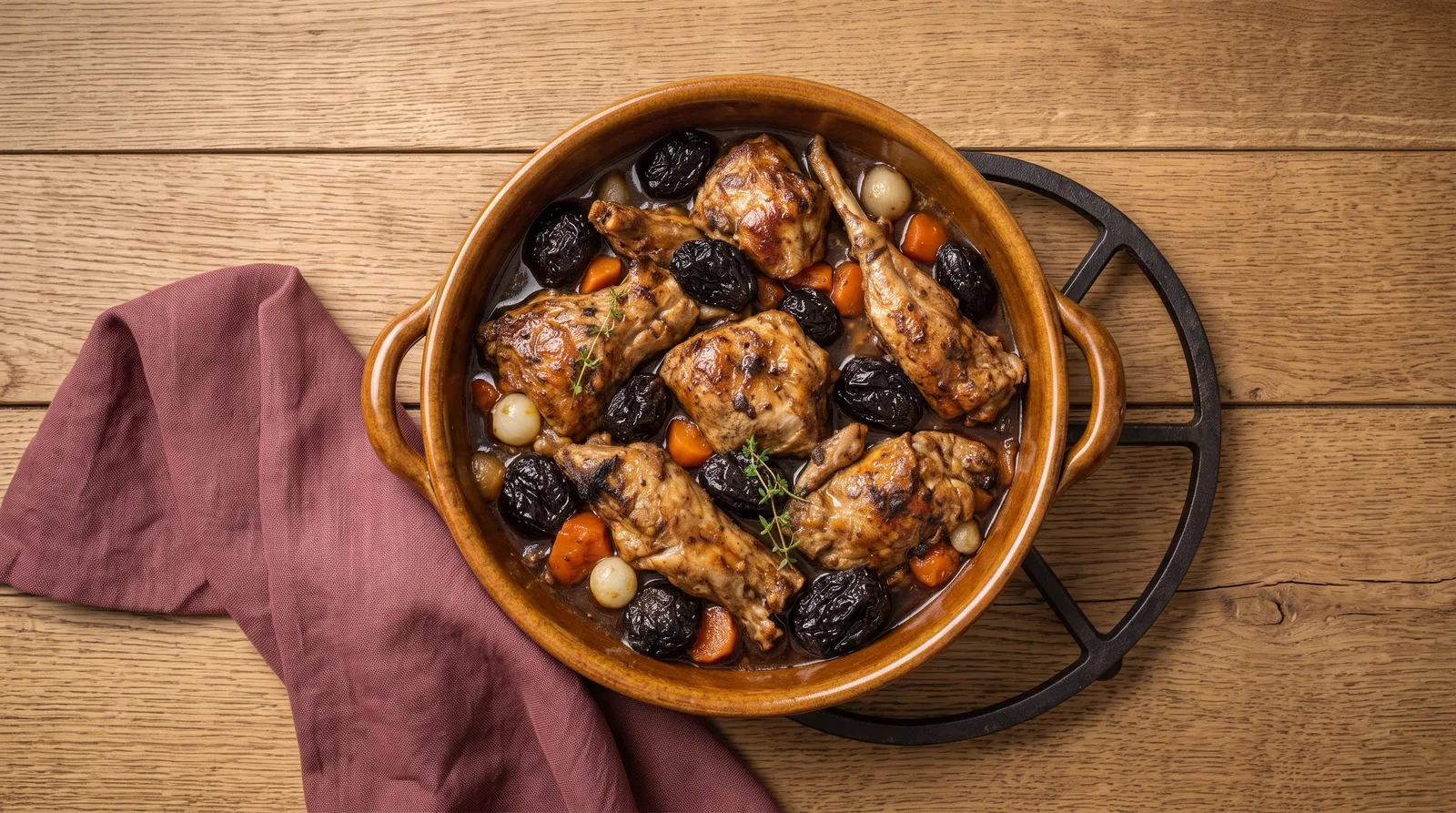
Lapin aux pruneaux — shown in a pan
Prep 25 minutes
Cook 80 minutes
Total 135 minutes
Yield 6 main-course portions
Introduction and overview

Lapin aux pruneaux in red wine

Lapin aux pruneaux balances lean rabbit, red wine and dried plums without turning the dish into a jam glaze. The prunes are pitted and soaked briefly in part of the wine, while the rabbit is browned and the onion-flour base is built in the casserole.

The braise is staged. Rabbit cooks first in stock and wine until it reaches at least 71 °C away from bone and the joints begin to yield. Only then do the soaked prunes and their wine go in for the final fifteen minutes. That timing lets the fruit soften and release sweetness while remaining recognisably whole.

Red wine is the sole alcoholic cooking liquid; beer and spirits are not combined with it. Flour provides modest body, and the measured sauce is served with the meat and prunes. Bone weight is excluded from edible nutrition through a documented cooked-yield calculation rather than counting the full dressed carcass as food.
Success points

Success points

  • Use pitted prunes and still check them for occasional stone fragments.
  • Add the prunes only for the final 15 minutes of braising.
  • Measure 71 °C away from bone and keep braising gently until the joints are tender.
Ingredients

Ingredients

Rabbit and prunes

  • 1500 g commercially dressed bone-in rabbit — cut into 6–8 pieces — Approx. 1,050 g cooked edible meat after bone removal
  • 250 g pitted dried prunes — about 18 large prunes
  • 150 ml red wine — for soaking prunes; counted within total wine below

Braise

  • 200 ml red wine — remaining wine for deglazing and braising
  • 250 ml chicken stock containing celery — low-sodium
  • 120 g onion — finely sliced
  • 40 g unsalted butter
  • 15 ml neutral oil
  • 25 g plain wheat flour
  • 5 g garlic — finely chopped
  • 2 g dried thyme
  • 1 g bay leaf — 1 large leaf
  • 8 g fine salt
  • 2 g black pepper
Method

Method

Soak and brown

  1. Soaking the pitted prunes. Soak the pitted prunes in 150 ml red wine in a covered bowl. Tool: covered bowl. Time: 30 minutes passive soaking. Temperature: room temperature. The prunes are plump but still hold their shape. A short soak hydrates the fruit without turning it soft enough to disintegrate in the braise. Confirm every prune is pitted; warn that occasional stone fragments are still possible.

  2. Drying the commercially dressed. Pat the commercially dressed rabbit pieces dry and season with the measured salt and pepper on a separate raw-meat board. Tool: separate board and tray. Time: 10 minutes. Temperature: chilled. The rabbit pieces are surface-dry and evenly seasoned. Dry meat browns rather than steams. Keep raw rabbit and its juices separate from ready-to-eat food.

  3. Browning the rabbit in. Brown the rabbit in the butter and oil in batches, then transfer the browned pieces to a clean plate. Tool: heavy casserole and tongs. Heat: medium heat. Time: 15 minutes. Temperature: stovetop. The rabbit is evenly browned in patches without scorched butter solids. Browning adds savoury depth before braising.

  4. Cooking the onion and. Cook the onion and garlic until softened, then stir in the flour and thyme for the final minute. Tool: heavy casserole. Heat: medium-low heat. Time: 5 minutes. Temperature: stovetop. The onion is translucent and the flour is absorbed with no dry pockets. The flour lightly thickens the braising liquid.

  5. Deglazing in the remaining. Pour in the remaining 200 ml red wine and scrape the casserole clean of browned fond. Tool: heavy casserole. Heat: medium heat. Time: 5 minutes. Temperature: gentle simmer. The fond has dissolved into the wine and the liquid is evenly coloured. Deglazing carries browned flavour into the sauce; alcohol may remain.

Braise and finish

  1. Braising the rabbit, add. Return the rabbit, add the celery-containing stock and bay leaf, cover partly and braise gently until the meat reaches a safe temperature and is becoming tender. Tool: covered casserole. Heat: low simmer. Time: 40 minutes. Temperature: gentle simmer. The thickest rabbit meat reaches at least 71 °C away from bone and the joints begin to yield when pierced. The safety threshold is checked before the fruit is added; tenderness continues to develop in the final stage. Measure at the thickest meat away from bone.

  2. Adding the soaked prunes. Add the soaked prunes and their 150 ml wine, then continue the gentle braise until the rabbit is fully tender and the prunes are soft but intact. Tool: covered casserole. Heat: low simmer. Time: 15 minutes. Temperature: gentle simmer. The rabbit is fork-tender, the sauce lightly coats a spoon, and the prunes are soft but still whole. Late fruit addition balances tenderness with shape retention. Alcohol from the soaking wine may remain after cooking.

  3. Finishing the bay leaf. Remove the bay leaf, skim only obvious excess fat, and serve one portion of rabbit with whole prunes and measured sauce. Tool: serving spoon and clean tongs. Time: 5 minutes. Temperature: hot. The sauce is savoury and glossy with intact prunes distributed through it. Removing only excess surface fat preserves the sauce while avoiding an oily finish. Warn diners about small rabbit bones and the possibility of a missed prune stone fragment.

Serving and planning

Practical

Serving and planning

Serve one portion of rabbit with about three prunes and enough sauce to coat the meat. Side dishes are separate from the base nutrition.

Serving and planning

Prunes can soak up to two hours ahead. Browned rabbit may also be chilled briefly before the braise if it is refrigerated promptly.

Serving and planning

Do not mix multiple alcoholic liquids into the braise. Changing the braising liquid creates a separate variation with different flavour and nutrition assumptions.

Storage

Refrigerate within 2 hours in shallow covered containers and use within 3 days. Reheat gently until steaming hot, adding a little water if the sauce has thickened. The prunes soften further on reheating.

Make-ahead

Soak the prunes up to 2 hours ahead, covered. Browned rabbit may be refrigerated promptly for a few hours before the braise.

Substitutions

Do not combine beer, wine and spirits in the same braise.

Substitutions

Boneless rabbit changes yield and cooking behaviour and requires a separate calculation.

Troubleshooting

Troubleshooting

  • IssuePrunes dissolve — they were added too early; keep them for the final 15 minutes.
  • IssueSauce too thick — add a small measured splash of water or unsalted stock and simmer briefly.
  • IssueRabbit still firm — after the 71 °C safety check, continue gentle braising until the joints yield.
Nutrition per serving

Nutrition per serving

  • Serving size1 of 6 portions: about 175 g cooked edible rabbit, 3 prunes and one-sixth of the sauce
  • Calories567 kcal
  • Carbohydrate32.5 g
  • Protein55.1 g
  • Fat22.9 g
  • Fibre3.4 g
  • Sodium669 mg
Allergens and food safety

Allergens and food safety

Allergens: Gluten; Celery; Sulphites

Safety: Use commercially dressed rabbit only.

Safety: Cook rabbit to at least 71 °C in the thickest meat away from bone.

Safety: Keep raw rabbit separate from ready-to-eat food.

Safety: Warn about rabbit bones and possible prune stone fragments.

Safety: Red wine contains sulphites and alcohol may remain.

Safety: Refrigerate leftovers within 2 hours.

FAQ

FAQ

Why add the prunes so late?

Long braising can make them collapse into the sauce; late addition keeps whole fruit in each serving.

Can I judge rabbit by colour?

No. Use a food thermometer and measure at least 71 °C in the thickest meat away from bone.

Closing

Closing

  • Result: A savoury bone-in rabbit braise with red wine and whole prunes, timed so the meat becomes tender before the fruit softens enough to lose its shape.
  • Decisive technique: Use pitted prunes and still check them for occasional stone fragments.