French Recipes

Lamproie à la bordelaise

A Bordeaux lamprey braise with red wine, leeks and aromatics, finished with the defining lamprey-blood liaison using only commercially prepared fish and food-grade blood.

French Recipes
Share
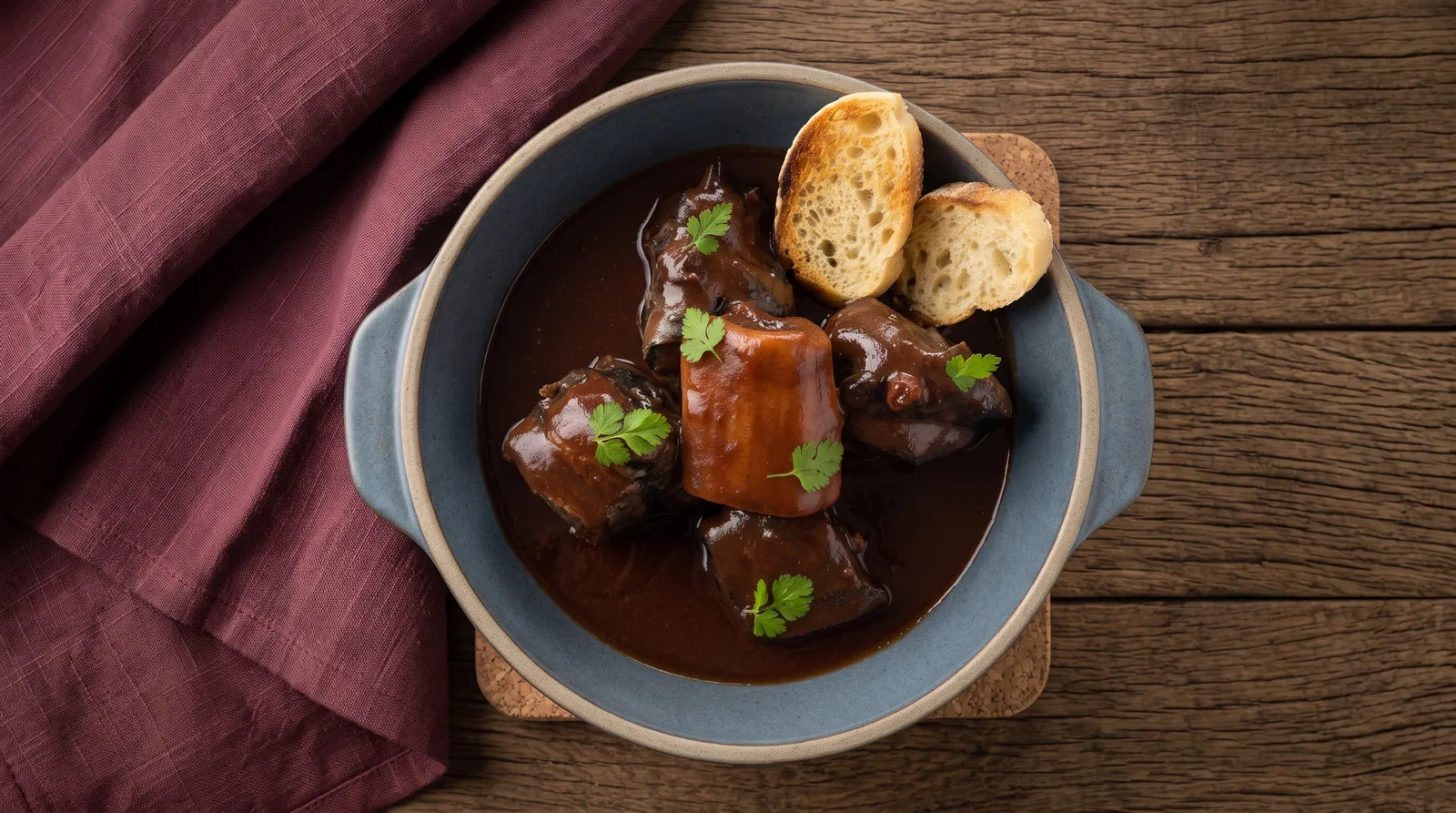
Lamproie à la bordelaise — served on a plate
Prep 35 minutes
Cook 135 minutes
Total 350 minutes
Yield 6 main-course portions with about 900 g sauce
Introduction and overview

Lamproie à la bordelaise with red wine, leeks and lamprey blood

Lamproie à la bordelaise is a Bordeaux preparation in which lamprey is braised with red wine, leeks and aromatics, then the dark sauce is finished with lamprey blood. The blood is not a decorative historical detail: it is part of the defining sauce structure, so this record does not replace it with flour, starch or another animal blood under the same unchanged name.

The sourcing rule is strict. The lamprey must arrive commercially dispatched and professionally cleaned, with no home bleeding, skinning, gutting or wild processing. Its blood must be supplied separately, sealed and chilled as a food ingredient by a licensed fishmonger or other lawful food business. If that ingredient is not legally available where the dish is being cooked, stop rather than improvising.

The cooked technique is deliberately gentle. Leeks and aromatics soften first, the Bordeaux wine is reduced, and the lamprey then braises at a quiet simmer until tender and at least 63 °C in the thickest piece. The chilled blood is tempered with hot sauce and added at the end over very low heat so its proteins thicken the sauce without forming curds.
Success points

Success points

  • Treat professional preparation and lawful blood supply as prerequisites, not optional conveniences.
  • Reduce the wine before the fish goes in so the sauce gains depth without overcooking the lamprey.
  • Temper the chilled blood gradually and never finish with a rolling boil.
Ingredients

Ingredients

Lamprey and marinade

  • 1000 g commercially dispatched and professionally cleaned lamprey pieces — head, viscera, mucus and dorsal cartilage already removed by licensed fishmonger — Approx. 900 g edible fish used in calculation after final cartilage/trim loss
  • 750 ml dry red Bordeaux wine — 300 ml for cold marination, 450 ml for the braise
  • 80 g food-grade lamprey blood — supplied sealed and chilled by the licensed fishmonger; stabilized for culinary use according to local law

Sauce

  • 600 g leeks — white and pale green parts, 5 cm lengths
  • 150 g onion — sliced
  • 100 g carrot — sliced
  • 10 g garlic — crushed
  • 100 g cured ham — cut into small lardons
  • 30 g plain wheat flour
  • 30 g olive oil
  • 150 ml unsalted fish stock
  • 4 g fine salt
Method

Method

Commercial preparation and marinade

  1. Checking that the lamprey. Verify that the lamprey has been legally sourced, commercially dispatched, professionally cleaned and supplied as ready-to-cook pieces with the food-grade blood in a separate sealed chilled container. Tool: clean tray and labels/packaging. Time: 5 minutes. Temperature: chilled. The lamprey arrives ready to cook with no home slaughter or cleaning step required, and the blood container is sealed, chilled and labelled for food use. The defining blood ingredient must be commercially handled rather than collected at home. If either the fish preparation or food-grade blood supply is not lawful and documented where you are cooking, stop and do not improvise.

  2. Chilling the prepared lamprey. Refrigerate the prepared lamprey pieces with 300 ml of the red wine in a covered non-reactive dish. Tool: non-reactive covered dish. Time: 180 minutes passive refrigeration. Temperature: 4 °C or below. The pieces are evenly wetted with wine and remain fully chilled throughout the marination. Cold marination flavours the fish without creating a room-temperature holding period. Keep the sealed blood container separately refrigerated at 4 °C or below.

  3. Draining the lamprey, reserving. Drain the lamprey, reserving the wine marinade, and prepare the leeks, onion, carrot and garlic on a clean board. Tool: sieve, clean board and knife. Time: 15 minutes. Temperature: chilled to room temperature. The vegetables are evenly cut and the reserved marinade is kept separate for cooking. Even vegetable sizes support steady braising.

Braise and liaison

  1. Softening the cured ham. Sweat the cured ham, leeks, onion, carrot and garlic in the olive oil until softened without hard browning, then stir in the flour for the final minute. Tool: heavy casserole. Heat: medium-low heat. Time: 20 minutes. Temperature: stovetop. The leeks are softened and glossy, and the flour has lost its raw powdery appearance without scorching. The flour lightly structures the sauce before the wine is added.

  2. Adding the reserved 300. Add the reserved 300 ml marinade and the remaining 450 ml wine; simmer to reduce and cook the alcohol-rich liquid before the fish goes in. Tool: heavy casserole. Heat: medium-low simmer. Time: 30 minutes. Temperature: gentle simmer. The wine mixture has reduced visibly and smells rounded rather than sharply alcoholic. Reducing the wine concentrates the sauce base; some alcohol may still remain.

  3. Adding the 150 ml. Add the 150 ml fish stock and lamprey pieces and braise gently until thoroughly cooked and tender. Tool: covered heavy casserole. Heat: low simmer. Time: 75 minutes. Temperature: gentle simmer. The thickest lamprey pieces reach at least 63 °C and feel tender without disintegrating. Gentle braising softens the fish while preserving the pieces. Use a clean food thermometer in the thickest piece; beware hot sauce and slippery fish skin.

  4. Tempering the chilled food-grade. Temper the chilled food-grade lamprey blood with several spoonfuls of hot sauce, then stir it gradually into the casserole and heat gently without a rolling boil. Tool: bowl, whisk and casserole. Heat: very low heat. Time: 10 minutes. Temperature: below a hard boil. The blood is fully dispersed and the sauce coats the spoon without curdling. Gradual tempering prevents the blood proteins from seizing into lumps. The blood is a perishable raw animal product; keep chilled until this step and cook it thoroughly in the hot sauce.

  5. Finishing only after the. Taste only after the sauce is fully cooked, adjust with the measured salt, and remove any remaining cartilage before serving. Tool: serving dish and clean tongs. Time: 5 minutes. Temperature: hot. The sauce is dark, glossy and cohesive, and no large cartilage pieces remain in the serving portions. Final cartilage removal reduces an unpleasant hard bite at the table. Do not taste the sauce before the blood has been cooked.

Serving and planning

Practical

Serving and planning

Serve hot with plenty of leek-rich sauce. Bread or potatoes may be offered separately, but they are outside the base nutrition.

Serving and planning

The wine-and-vegetable base can be prepared earlier in the day; keep the lamprey and blood separately refrigerated until the braise and liaison stages.

Serving and planning

There is no authorised substitute for the lamprey blood under the unchanged dish name. If lawful food-grade supply is unavailable, do not introduce a different thickener and present the result as Lamproie à la bordelaise.

Storage

Cool leftovers quickly and refrigerate within 2 hours in shallow covered containers. Use within 2 days. Reheat very gently, stirring often, until steaming hot; a hard boil can split the blood-thickened sauce. Freezing is not recommended for texture.

Make-ahead

The wine-and-vegetable base can be cooked earlier in the day. Keep the fish and blood refrigerated separately until the braising stage.

Substitutions

No substitute for lamprey blood is authorised under the unchanged Lamproie à la bordelaise identity.

Substitutions

If legal food-grade blood supply is unavailable, do not make the dish under the unchanged name rather than introducing a different thickener.

Troubleshooting

Troubleshooting

  • IssueBlood sauce forms small curds — it was added too hot or boiled; temper gradually and keep the finish below a hard boil.
  • IssueLamprey pieces break apart — the braise was too vigorous; keep only a gentle simmer.
  • IssueSauce tastes sharply alcoholic — the wine reduction was shortened; complete the full reduction stage.
Nutrition per serving

Nutrition per serving

  • Serving size1 of 6 portions: about 150 g edible lamprey plus one-sixth of the measured sauce
  • Calories552 kcal
  • Carbohydrate23.2 g
  • Protein36.8 g
  • Fat33.4 g
  • Fibre2.9 g
  • Sodium647 mg
Allergens and food safety

Allergens and food safety

Allergens: Fish; Gluten; Sulphites; Cured ham may contain additional allergens depending on producer; verify label

Safety: Use only legally sourced, commercially dispatched and professionally cleaned lamprey.

Safety: Never bleed, skin, gut or process wild lamprey at home for this recipe.

Safety: Keep the food-grade blood at 4 °C or below until the final cooking stage.

Safety: Fish must reach at least 63 °C in the thickest piece.

Safety: Red wine contains sulphites and alcohol may remain after cooking.

FAQ

FAQ

Can I collect the blood myself?

No. This recipe is restricted to commercially dispatched, professionally cleaned lamprey with food-grade blood supplied by a licensed food business.

Why not boil after adding the blood?

Strong boiling can curdle the blood proteins and break the smooth sauce.

Closing

Closing

  • Result: A Bordeaux lamprey braise with red wine, leeks and aromatics, finished with the defining lamprey-blood liaison using only commercially prepared fish and food-grade blood.
  • Decisive technique: Treat professional preparation and lawful blood supply as prerequisites, not optional conveniences.