French Recipes

Hochepot flamand

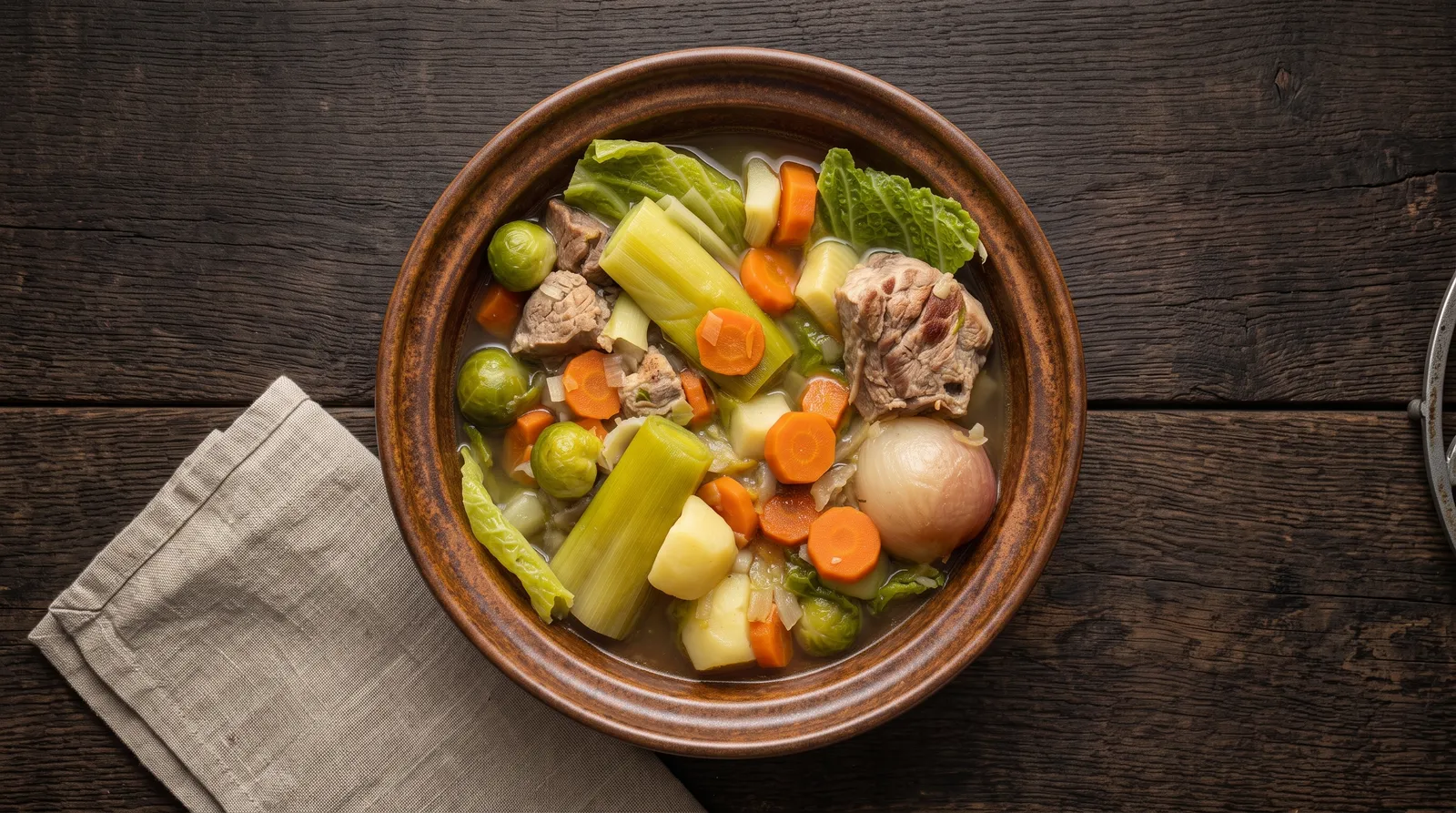
A French-Flemish mixed-meat pot of beef, pork, chicken and winter vegetables, cooked in stages so each meat becomes tender while the vegetables remain recognisable in their broth.

French Recipes
Share
Hochepot flamand — served in a bowl
Prep 30 minutes
Cook 155 minutes
Total 185 minutes
Yield 1 large pot, about 4.2 kg including broth
Introduction and overview

Hochepot Flamand with Beef, Pork, Chicken and Winter Vegetables

Hochepot flamand belongs to the winter cooking of French Flanders and neighbouring northern terroirs, where several meats and sturdy vegetables share one pot. It can be described as a Flemish pot of meats and vegetables, but reducing it to generic pot-au-feu misses the identity created by mixed meat, long quiet simmering and a broth served with the solid components.

The three meats are deliberately staggered. Beef chuck and pork shoulder need the longest head start, chicken thighs join later, and the vegetables are held back until the meats are well on their way. Cabbage, carrot, leek, turnip, celery and potato are cut large enough to remain visible, because a hochepot should still show its separate meat and vegetable families at the table.

The broth should barely move. A rolling boil breaks vegetables, emulsifies more fat into the liquid and works against the clean, brothy result. Skimming during the initial rise to a simmer and keeping the pot partially covered produce a clearer cooking liquid while still allowing the tougher cuts to tenderise over time.

For serving and nutrition, bone and edible meat must be separated. The chicken is purchased bone-in but calculated from its cooked edible meat after bones are discarded. Each portion includes a measured amount of broth as well as meat and vegetables; bones and skimmed surface fat are not treated as food that was eaten.
Success points

Success points

  • Keep the simmer quiet. Vigorous boiling clouds the broth, toughens the cooking environment and breaks the vegetables.
  • Stagger the additions by toughness: beef and pork first, poultry later, then vegetables and potatoes.
  • Serve only edible meat; remove chicken bones and any loose bone fragments before portioning.
Ingredients

Ingredients

Meats

  • 600 g boneless beef chuck, trimmed of large surface fat — about 450 g cooked edible yield
  • 500 g boneless pork shoulder, trimmed — about 375 g cooked edible yield
  • 700 g bone-in skinless chicken thighs, commercially prepared — about 420 g cooked edible meat after bones are discarded

Vegetables and broth

  • 1800 ml water, cold
  • 300 g Savoy cabbage, cut into broad wedges
  • 250 g carrots, peeled and cut into large pieces
  • 200 g leeks, cleaned and cut into 6 cm lengths
  • 200 g turnips, peeled and quartered
  • 500 g waxy potatoes, peeled and halved if large
  • 100 g celery stalks, cut into 6 cm lengths
  • 120 g yellow onion, halved
  • 10 g garlic, crushed
  • 3 g fresh thyme, tied with the bay leaf
  • 2 piece bay leaves, whole
  • 4 g fine salt, measured
  • 2 g black peppercorns, lightly crushed
Method

Method

Directions

  1. Prepare the pot components. Trim the beef and pork, prepare the chicken thighs, and cut the vegetables into large pieces. The vegetables are cut into large pieces that will remain identifiable after simmering. Keep the chicken chilled and prevent cross-contamination while preparing the pot.

  2. Start the broth gently. Put the beef, pork, onion, garlic, thyme, bay, pepper and 1800 ml water into the pot. Bring up slowly over medium heat for about 15 minutes, skimming as foam rises. The liquid reaches a quiet simmer with only occasional bubbles, and grey foam has been skimmed from the surface.

  3. Give the tougher meats a head start. Partially cover the pot and maintain a very quiet simmer for 60 minutes. The beef and pork have begun to soften but still offer resistance to a fork.

  4. Add the poultry later. Lower the chicken thighs into the broth and simmer gently for 35 minutes. The chicken is tender, and its thickest part reaches 74 °C without the probe touching bone.

  5. Add the winter vegetables. Add the cabbage, carrots, leeks, turnips and celery. Continue at a quiet simmer for 20 minutes. The vegetables are beginning to soften but still hold clear edges and separate shapes.

  6. Finish with the potatoes. Add the potatoes and 4 g salt, then simmer for 25 minutes. The potatoes are tender through the centre without breaking apart, and the beef and pork pull apart readily with a fork. Confirm the beef and pork are at least 63 °C; the long simmer normally takes them well beyond that threshold.

Serving

Practical

Serving

Lift the meats and vegetables onto a warm platter, keeping each vegetable recognisable. Divide the edible beef, pork and chicken among six bowls or plates and add roughly 250 ml broth per portion. Any broth left beyond the stated serving allowance is not counted in the nutrition estimate.

Storage and reheating

Remove bones before storing. Cool meat, vegetables and broth promptly in shallow containers and refrigerate within 2 hours at 4 °C or below for up to 3 days. Reheat the portioned stew to 74 °C, stirring the broth around the solid pieces so the centre heats evenly.

Make-ahead and substitutions

Hochepot suits advance cooking because the components can be chilled in their broth, but degrease only after cooling and do not discard broth that is part of the planned servings. Freezing is possible for the meats and broth, although potatoes and cabbage soften noticeably after thawing.

Nutrition per serving

Nutrition per serving

  • Serving sizeabout 700 g including 250 ml broth
  • Calories645 kcal
  • Carbohydrate38 g
  • Protein55 g
  • Fat29 g
  • Fibre7 g
  • Sodium690 mg
Allergens and food safety

Allergens and food safety

Celery. The recipe contains three meats with different handling needs. Prevent raw chicken cross-contamination, cook chicken to 74 °C, confirm the whole beef and pork pieces reach at least 63 °C and continue cooking until tender, remove small bones before serving, refrigerate within 2 hours, and reheat leftovers to 74 °C.

Closing

Closing

  • Result: A French-Flemish mixed-meat pot of beef, pork, chicken and winter vegetables, cooked in stages so each meat becomes tender while the vegetables remain recognisable in their broth.
  • Decisive technique: Keep the simmer quiet. Vigorous boiling clouds the broth, toughens the cooking environment and breaks the vegetables.