French Recipes

Gâteau de Savoie

A tall, airy Savoyard cake built from whipped eggs, flour and cornstarch, with lemon zest for a restrained aromatic lift. There is no chemical leavening and no fat in the batter.

French Recipes
Share
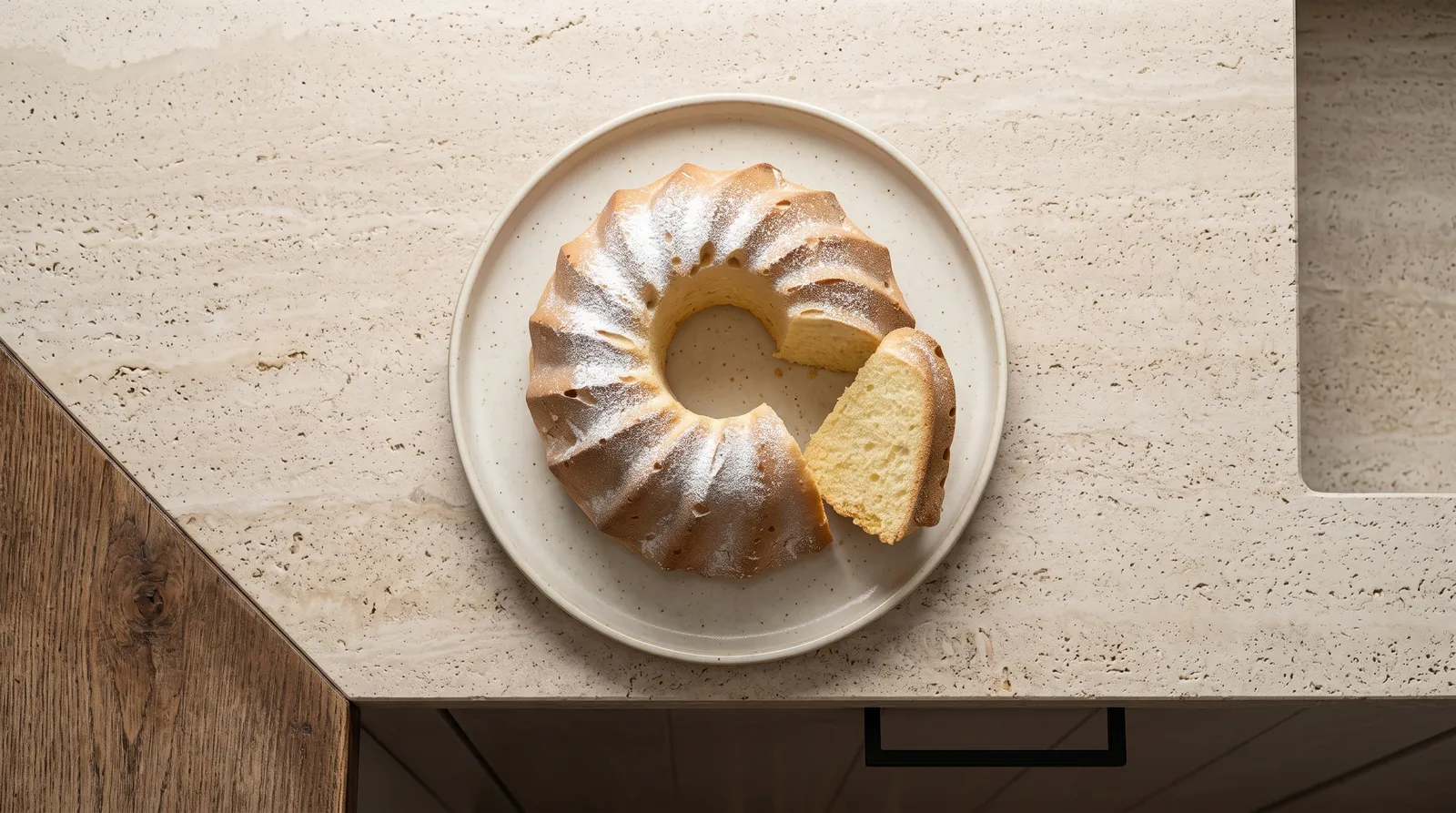
Gâteau de Savoie — shown with a cut section visible
Prep 26 minutes
Cook 38 minutes
Total 2 h 4 min (124 minutes)
Yield 1 round 20 cm cake, 8 slices
Introduction and overview

Gâteau de Savoie — feather-light egg and starch sponge

Gâteau de Savoie, also called biscuit de Savoie, is defined by lightness rather than richness. The structure comes from eggs: the yolks and one whole egg are whisked with sugar until they form a ribbon, while the remaining whites are beaten separately and folded through a sifted blend of flour and cornstarch. That combination gives a crumb that is fine, springy and noticeably lighter than a butter cake.

This is not a génoise or chiffon. There is no melted butter or oil in the batter, and there is no baking powder. The cook therefore has to protect the air already built into the eggs. Sifting matters, as does the order of folding: alternate the dry ingredients and whites instead of forcing all the flour into the foam at once, and stop as soon as the batter is evenly aerated.

A 20 cm springform gives the cake enough height for the foam to show its character. The cake is fully baked when the top springs back and a skewer comes out clean, but it is still fragile while hot. Release it carefully and cool it on a rack for a full hour so steam can escape and the crumb can stabilise before cutting.
Success points

Success points

  • Use room-temperature eggs so the foams build evenly.
  • Aim for glossy medium-firm whites, not dry stiff clumps.
  • Fold in broad strokes from the bottom of the bowl and get the batter into the oven without delay.
Ingredients

Ingredients

  • 75 g plain wheat flour — sifted
  • 45 g cornstarch — sifted with flour
  • 166 g caster sugar — 160 g for batter, 6 g retained from pan dusting
  • 300 g egg contents — from 6 large eggs; Separate 5 eggs; keep 1 egg whole. Total edible egg weight about 300 g.
  • 8 g unsalted butter — soft; For pan only; about 5 g retained in nutrition.
  • 8 g finely grated lemon zest — from about 2 lemons
Method

Method

Directions

  1. The base of a 20 cm springform tin, lightly grease the sides, dust with 10 g sugar and preheat the oven. Line the base of a 20 cm springform tin, lightly grease the sides, dust with 10 g sugar and preheat the oven. Use 20 cm springform tin. Allow 10 minutes. Keep the relevant temperature at 180 °C. The pan is prepared with a thin sugar coat and the oven is fully heated to 180 °C. A prepared tall-sided pan supports release without putting fat into the batter. Handle the preheated oven and metal tin with oven gloves.

  2. Prepare the dry ingredients. Sift the 75 g flour and 45 g cornstarch together. Use fine sieve and bowl. Allow 2 minutes. The dry ingredients are evenly blended and free of lumps. Sifting reduces flour pockets during delicate folding. Keep dry flour away from the face when tipping or whisking.

  3. 5 yolks plus the 1 whole egg with 160 g sugar and lemon zest to a ribbon. Whisk 5 yolks plus the 1 whole egg with 160 g sugar and lemon zest to a ribbon. Use large bowl and electric mixer. Allow 4 minutes. The egg-sugar mixture is pale and falls from the whisk in a ribbon that sits briefly on the surface. A stable yolk foam adds volume before the whites are folded in. Do not taste raw egg foam.

  4. The 5 egg whites to medium-firm peaks. Whip the 5 egg whites to medium-firm peaks. Use clean bowl and whisk. Allow 4 minutes. The whites are glossy and hold medium-firm peaks whose tips bend slightly. Medium-firm foam folds more evenly than dry, overbeaten whites. Use a clean grease-free bowl and do not taste raw egg foam.

  5. The sifted dry ingredients and whites into the yolk foam in alternating additions. Fold the sifted dry ingredients and whites into the yolk foam in alternating additions. Use large bowl and flexible spatula. Allow 6 minutes. The batter is evenly aerated with no visible flour pockets or streaks of white. Alternating additions limit collapse while dispersing the starch and flour. Fold gently and do not sample raw batter.

  6. The foam-raised cake. Bake the foam-raised cake. Use preheated oven. Work at 180 °C conventional oven. Allow 38 minutes. Keep the relevant temperature at 180 °C. The top springs back lightly and a skewer from the centre comes out clean. A fully baked centre stabilises the egg foam without chemical leavening. Protect hands from the hot tin and oven rack.

  7. The cake stand briefly, release it carefully and cool it completely on a rack. Let the cake stand briefly, release it carefully and cool it completely on a rack. Use springform tin and wire rack. Allow 60 minutes passive cooling. The cake is completely cool on the rack and its crumb has stabilized before slicing. Cooling on a rack prevents a damp base and protects the fragile crumb. Release the hot, delicate cake carefully to avoid tearing or burns.

Serving, storage and make-ahead

Practical

Serving, storage and make-ahead

Serve the cake completely cool in eight slices. It is delicate enough to eat plain; a very light dusting of sugar can finish the surface without turning it into a frosted or filled cake.

Serving, storage and make-ahead

For make-ahead service, bake it earlier the same day. Once fully cool, cover it to prevent drying. It keeps for about two days at a cool room temperature, but reheating is unnecessary and works against the light crumb.

Serving, storage and make-ahead

Cornstarch gives a clean, light household result. Potato starch can fill the same structural role when measured by weight, but the absorption is slightly different, so the batter should still be judged by its airy, even consistency rather than by forcing extra dry ingredient into it.

Nutrition per serving

Nutrition per serving

  • Serving size1 slice (1 of 8)
  • Calories197 kcal
  • Carbohydrate33.5 g
  • Protein5.7 g
  • Fat4.2 g
  • Fibre0.4 g
  • Sodium54 mg
Allergens and food safety

Allergens and food safety

Allergens: Egg; Gluten (wheat); Milk from pan butter.

Do not taste raw egg foam or batter.

Bake until the centre is fully set and the skewer test is clean.

Closing

Closing

  • Result: a pale-gold, springy cake with a fine crumb and a gentle lemon aroma.
  • Decisive technique: preserve the whipped-egg foam through careful sifting, medium-firm whites and gentle alternating folds.