French National Dishes

Gaufre lilloise fourrée

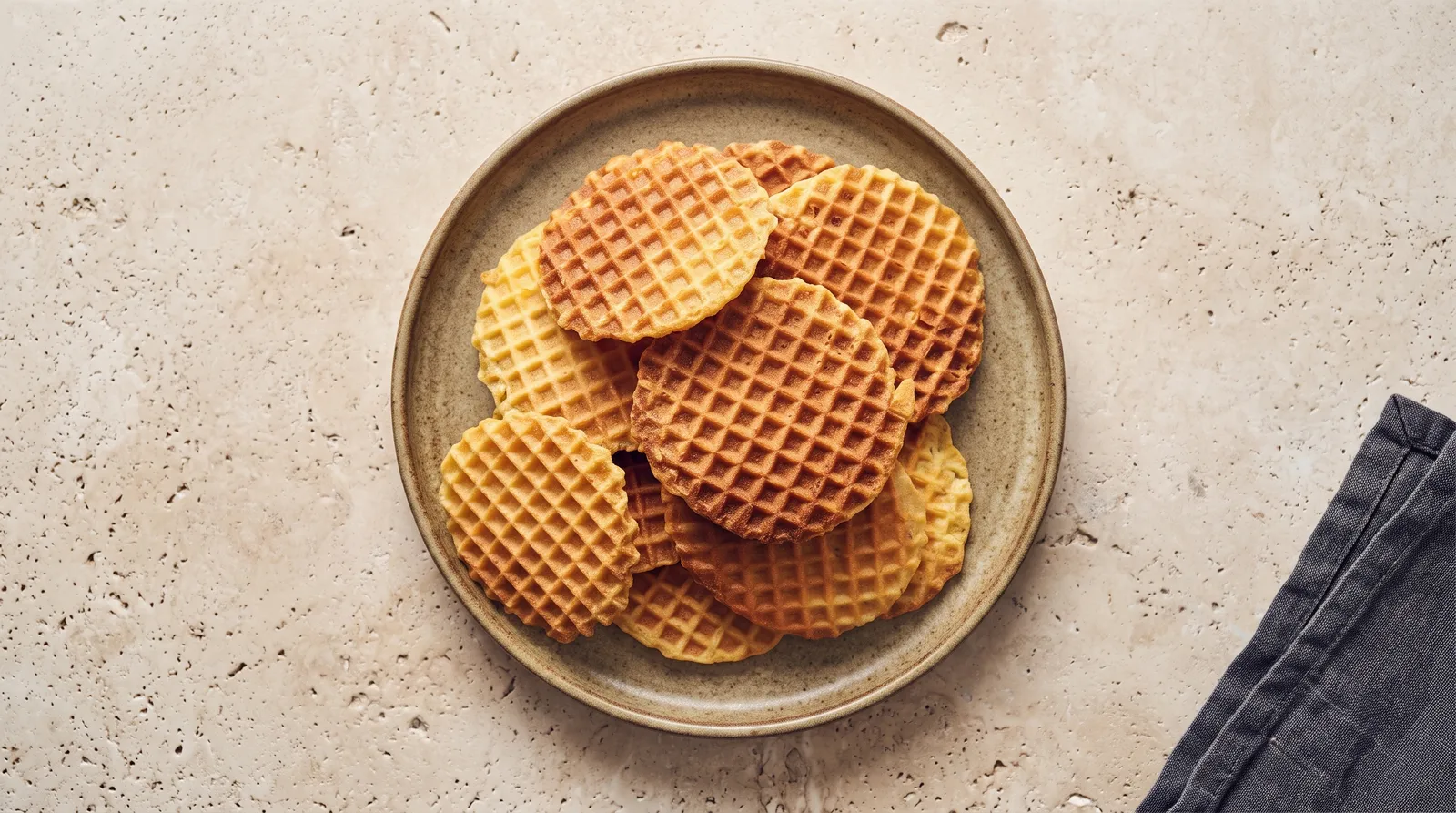
Thin oval Lille-style yeast waffles cooked on shallow grids, opened while still warm and filled with a soft butter-vergeoise cream. Rum is omitted in this household preparation.

French National Dishes
Share
Gaufre lilloise fourrée — served on a plate
Prep 60 minutes
Cook 25 minutes
Total 3 h 55 min (235 minutes)
Yield 20 filled oval waffles
Introduction and overview

Gaufre lilloise fourrée — thin yeast waffles filled with butter and vergeoise

The filled waffle associated with Lille belongs to a very different family from deep Brussels waffles, pearl-sugar Liège waffles or dry wafers. The dough is yeast-raised, portioned into small ovals and cooked between shallow plates so each waffle stays thin and flexible. While it is still warm, it is split through the thickness and filled before the crumb firms.

Vergeoise is central to the filling. Its moist beet-sugar texture blends with soft butter into a paste that stays more supple than a filling made with dry granulated sugar. The waffle itself is only lightly sweetened; most of the sweetness is inside, spread at a measured 18.5 g per piece so all twenty waffles receive an even layer.

Timing around the iron is the demanding part. Cook two waffles at a time only to pale gold, then split them immediately with a serrated knife while they are still pliable. A darker waffle becomes brittle and cracks. Once filled, stack or press them lightly as they cool so the two thin faces stay in contact while the butter sets.
Success points

Success points

  • Proof until the dough has roughly doubled, not by the clock alone.
  • Use shallow small-grid plates; a deep Brussels iron changes the shape and crumb.
  • Split and fill while each waffle is warm and flexible.
Ingredients

Ingredients

Yeast waffle dough

  • 250 g plain wheat flour
  • 30 g caster sugar
  • 2 g fine salt
  • 50 g unsalted butter — soft
  • 90 g whole egg — from 2 small eggs
  • 100 ml whole milk — warmed to about 30 °C
  • 10 g fresh baker’s yeast

Vergeoise filling

  • 250 g vergeoise sugar — blonde or light brown
  • 120 g unsalted butter — soft
Method

Method

Directions

  1. Wake the yeast gently. Warm the 100 ml milk and dissolve the 10 g fresh yeast. Use small jug. Allow 5 minutes. The yeast is dispersed and the milk is warm, not hot, at about 30 °C. Gentle warmth wakes the yeast without damaging it. Do not overheat the milk.

  2. The flour, sugar and salt with 50 g soft butter, 90 g egg and the yeast milk. Mix the flour, sugar and salt with 50 g soft butter, 90 g egg and the yeast milk. Use mixing bowl or stand mixer. Allow 10 minutes. The dough is smooth, supple and slightly tacky, with a finished temperature near 25 °C. A soft yeast dough gives a flexible waffle that can be split after cooking. Keep raw dough away from ready-to-eat filling and do not taste it.

  3. The dough for the first rise. Rest the dough for the first rise. Use covered bowl. Allow 120 minutes passive rest. The dough has expanded to about twice its original volume. The long first rise develops gas for the thin but tender structure. Keep the dough covered and away from excessive heat.

  4. The dough into twenty 26.6 g pieces and shape short ovals. Divide the dough into twenty 26.6 g pieces and shape short ovals. Use scale and work surface. Allow 15 minutes. Twenty even 26.6 g pieces are shaped into short smooth ovals without exposed seams, using the full dough batch. Equal piece weight keeps cooking time consistent. Use a scraper rather than fingers near any sharp blade.

  5. The shaped pieces before cooking. Rest the shaped pieces before cooking. Use covered tray. Allow 15 minutes passive rest. The shaped pieces look slightly fuller and relax without spreading flat. A short rest reduces spring-back in the iron. Keep the pieces covered so the surface does not dry.

  6. The 250 g vergeoise with 120 g soft butter. Beat the 250 g vergeoise with 120 g soft butter. Use mixing bowl. Allow 5 minutes. The vergeoise filling is smooth and spreadable but not liquid. A soft filling spreads thinly without tearing the warm waffles. Rum is omitted; no alcohol is present in the filling.

  7. A small-grid iron that cooks two thin oval waffles at a time. Preheat a small-grid iron that cooks two thin oval waffles at a time. Use small-grid waffle iron. Allow 5 minutes. Both small-grid plates are evenly hot before the first dough pieces go in. A shallow grid is necessary for the thin Lille-style profile. Keep hands clear of the hot iron and escaping steam.

  8. The 20 waffles in ten two-waffle batches. Cook the 20 waffles in ten two-waffle batches. Use small-grid waffle iron. Work at hot waffle iron. Allow 25 minutes total across 10 two-waffle batches, about 2.5 minutes each. Keep the relevant temperature at hot iron. Each waffle is pale golden, thin and flexible enough to split without cracking. Over-browning makes the shell brittle and difficult to open. Keep fingers and loose cloth away from the closing plates and steam.

  9. Each waffle while warm and spread about 18.5 g filling inside. Split each waffle while warm and spread about 18.5 g filling inside. Use serrated knife, towel and small spatula. Allow 20 minutes. Keep the relevant temperature at warm waffles. Each waffle is opened in one horizontal pocket without cutting through the far edge, then receives about 18.5 g of filling. Warm waffles remain flexible enough to split cleanly. Hold each hot waffle with a clean towel and cut away from the supporting hand.

  10. The filled waffles under light pressure. Cool the filled waffles under light pressure. Use tray and baking paper. Allow 15 minutes passive cooling. The filling has set enough not to squeeze out, and the waffles remain soft rather than brittle. Light pressure keeps the two faces in contact as the butter firms. Cool before packing to limit condensation.

Serving, storage and make-ahead

Practical

Serving, storage and make-ahead

Let the filled waffles cool until the butter-vergeoise layer has firmed enough not to squeeze out. Serve them at room temperature; cold butter makes the centre hard, while warming can make it leak.

Serving, storage and make-ahead

They are best on the day they are made. Once fully cool, keep them airtight and refrigerate leftovers within two hours. Bring refrigerated waffles back toward room temperature before serving rather than toasting them.

Serving, storage and make-ahead

Rum appears in some household fillings but is omitted here. Dry brown sugar can be used only as a practical fallback: it produces a drier, more granular filling and should not be described as equivalent to vergeoise.

Nutrition per serving

Nutrition per serving

  • Serving size1 filled waffle (1 of 20)
  • Calories170 kcal
  • Carbohydrate23.7 g
  • Protein2.1 g
  • Fat7.6 g
  • Fibre0.4 g
  • Sodium52 mg
Allergens and food safety

Allergens and food safety

Allergens: Egg; Milk; Gluten (wheat).

Fully cook the egg-and-flour yeast dough; do not taste raw dough.

Use care around the hot waffle iron and steam.

Refrigerate leftovers within two hours; serve again at room temperature for texture.

Closing

Closing

  • Result: thin, pale-golden oval waffles with a tender yeast crumb and an even, soft vergeoise-butter centre.
  • Decisive technique: cook lightly, split each waffle while hot and flexible, and fill before the shell turns brittle.