French Recipes

Gâche normande

A milk-based Norman gâche shaped as one brioched loaf, enriched with butter and egg, given a single rise and baked for about 45 minutes.

French Recipes
Share
Gâche normande — arranged in a basket
Prep 30 minutes
Cook 45 minutes
Total 225 minutes
Yield 1 loaf, 12 slices
Introduction and overview

Gâche normande: milk-enriched Cotentin brioche loaf

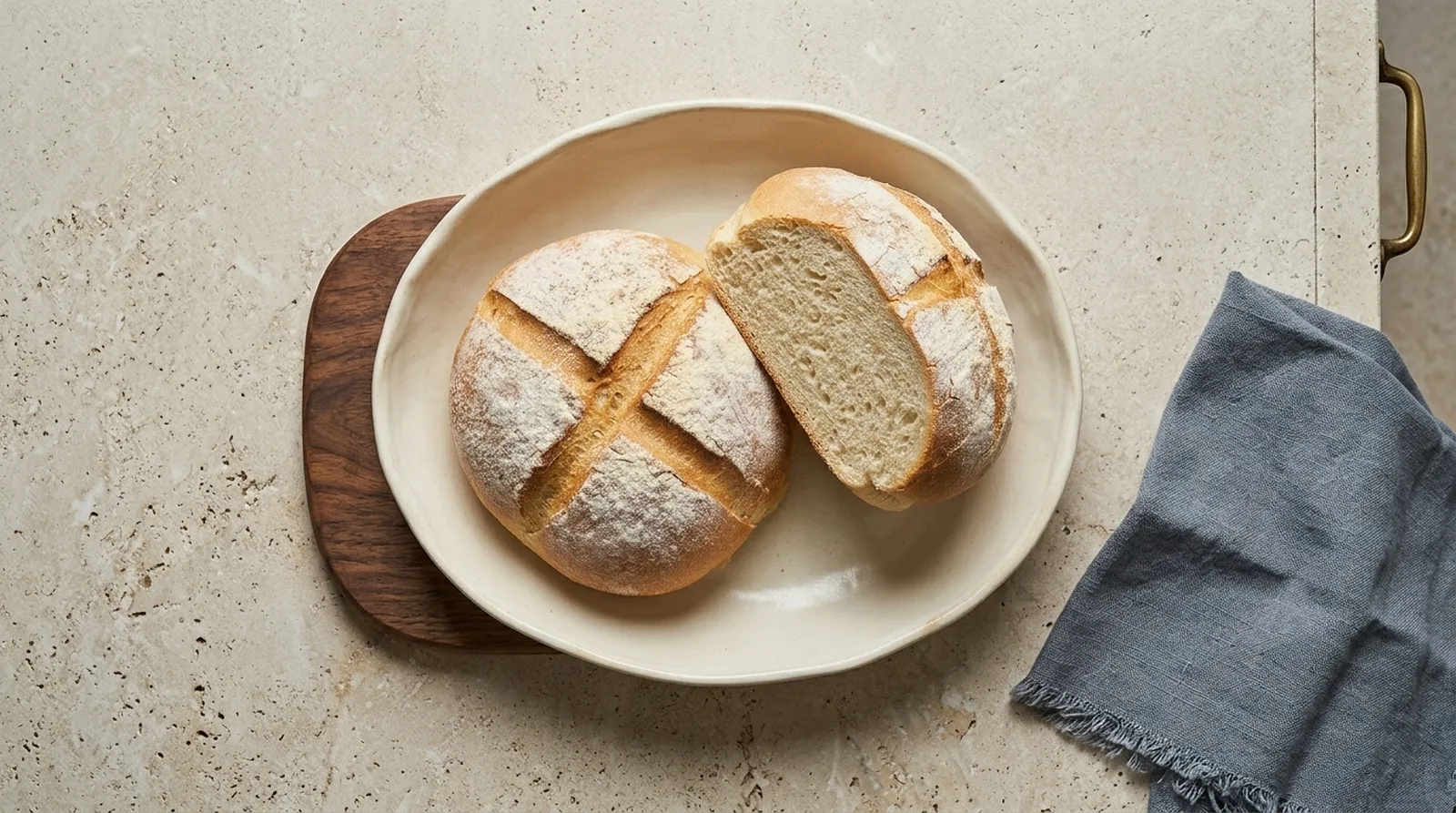
Gâche normande in this version is a Cotentin-style milk-enriched loaf. Wheat flour, whole milk, butter, egg and baker’s yeast produce a soft brioched crumb, but the formula is kept distinct from cream-based gâche vendéenne and from the dried-fruit gâche associated with Guernsey. The loaf form, milk basis and single rise define the household method used here.

Because the dough is rich, butter must disappear into the gluten network rather than sit in greasy streaks. The dough is first brought together with milk and egg, then kneaded until smooth and satiny. It is shaped, scored and egg-washed before the one rise, so the proofed loaf can move to the oven without being knocked back and reshaped.

The bake is deliberately substantial: about 45 minutes at 180 °C for a large loaf. Colour alone is not enough. The bottom should sound hollow and the centre should have no wet dough line. A full hour on a rack follows, because cutting a warm enriched loaf compresses the crumb and can create the false impression that the centre is underbaked.
Success points

Success points

  • Use milk, not cream, to preserve this selected Norman profile.
  • The recipe relies on one complete rise after shaping rather than two separate proof stages.
Ingredients

Ingredients

  • 500 g strong wheat flour
  • 250 ml whole milk — lukewarm, about 25 °C
  • 125 g unsalted butter — softened
  • 100 g egg — about 2 large eggs
  • 20 g caster sugar
  • 8 g fine salt
  • 10 g instant dried yeast
  • 25 g beaten egg — for wash
Method

Method

Directions

  1. Mix the dough. Mix the flour, yeast, sugar and salt, then add the 250 ml milk at about 25 °C and the 100 g egg. Begin adding the softened butter. The flour is fully hydrated and the dough forms a soft cohesive mass.

  2. Develop the dough. Knead for about 10 minutes until the butter is completely incorporated. The dough is smooth, elastic and satiny with no greasy butter streaks.

  3. Shape the loaf. Shape the dough into an even loaf for a 30 × 11 cm tin or equivalent freeform length, score the top lengthwise and brush with the 25 g beaten egg. The loaf is evenly shaped, cleanly scored and covered with a thin, even coat of the 25 g egg wash.

  4. Give the loaf its single rise. Cover and leave the shaped loaf for about 90 minutes at around 22 °C. The loaf is visibly expanded and light, rising to roughly double its starting volume.

  5. Bake the loaf. Bake at 180 °C for about 45 minutes. The crust is deep golden, the base sounds hollow and the centre is fully baked with no wet dough line.

  6. Cool on a rack. Turn the loaf onto a wire rack and leave it for 60 minutes. The loaf is completely cool and the crumb cuts without compressing or smearing.

Serving, storage and planning

Practical

Serving, storage and planning

Cut the completely cooled loaf into 12 slices. Butter and jam can be offered, but they are optional accompaniments and are not part of the measured ingredient list or nutrition.

Serving, storage and planning

For planning, weigh the ingredients in advance but preserve the single 90-minute rise as the actual fermentation stage. Once baked, cool the loaf completely before wrapping. For keeping beyond a short room-temperature period, freeze slices rather than relying on the refrigerator, which accelerates bread staling.

Serving, storage and planning

Milk is not an interchangeable placeholder in this identity. Replacing it with cream changes both the dough balance and the regional comparison, while changing yeast form requires a proper conversion rather than equal weights.

Troubleshooting

If the crumb is dense and greasy, the butter was not fully incorporated or the single proof ended too early. Knead to a satiny dough and wait for clear expansion before baking.

Troubleshooting

If the loaf bursts irregularly beside the score, the cut may have been too shallow or the dough under-proofed. Shape evenly, score decisively and let the loaf become visibly light before it enters the oven.

Nutrition per serving

Nutrition per serving

  • Serving size1 of 12 slices
  • Calories262 kcal
  • Carbohydrate34 g
  • Protein6.5 g
  • Fat11 g
  • Fibre1.2 g
  • Sodium310 mg
Allergens and food safety

Allergens and food safety

Allergen: Gluten from wheat.

Allergen: Milk from milk and butter.

Allergen: Egg from the dough and wash.

Safety: Keep milk and eggs refrigerated before use and handle raw egg wash cleanly.

Safety: Bake the loaf fully and cool before wrapping to avoid trapped moisture.

FAQ

FAQ

Why is there only one rise?

This household version follows the documented Norman pattern selected here: the dough is shaped first and receives one full rise before baking.

Can I use cream instead of milk?

Not without changing the formula and identity. Cream is associated with other gâche traditions and alters the fat and liquid balance.

Closing

Closing

  • Result — a deep-golden loaf with a tender, milky, butter-enriched crumb that slices cleanly after cooling.
  • Decisive technique — incorporate the butter completely, then give the shaped loaf its one full rise before the 45-minute bake.