French Recipes

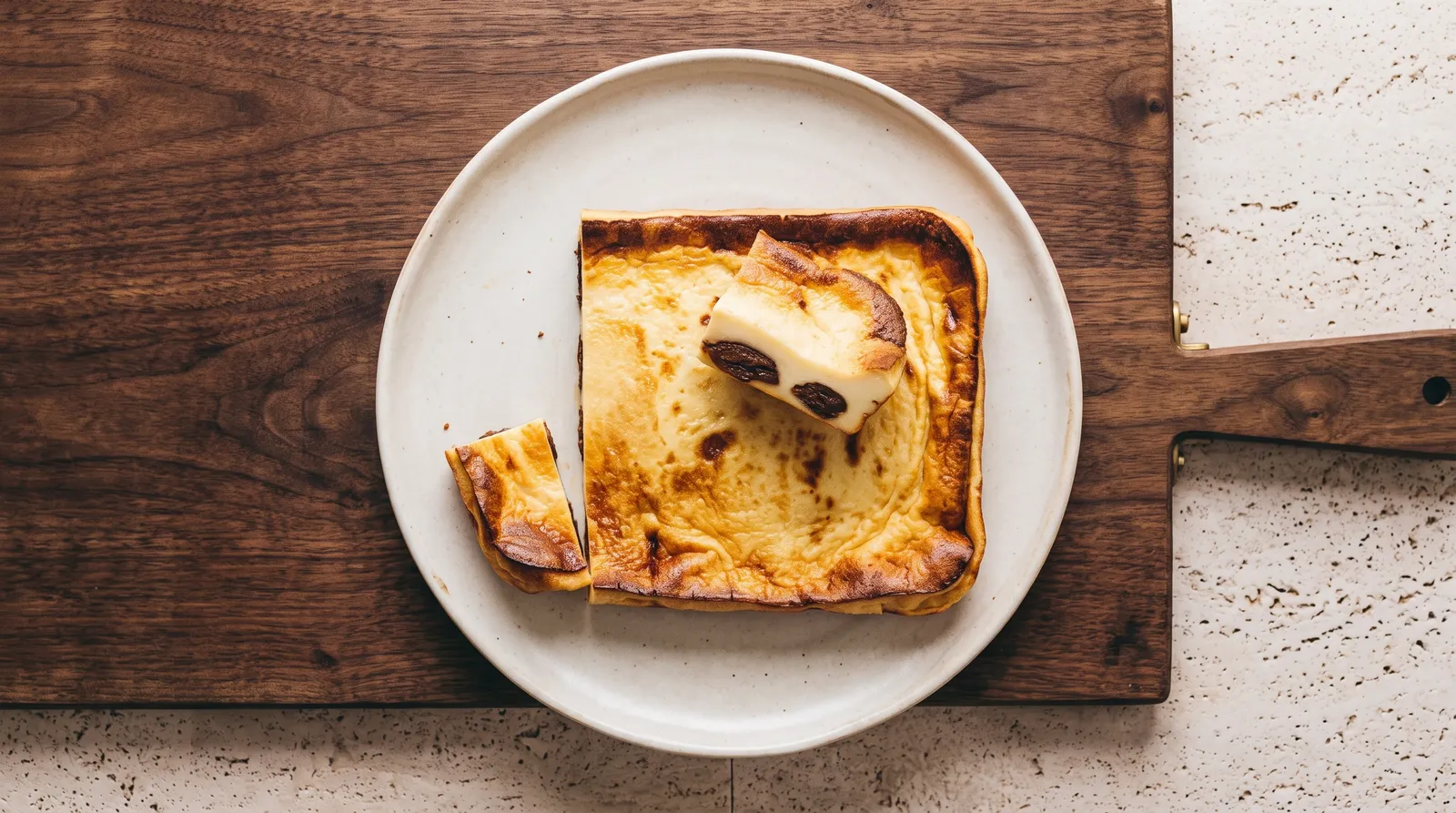
Far breton aux pruneaux

A dense but tender Breton baked batter of whole milk, eggs and flour, set around pitted prunes with no pastry crust and no pastry-cream layer.

French Recipes
Share
Far breton aux pruneaux — shown in an oven dish
Prep 15 minutes
Cook 55 minutes
Total 160 minutes
Yield 1 × 24 cm far, cut into 8 portions
Overview

Far breton aux pruneaux — Breton baked prune far

Far breton aux pruneaux is a baked Breton preparation with a texture between a firm custard and a very thick crêpe batter. Flour is structural rather than decorative: it works with the eggs to give the cooled far a clean, substantial slice. The prunes sit inside that matrix, adding concentrated fruit sweetness without turning the dish into a clafoutis or a fruit tart.

The batter is intentionally simple. Flour, sugar and salt are mixed first, eggs provide the emulsion and set, and warm vanilla-infused whole milk is added gradually. There is no pastry case and no separate pastry cream. The 24 cm dish gives enough depth for the middle to remain moist while the top develops the characteristic deep-golden colour.

Doneness depends on more than colour. The edges should be firmly set, the middle should move only with a small tremble, and the coldest point in the centre must reach at least 71 °C. That combination avoids the two common extremes: a runny egg centre or an overbaked, rubbery slice.

Cooling is part of the texture, not an afterthought. Ninety minutes at room temperature gives the starch-and-egg structure time to settle so the eight portions cut neatly. If the far will be held longer, refrigerate it promptly after that cooling period and serve it lightly chilled or allowed to lose some of its refrigerator chill.
Success points

Success points

  • Add the milk gradually so flour hydrates without persistent lumps.
  • Spread the prunes before pouring the batter so each portion receives fruit.
  • Judge doneness with both the 71 °C centre temperature and the set-edge/slight-tremble cue; a liquid centre needs more baking.
Ingredients

Ingredients

  • 200 g plain wheat flour, sifted — All retained.
  • 150 g caster sugar — All retained.
  • 2 g fine salt — All retained.
  • 200 g whole egg without shell, about 4 large eggs — All retained.
  • 750 ml whole milk — All retained.
  • 5 g vanilla bean seeds and pod, 1 small pod, split and scraped — Seeds flavour the batter; pod is removed after infusing.
  • 250 g pitted dried prunes, ready to use, no soaking liquid — All 250 g retained.
  • 20 g unsalted butter, soft, for the baking dish — Counted as retained except a negligible film on the dish.
Method

Method

Directions

  1. Infuse the milk. Warm the milk with the scraped vanilla seeds and pod until steaming but not boiling, then remove from the heat and leave for 5 minutes. Discard the pod. Time: 5 minutes. Temperature: 70–80 °C. The milk is steaming and fragrant with vanilla but has not boiled over.

  2. Mix the batter. Whisk flour, sugar and salt together, add the eggs, then gradually whisk in the warm milk until smooth and fluid. Time: 7 minutes. The batter is smooth, pourable and thicker than ordinary crêpe batter, with no flour lumps.

  3. Fill the dish. Heat the oven to 180 °C. Butter a 24 cm round baking dish with the full 20 g butter, distribute the pitted prunes evenly, and pour in the batter. Time: 3 minutes. Temperature: 180 °C. The prunes are evenly spaced and covered by a level layer of batter.

  4. Bake the far. Bake for 45–50 minutes at 180 °C until the centre reaches at least 71 °C. Time: 50 minutes. Temperature: 180 °C. The custard-like batter needs enough heat to set the starch and egg network. Verify at least 71 °C in the coldest part of the centre. The top is deeply golden, the edges are set, and the centre trembles only slightly rather than moving as liquid.

  5. Cool before cutting. Set the dish on a rack and cool for 90 minutes before cutting into eight portions. Time: 90 minutes cooling. The far is at room temperature, holds a clean wedge, and remains moist rather than runny in the centre.

Practical guidance

Practical

Practical guidance

Cut into eight wedges only after the 90-minute cooling period; warm far tends to slump and can look undercooked even when it has reached the correct temperature.

Practical guidance

For make-ahead, bake one day in advance, cool as directed, cover and refrigerate at 4 °C or below.

Practical guidance

For storage, refrigerate leftovers within 2 hours and use them within 3 days. The far does not need aggressive reheating; 20–30 minutes out of the refrigerator is enough for a softer texture.

Practical guidance

Vanilla can simply be omitted. If rum is added in another preparation, it must be measured and treated as retained to some degree rather than assumed to disappear.

Troubleshooting

Rubbery centre — the far was overbaked; stop once the centre is safely at 71 °C and only slightly trembling.

Troubleshooting

Wet centre after cooling — the bake ended before the egg-starch matrix set; return to the oven only if the dish is still safely hot and continue until both cues are met.

Troubleshooting

Prunes clustered in one area — distribute them before pouring the batter and pour gently so they do not drift.

Nutrition per serving

Nutrition per serving

  • Serving size1 portion, 1/8 far
  • Calories352 kcal
  • Carbohydrate62 g
  • Protein9 g
  • Fat8 g
  • Fibre3 g
  • Sodium176 mg
Allergens and food safety

Allergens and food safety

Allergens: Egg; Milk; Gluten (wheat)

The coldest part of the centre must reach at least 71 °C; colour alone does not establish egg safety.

Refrigerate at 4 °C or below if the far is not eaten after cooling, and refrigerate leftovers within 2 hours.

FAQ

FAQ

Is far breton the same as clafoutis?

No. Here flour is present in a substantial proportion and the result is a denser Breton far, not a light fruit clafoutis.

Why are the prunes not soaked?

This preparation uses ready-to-eat pitted prunes directly, keeping the liquid balance fixed and avoiding an unmeasured soaking liquid.

Closing

Closing

  • Result: a deeply golden Breton far with eight clean portions, tender egg-milk crumb and evenly distributed prunes.
  • Decisive technique: stop baking when the centre is safely at 71 °C, set at the edges and only slightly trembling, then cool before cutting.