French National Dishes

Farci poitevin

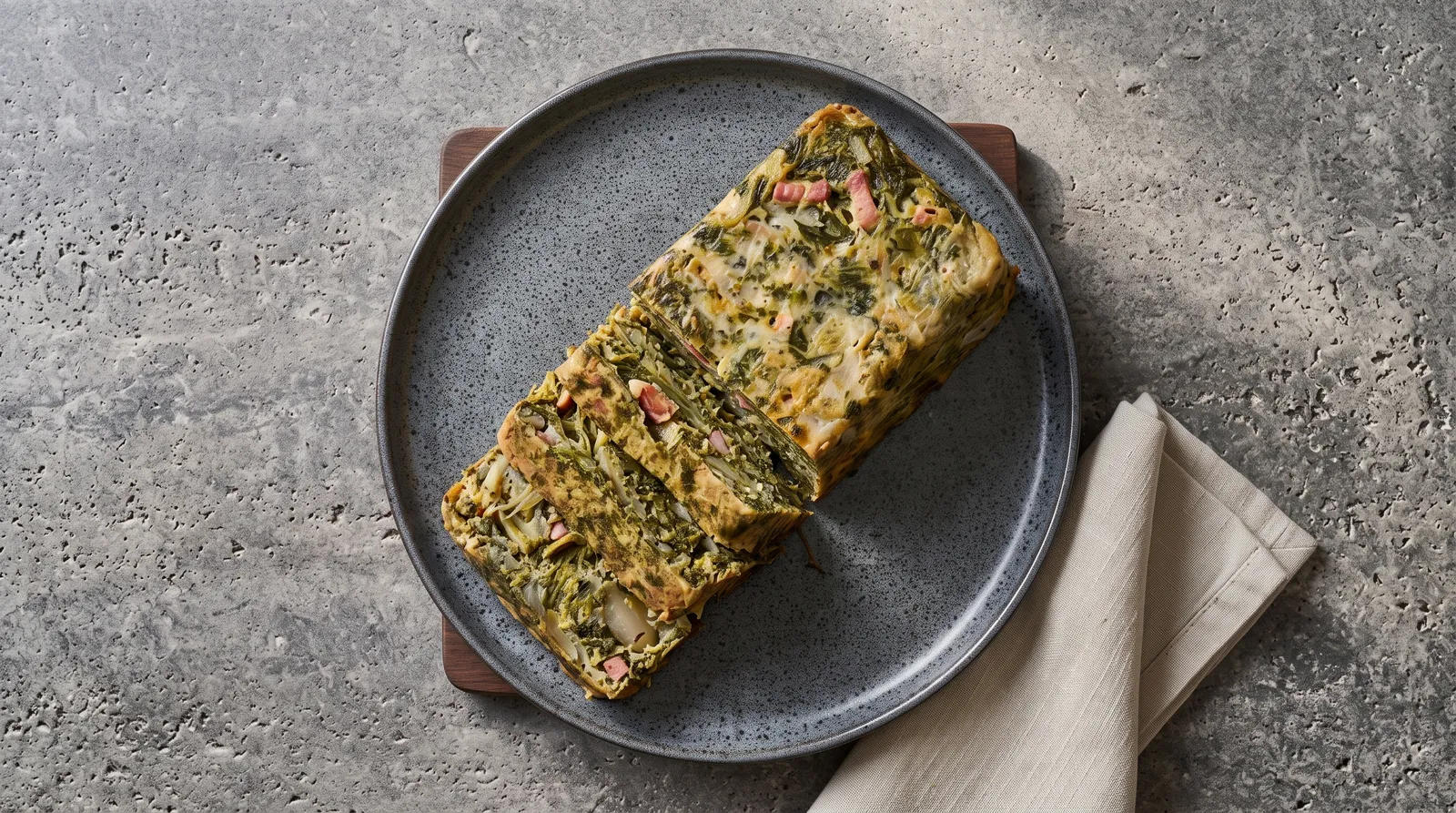
A cabbage-wrapped Poitou terrine packed with leafy greens, fresh and smoked pork belly, egg and crème fraîche, poached gently for four hours and chilled before slicing.

French National Dishes
Share
Farci poitevin — arranged on a board
Prep 55 minutes
Cook 266 minutes
Total 636 minutes
Yield 1 chilled green terrine, cut into 10 slices
Overview

Farci poitevin — slow-poached Poitou green terrine

Farci poitevin is one of the clearest examples of a regional dish whose method matters as much as its ingredient list. In Poitou it is also encountered as pâté d’herbes or terrine verte: cabbage leaves form the outside, while a dense mixture of leafy greens, pork and egg fills the centre. The characteristic preparation is enclosed and poached slowly, not merely spooned into a gratin dish for a short bake.

This recipe fixes the greens at spinach, chard leaves, leeks and parsley. Their purchased and usable states matter because stems, damaged leaves and excess water can distort both the texture and the nutrition calculation. The spinach, chard and leeks are cooked first so their volume collapses and much of their free moisture is driven away; after a measured drain, they are chopped and combined with cooked aromatics and pork.

Eight blanched cabbage leaves overlap inside food-grade muslin to create a continuous wrapper. The filling is packed in firmly, the leaves close over the top and the muslin is tied into a rounded bundle. That package then poaches for four hours in a barely simmering unsalted vegetable stock. The long, moist cook softens the greens and sets the egg-and-flour binder without producing the baked crust associated with a faster oven method.

Because this presentation is served cold, cooling is part of the recipe schedule. After the centre has reached at least 74 °C and the bundle has drained, the terrine is cut into thick slices and transferred to shallow trays. That exposes more surface area for faster chilling. A further four hours in the refrigerator firms the slices so the green filling stays neat inside the cabbage wrapper.


Success points

Success points

  • Cook excess water out of the greens before mixing; trapped liquid weakens the terrine.
  • Use food-grade muslin or a purpose-made cooking net, not an unspecified household cloth.
  • Tie the bundle snugly enough to hold shape but not so hard that filling is forced through the cabbage.
  • After the four-hour poach, cool the sliced terrine rapidly in shallow trays before the final chill.
Ingredients

Ingredients

Wrapper and greens

  • 8 l arge savoy cabbage leaves, blanched; about 400 g usable from a roughly 1.2 kg head — Eight intact leaves are used as wrapper; hard central rib ends are trimmed.
  • 450 g spinach leaves, trimmed weight from about 500 g purchased, washed and dried — All 450 g trimmed leaves retained.
  • 250 g chard greens, leaf-only trimmed weight from about 500 g purchased chard — Stalks are excluded from this preparation.
  • 300 g leeks, trimmed white and light-green weight from about 400 g purchased, washed and sliced — All 300 g retained.
  • 40 g flat-leaf parsley, leaves and tender stems, washed — All retained.

Pork and binder

  • 150 g white onion, peeled, chopped — All retained.
  • 100 g shallots, peeled, chopped — All retained.
  • 12 g garlic, peeled, chopped — All retained.
  • 200 g fresh pork belly, raw, skin removed, diced — All 200 g edible weight retained.
  • 200 g smoked pork belly, raw cured, skin removed, diced — All 200 g edible weight retained.
  • 30 g unsalted butter, for sautéing — All except a negligible pan film is counted as retained.
  • 150 g whole egg without shell, about 3 large eggs — All retained.
  • 30 g plain wheat flour — All retained.
  • 200 g crème fraîche, 30% fat — All retained.
  • 3 g fine salt — All retained.
  • 2 g black pepper — All retained.

Poaching liquid

  • 3000 ml unsalted vegetable stock containing celery, hot; used only for poaching — The edible terrine is lifted out; the stock is discarded and is excluded from nutrition except for negligible carryover.
Method

Method

Directions

  1. Blanch the cabbage leaves. Bring a large pot of water to a gentle boil and blanch the eight cabbage leaves for 4 minutes, then lift them out and drain. Time: 4 minutes. Temperature: 100 °C. The leaves are flexible enough to fold without tearing but still hold their structure.

  2. Sauté the greens. Melt 15 g of the butter in a wide pan. Cook spinach, chard greens and leeks over medium heat for 10 minutes, stirring, then add parsley and transfer to a colander. Time: 10 minutes. The greens are wilted and tender with most free moisture evaporated, not swimming in liquid.

  3. Cook the pork and aromatics. Melt the remaining 15 g butter in the same pan. Cook onion, shallots, garlic and fresh pork belly for 12 minutes over medium heat. Add the smoked pork belly for the final 3 minutes. Time: 12 minutes. Pre-cooking drives off moisture before the filling is enclosed. Wash hands and any tools that touched raw pork before handling the cooked greens or cabbage. The aromatics are soft, the fresh pork has lost its raw exterior colour, and the pan contains no pool of watery liquid.

  4. Drain and chop. Leave the cooked greens in the colander for 15 minutes, then squeeze gently and chop them finely. Time: 15 minutes draining. The greens are moist but no longer release free liquid when pressed.

  5. Mix the filling. Combine chopped greens, pork mixture, eggs, flour, crème fraîche, salt and pepper. Time: 8 minutes. The mixture is evenly bound and thick enough to mound rather than pour.

  6. Build the bundle. Line a round colander or 22 cm bowl with clean food-grade muslin, overlap the eight cabbage leaves across it, pack in the filling, fold the leaves over the top and tie the muslin tightly with food-safe kitchen twine. Time: 10 minutes. The bundle is tight, rounded and fully enclosed by cabbage before the muslin is tied.

  7. Poach slowly. Bring the 3,000 ml unsalted celery-containing vegetable stock to a gentle simmer. Lower in the bundle and poach very gently for 240 minutes, adding hot water to the pot only if evaporation leaves part of the bundle exposed. Time: 240 minutes. Temperature: 90–95 °C. The long poach melds the dense herb-and-pork filling without the dry crust of a short bake. Verify 74 °C at the coldest centre before ending the poach. The coldest part of the centre reaches at least 74 °C and the greens are fully tender while the bundle remains intact.

  8. Drain the bundle. Lift the bundle from the broth, place it in a clean colander over a tray and drain for 15 minutes before untying the muslin. Time: 15 minutes draining. The bundle stops dripping steadily and holds its rounded shape when the muslin is loosened.

  9. Cool in shallow portions. Unwrap, cut the warm terrine into 10 thick slices, lay them in a single layer in shallow refrigeration-safe trays and cool for 60 minutes in the refrigerator. Time: 60 minutes cooling and refrigeration. Temperature: 4 °C or below. Shallow portions shed heat faster than one large dense bundle. Refrigerate within 2 hours of leaving the poaching liquid. The slices are cold at the surface and no longer release visible steam.

  10. Chill before serving. Cover the trays and refrigerate for a further 240 minutes before serving. Time: 240 minutes refrigeration. Temperature: 4 °C or below. The slices are fully chilled, firm and clean-cut, with the green filling held securely by the cabbage wrapper.

Practical guidance

Practical

Practical guidance

Serve one fully chilled slice per person as a starter. The cross-section should show a compact green filling held by the overlapping cabbage leaves.

Practical guidance

For make-ahead, prepare the dish the previous day. After the four-hour poach, follow the measured drain, shallow cooling and four-hour chill rather than leaving the whole bundle to cool slowly.

Practical guidance

Store covered at 4 °C or below and use within 3 days. If a slice is reheated, take it all the way to 74 °C and serve immediately.

Practical guidance

A purpose-made cooking net can replace food-grade muslin. Do not use an unidentified household cloth that may contain dyes, detergents or fibres unsuitable for prolonged food contact.

Troubleshooting

Loose, watery slice — the greens were not cooked and drained enough before mixing; reduce free moisture before adding eggs and cream.

Troubleshooting

Bundle splits — cabbage leaves did not overlap sufficiently or the muslin was tied too loosely; overlap the leaves fully and secure the bundle before poaching.

Troubleshooting

Centre stays below 74 °C — maintain a true gentle simmer and continue poaching until the thermometer confirms the threshold.

Nutrition per serving

Nutrition per serving

  • Serving size1 slice, 1/10 terrine
  • Calories357 kcal
  • Carbohydrate16 g
  • Protein11 g
  • Fat28 g
  • Fibre4 g
  • Sodium500 mg
Allergens and food safety

Allergens and food safety

Allergens: Egg; Milk; Gluten (wheat); Celery (from the poaching stock)

Prevent cross-contamination from raw fresh and smoked pork belly; wash hands, knives, boards and bowls before they return to ready-to-eat work.

The coldest centre of the bundle must reach at least 74 °C during poaching.

After poaching, refrigerate the sliced terrine within 2 hours, cool it in shallow trays and hold at 4 °C or below.

Reheated portions must reach 74 °C.

FAQ

FAQ

Why is the cooking time so long?

The tightly packed bundle is dense. The gentle four-hour poach cooks the greens and pork through while setting the binder without a dry exterior.

Is the baked 30–40 minute preparation interchangeable?

It is a different regional shortcut; this recipe keeps the slow-poached Poitou method.

Closing

Closing

  • Result: a chilled, sliceable green terrine with a cabbage wrapper, tender greens and savoury pieces of pork throughout.
  • Decisive technique: drive off free moisture before wrapping, then poach the tightly enclosed bundle for the full four hours and cool it rapidly in shallow slices.