French Recipes

Fallue normande

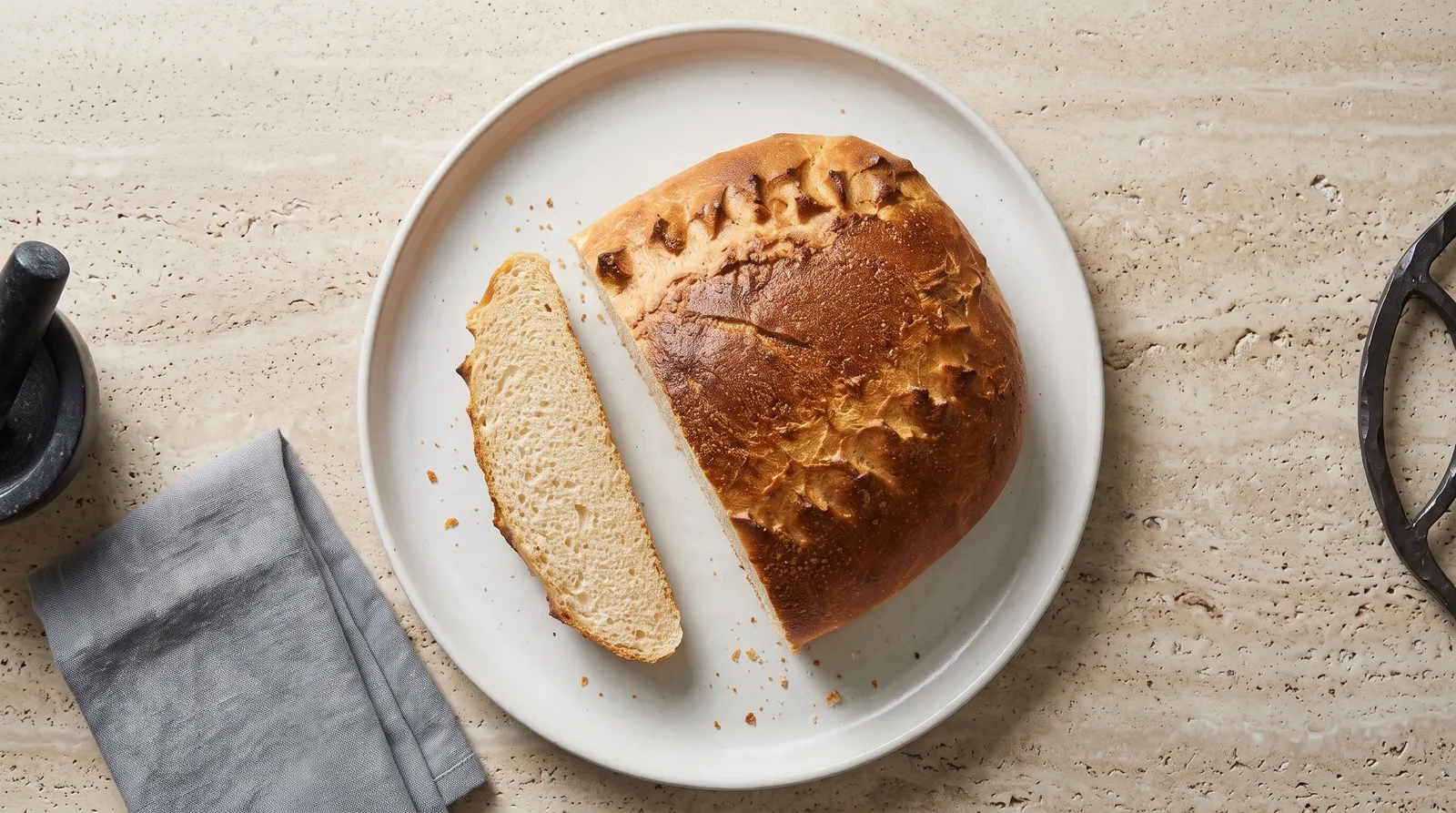
A softly aerated Norman yeast bread shaped as a low oval, enriched with egg, butter, milk and crème fraîche, then baked to a deep-golden crust and cooled fully before slicing.

French Recipes
Share
Fallue normande — shown with a cut section visible
Prep 35 minutes
Cook 30 minutes
Total 245 minutes
Yield 1 shallow oval loaf, about 30 × 18 cm, cut into 12 slices
Overview

Fallue normande — shallow Norman enriched yeast bread

Fallue normande, also written falue, belongs to a Norman family of enriched yeast breads rather than to the tall, moulded brioche style that the word “brioche” can suggest elsewhere. Its regional identity is especially associated with Bessin, the Saint-Lô area and the Coutances area. The defining visual cue is a broad, shallow oval: the loaf spreads gently across the baking sheet, carries light decorative scoring and has a pale, soft, finely aerated crumb under a deeper golden crust.

The richness comes from several sources at once. Whole egg gives colour and structure, butter brings tenderness, and the combination of milk and crème fraîche softens the crumb without turning the dough into a batter. Because fat and sugar both slow gluten development and fermentation, the order matters. The dough is first mixed and partly kneaded before the butter goes in gradually; only then is it worked to the smooth, elastic stage that can hold gas through two controlled proofs.

The proofs are deliberately moderate. The first builds internal aeration, while the second gives the shaped oval enough lift without making it fragile. A light egg-and-milk wash and shallow scoring supply the traditional bakery finish. Bake until the loaf is deeply golden and the centre is fully set, then give it a full hour on a rack. Slicing while hot can compress the still-setting crumb and make an otherwise well-baked loaf seem gummy.

In Normandy, fallue is often eaten with teurgoule, the long-baked rice pudding scented with cinnamon. That pairing is useful cultural context, but the bread stands on its own as breakfast, afternoon food or a simple dessert bread. This recipe keeps the accompaniment outside the ingredient list so the loaf’s own proportions, yield and nutrition remain clear.
Success points

Success points

  • Develop gluten before the butter is fully incorporated; a rich dough will look slack before it becomes smooth.
  • Keep the two proofs moderate rather than pushing for a doubled volume, so the shallow oval holds its characteristic profile.
  • Score shallowly after the egg wash; deep cuts can collapse an enriched, fully proofed loaf.
Ingredients

Ingredients

Dough

  • 500 g plain wheat flour, weighed before mixing — All 500 g is retained in the loaf.
  • 100 ml whole milk, lukewarm, about 25 °C — Purchased volume equals usable volume.
  • 100 g crème fraîche, cold, 30% fat — All retained.
  • 150 g whole egg without shell, about 3 large eggs — All retained.
  • 75 g caster sugar — All retained.
  • 10 g fresh baker’s yeast, crumbled — All retained.
  • 6 g fine salt — All retained.
  • 100 g unsalted butter, soft but not melted — All retained.

Finish

  • 50 g whole egg without shell, beaten for egg wash — About 1 large egg; all applied except a negligible bowl film.
  • 15 ml whole milk, mixed with egg wash — All applied except a negligible brush loss.
Method

Method

Directions

  1. Wake the yeast. Stir the fresh yeast into the 100 ml lukewarm milk and leave it for 5 minutes. Time: 5 minutes. Temperature: 25 °C. Dispersing fresh yeast helps it blend evenly through a rich dough. The yeast is evenly dispersed and the liquid smells fresh and yeasty.

  2. Build the dough. Combine flour, sugar and salt in a mixer bowl. Add the yeast milk, crème fraîche and 150 g egg, then mix until no dry flour remains. Time: 5 minutes. The dough is rough but evenly hydrated with no dry flour pockets.

  3. Knead in the butter. Knead for 4 minutes, then add the soft butter in four additions and continue kneading for about 8 minutes. Time: 12 minutes. Gradual butter addition lets gluten form before the full fat load is incorporated. The dough is smooth, elastic and softly tacky, and a stretched piece forms a thin window before tearing.

  4. First proof. Cover the bowl and leave to stand for the first proof at 24–26 °C for 75 minutes. Time: 75 minutes proofing. Temperature: 24–26 °C. The dough is visibly aerated and has expanded to roughly one and a half times its starting volume.

  5. Shape the shallow oval. Turn the dough onto a lightly floured surface, press out only the largest gas pockets, and shape it into one 30 × 18 cm shallow oval about 4 cm thick. Transfer to a lined baking sheet. Time: 8 minutes. The oval is even in thickness with a taut surface and no torn seams.

  6. Second proof. Cover loosely and leave to stand for the second proof at 24–26 °C for 45 minutes. Time: 45 minutes proofing. Temperature: 24–26 °C. The loaf looks puffy and a light fingertip indentation returns slowly rather than springing back at once.

  7. Wash and score. Heat the oven to 180 °C. Mix the 50 g egg with 15 ml milk, brush the loaf thinly, and make shallow decorative ear or chevron cuts without deflating it. Time: 5 minutes. Temperature: 180 °C. The surface is evenly glazed and the shallow cuts remain clearly defined.

  8. Bake until deep golden. Bake at 180 °C for 28–30 minutes, rotating only if the oven browns unevenly. Time: 30 minutes. Temperature: 180 °C. The crust is deep golden, the loaf sounds lightly hollow underneath, and the centre is fully baked rather than gummy.

  9. Cool completely. Transfer the loaf to a wire rack and cool for 60 minutes before slicing. Time: 60 minutes cooling. Cooling completes crumb setting in an enriched loaf. The loaf is at room temperature and the crumb cuts cleanly without compressing into a gummy line.

Practical guidance

Practical

Practical guidance

For serving, cut the completely cooled loaf into 12 even slices. It is pleasant plain and can accompany teurgoule without needing additional sweetness in the dough.

Practical guidance

For make-ahead, bake the loaf the day before, cool it completely, then wrap it tightly. The crumb stays supple for about 2 days at cool room temperature.

Practical guidance

For reheating, warm individual slices for 4–5 minutes in a 150 °C oven. A long microwave cycle can make the enriched crumb rubbery.

Practical guidance

If crème fraîche is unavailable, use a cultured cream close to 30% fat and label the result as an adaptation. Do not substitute chemical raising agent for baker’s yeast.

Troubleshooting

Dense crumb — the dough was under-kneaded or under-proofed; reach the elastic window and use the slow-return fingertip cue.

Troubleshooting

Greasy streaks — the butter was added before the dough had enough structure or was too warm; add soft butter gradually.

Troubleshooting

Collapsed oval — the second proof went too far or the scores were too deep; shorten proofing and cut only the surface.

Nutrition per serving

Nutrition per serving

  • Serving size1 slice, 1/12 loaf
  • Calories292 kcal
  • Carbohydrate39 g
  • Protein7 g
  • Fat12 g
  • Fibre1 g
  • Sodium230 mg
Allergens and food safety

Allergens and food safety

Allergens: Egg; Milk; Gluten (wheat)

Wash hands, bowls and utensils after handling raw egg before touching ready-to-eat food.

Cool the baked loaf completely on a rack before wrapping so trapped steam does not make the crumb gummy.

FAQ

FAQ

Why is the loaf not shaped in a brioche tin?

The shallow free-form oval is part of the regional presentation and gives a different crust-to-crumb balance.

Can the first proof simply be doubled in volume?

A roughly one-and-a-half-times increase is enough here; pushing much further can make the second proof and scoring less stable.

Closing

Closing

  • Result: a deep-golden, shallow Norman loaf with a soft, evenly aerated crumb rather than a tall brioche profile.
  • Decisive technique: develop the dough before adding all the butter, then stop each proof at the stated visual and fingertip cues.