French Recipes

Escalope cordon bleu

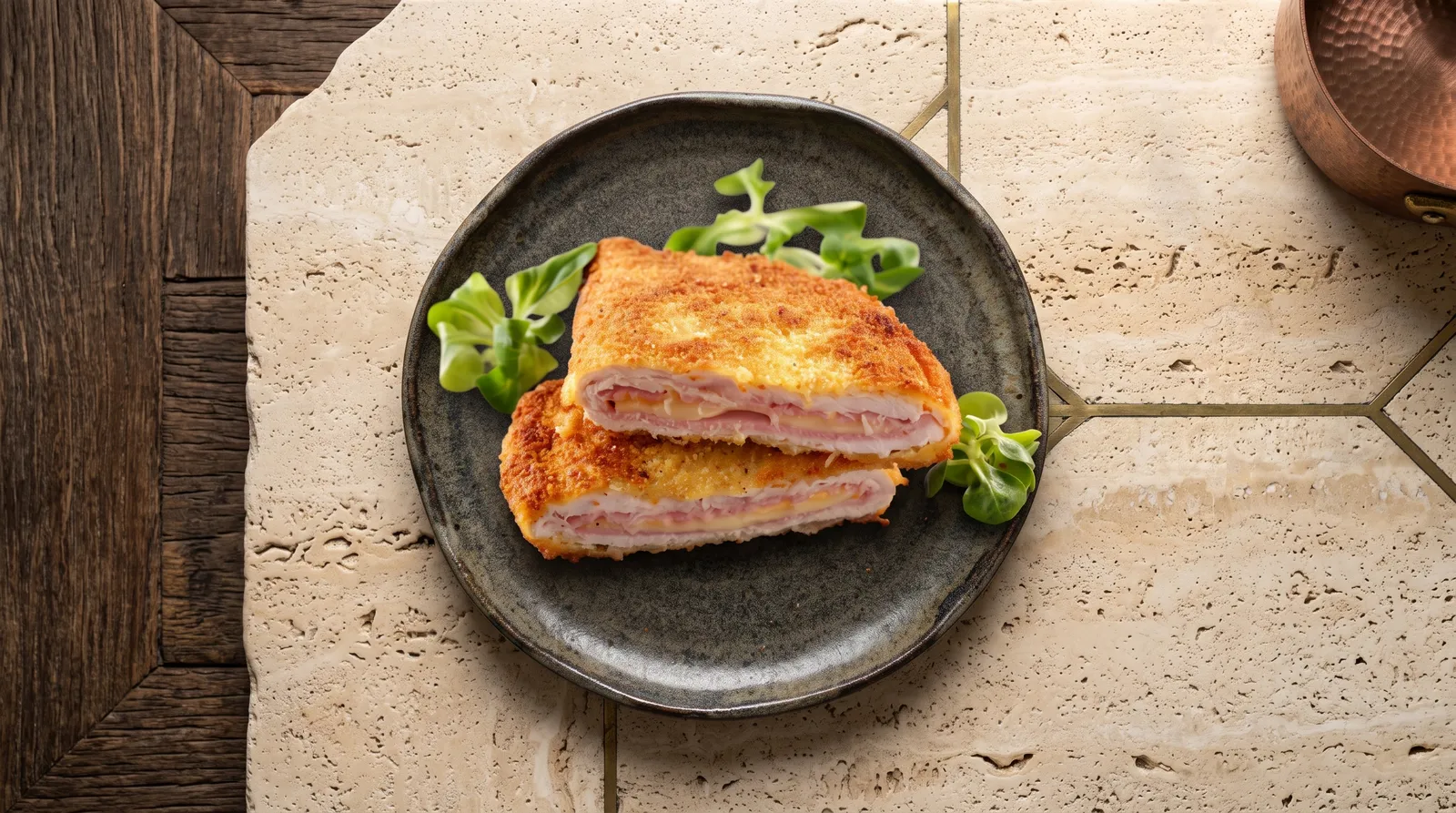
Chicken breasts are pounded thin, filled with cooked ham and Emmental, securely folded, breaded and browned before an oven finish brings the coldest stuffed centre to 74 °C.

French Recipes
Share
Escalope cordon bleu — served on a plate
Prep 35 minutes
Cook 18 minutes
Total 71 minutes
Yield 4 chicken cordons bleus
Introduction and overview

Escalope cordon bleu: chicken with ham and Emmental in crisp breadcrumbs

This cordon bleu is deliberately a chicken escalope from start to finish. Each boneless breast is opened and pounded to about 6 mm, filled with a measured slice of cooked ham and Emmental, then folded closed before breading. Fixing the protein matters because chicken, turkey and veal do not share the same cooking endpoint, and switching among them would make the method and nutrition inconsistent.

The filling needs a clean border. Cheese that reaches the edge tends to melt out before the meat is cooked, while holes made during pounding give it another escape route. Two wooden picks secure each parcel. Flour, pasteurized egg and dry breadcrumbs build the coating in that order, and a 15-minute cold rest helps the crumbs adhere before they meet the pan.

Pan browning is only the first part of cooking. Four minutes in the skillet gives the crumb a golden crust, while the oven brings the stuffed centre safely through. A thermometer is inserted from the side through the meat and filling, away from the pan, and the coldest thick point must reach 74 °C. Golden crumbs and melted cheese are useful quality cues, but neither proves that poultry at the centre is safe.
Success points

Success points

  • Cover the chicken before pounding and use a smooth mallet so the meat thins without tearing.
  • Keep ham and cheese away from the outer edge, then count the wooden picks in and out.
  • Use fresh clean tongs after the raw-chicken stage; the coating can look cooked before the centre is safe.
Ingredients

Ingredients

Chicken and filling

  • 720 g boneless skinless chicken breast, 4 breasts, about 180 g each
  • 120 g cooked ham, 4 slices, 30 g each
  • 120 g Emmental cheese, 4 slices, 30 g each
  • 4 g fine salt
  • 1 g black pepper, ground

Breading and cooking

  • 50 g plain wheat flour
  • 100 g pasteurized whole egg, beaten
  • 100 g dry breadcrumbs
  • 60 g neutral cooking oil, for the pan; about 25 g is estimated to be absorbed and eaten
Method

Method

Fill and bread

  1. Pound the chicken evenly. Butterfly each breast without cutting through, cover and pound to an even 6 mm thickness, keeping the four pieces separate. Use Cutting board, film and smooth meat mallet. Allow 10 minutes. Each chicken piece is an even sheet about 6 mm thick with no holes through the centre. Even thickness lets the stuffed parcel heat predictably without overcooking its edges. Use a board reserved for raw poultry, wash hands after handling, and sanitize the mallet covering and work area.

  2. Enclose the ham and cheese. Season the chicken with all 4 g salt and pepper, place one 30 g ham slice and one 30 g cheese slice on each piece leaving a clean border, fold tightly and secure each parcel with two wooden picks. Use Raw-poultry board and eight wooden picks. Allow 8 minutes. The filling is fully enclosed, the edges meet firmly and no cheese protrudes from the seam. A clean border and secure closure reduce cheese leakage in the pan and oven. Keep raw-poultry utensils separate from the later cooked-food plate.

  3. Bread in three layers. Coat each parcel first in flour, then beaten pasteurized egg, then breadcrumbs, pressing the crumbs on evenly. Use Three shallow dishes. Allow 7 minutes. Every parcel has a complete dry crumb coating with no bare wet patches. The flour helps egg adhere and the crumbs create the crisp outer layer. Treat the egg dishes and raw chicken as contaminated until washed; discard leftover coating mixtures.

  4. Rest the breading cold. Place the breaded parcels on a clean tray and refrigerate before cooking. Use Clean tray and refrigerator. Work under cold conditions. Allow 15 minutes resting. Target 4 °C. The coating feels set and dry rather than loose when a parcel is lifted from the tray. A brief chill helps the breading adhere during turning. Keep breaded raw chicken at 4 °C or below during the rest.

Cook

  1. Brown the coating. Heat the oil in a wide oven-safe skillet and brown the parcels for 2 minutes per side, turning with clean tongs after the first side has cooked. Use Wide oven-safe skillet and tongs. Work at medium-high heat. Allow 4 minutes. The crumb coating is evenly golden on both broad sides without dark burnt patches. Pan browning builds a crisp crust before the gentler oven finish. Do not reuse tongs that touched raw chicken without washing them before handling cooked parcels.

  2. Finish to 74 °C in the oven. Transfer the skillet to a preheated oven and bake until a probe inserted from the side into the coldest thick centre passes through chicken and stuffing without touching the pan and reaches 74 °C. Use 180 °C oven and food thermometer. Work at 180 °C oven. Allow 14 minutes. Target 74 °C. The coldest thick centre through chicken and stuffing reaches 74 °C, the coating remains crisp and the cheese stays mostly enclosed. The oven brings the stuffed centre safely to temperature without burning the breadcrumb crust. Colour alone is not a safety test; verify 74 °C with a clean food thermometer.

  3. Rest and remove every pick. Move the cooked cordons bleus to a clean plate, rest briefly, then remove all eight wooden picks before serving. Use Clean plate. Work under room temperature conditions. Allow 3 minutes resting. The cheese has settled enough not to flood out when cut, and all eight wooden picks have been removed. A short rest makes the filling easier to contain on the plate. Count the picks before and after cooking so none remains in a serving.

Practical guidance

Practical

Serving

Serve one parcel per person after the three-minute settling rest, with every wooden pick removed. Cutting at the table keeps the cheese enclosed longer. The nutrition includes the measured filling and coating plus 25 g estimated absorbed oil across four pieces, not the full 60 g supplied to the pan.

Storage, reheating and make-ahead

The breaded raw parcels can be assembled up to six hours ahead and kept at 4 °C or below. Cook directly from chilled and let the 74 °C centre determine timing. Refrigerate cooked leftovers within two hours and use within three days. Reheat in a 180 °C oven to 74 °C for the best balance of safety and crust texture. Stuff and bread the chicken up to 6 hours ahead, cover and keep at 4 °C or below. Cook directly from refrigerator temperature, allowing the stated thermometer endpoint to determine doneness.

Substitutions

- Turkey or veal: Not identity-preserving. Both appear in broader cordon bleu traditions, but changing the protein would alter the defined chicken preparation and its timing.

Troubleshooting

Troubleshooting

  • Cheese leaks out.The filling sat too close to the edge, the fold was not fully closed or the chicken was punctured. Keep the ham and cheese inside the border, close the fold securely and use picks only as needed, removing them before serving.
  • Breading slips off.The chicken surface was wet or the coated escalopes did not complete their breading rest. Pat the chicken dry before coating and give the breaded pieces the full 15-minute rest before browning.
Nutrition per serving

Nutrition per serving

  • Serving size1 chicken cordon bleu
  • Calories598 kcal
  • Carbohydrate28 g
  • Protein63 g
  • Fat25 g
  • Fibre1 g
  • Sodium1188 mg
Allergens and food safety

Allergens and food safety

Allergens: Egg, Milk, Gluten (wheat)

Prevent cross-contamination from raw poultry and the egg coating to cooked food, garnishes and utensils.

Cook the coldest thick centre through chicken and stuffing to 74 °C; colour is not a safety test.

Keep raw breaded parcels at 4 °C or below and refrigerate cooked leftovers within 2 hours.

Remove every wooden pick before serving.

FAQ

FAQ

Why finish cordon bleu in the oven?

The pan quickly browns the crumbs, while the oven supplies gentler heat to the stuffed centre without burning the exterior.

Can I judge chicken by the colour of the juices?

No. Use a food thermometer at the coldest stuffed centre; visual colour is not a reliable poultry safety test.

Closing

Closing

  • A crisp breadcrumb shell around moist chicken, cooked ham and contained melted Emmental.
  • Seal the filling securely and verify 74 °C through the coldest meat-and-stuffing centre before serving.