French National Dishes

Estofinade

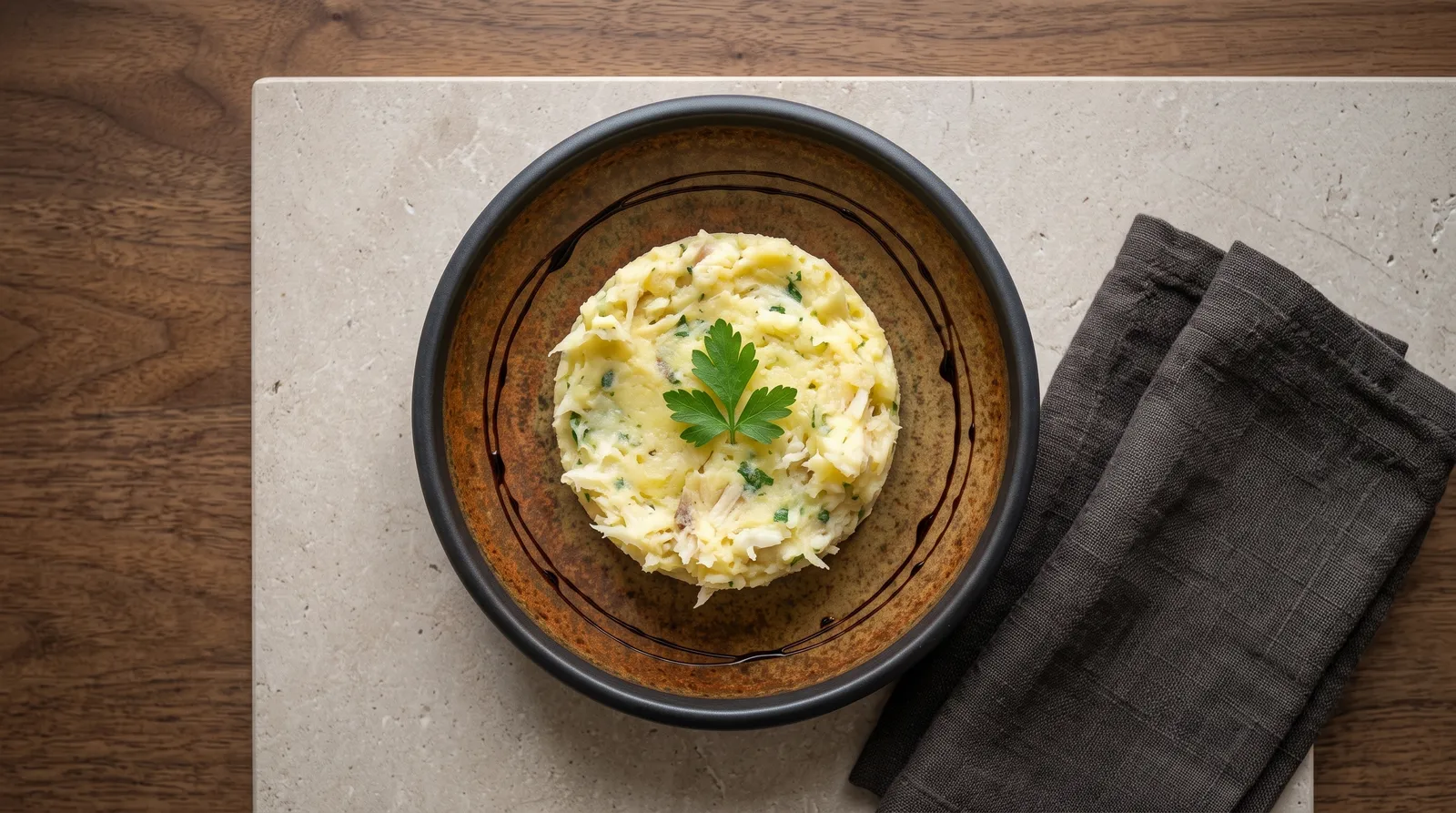
Aveyronnais estofinade combines seven-day refrigerated unsalted stockfish with potato, egg, garlic, parsley and walnut oil, finished hot enough for the pasteurized fresh egg mixture to reach 71 °C.

French National Dishes
Share
Estofinade — served on a plate
Prep 45 minutes
Cook 70 minutes
Total 10210 minutes
Yield 6 substantial portions, about 450–500 g each
Introduction and overview

Estofinade: Aveyronnais stockfish and potato with egg and walnut oil

Estofinade, also encountered as estofinado in Aveyron, belongs to the Lot-valley tradition of cooking true stockfish: unsalted fish preserved by air-drying until board-hard. That distinction matters. Salt cod is cured with salt and needs a different desalting logic, so it should not be substituted here and described as the same preparation.

The planning begins seven days before serving. The 350 g dry stockfish stays submerged in potable cold water at 4 °C or below, with one complete water change each day. At the end of the soak it should be flexible and roughly doubled in drained weight. Cooking makes it flake readily; only then are skin and every bone removed, giving an expected edible yield of about 560 g.

Potatoes and hard-cooked eggs supply body, while garlic and parsley keep the mixture savoury and fresh. A second egg component is beaten pasteurized whole egg. It goes into the hot fish-potato base before very hot walnut oil is added in a slow stream. The final safety control is the mixture itself: stir over controlled low heat until the coldest point reaches at least 71 °C and the oil is fully incorporated.
Success points

Success points

  • Use unsalted air-dried stockfish and treat the seven-day soak as refrigerated rehydration, not as salt removal from bacalhau-style fish.
  • Spread the cooked fish out and check systematically for skin and bones before combining it with the potatoes.
  • Add the hot walnut oil slowly in a deep vessel while stirring, and verify 71 °C in the finished mixture rather than judging safety from the oil's appearance.
Ingredients

Ingredients

Stockfish and potatoes

  • 350 g unsalted air-dried stockfish, normally cod, dry purchased weight — After seven days of refrigerated soaking, expect about 700 g drained rehydrated fish and roughly 560 g edible fish after skin and bones are removed.
  • 1200 g potatoes, peeled and cut into even chunks
  • 20 g garlic, finely chopped
  • 30 g flat-leaf parsley, finely chopped
  • 4 g fine salt
  • 1 g black pepper, ground

Egg and oil finish

  • 150 g hard-cooked egg, about 3 large eggs, peeled and chopped
  • 150 g pasteurized whole egg, about 3 large eggs, beaten
  • 180 ml walnut oil, about 166 g; all retained in the finished mixture
Method

Method

Seven-day rehydration

  1. Soak the stockfish for seven days. Place the dry stockfish in a non-reactive covered container, submerge it in potable cold water and keep it refrigerated for seven full days, changing the water with clean cold water once each day. Use Large non-reactive covered container and refrigerator. Work under cold conditions. Allow 168 hours soaking. Target 4 °C. After seven full days the stockfish is thoroughly rehydrated, flexible rather than board-hard, and weighs about 700 g after draining. Long cold soaking rehydrates unsalted air-dried stockfish without turning the process into salt-cod desalting. Keep the fish and soaking water at 4 °C or below for the entire seven-day soak and use potable water for every change.

  2. Change the soaking water daily. Once on each of the seven days, drain the soaking water completely and replace it with enough fresh potable cold water to keep the stockfish submerged. Use Sink, colander and clean container. Work under cold conditions. Allow 21 minutes total active time across seven daily changes. Each daily water change leaves the fish fully submerged in fresh, clear cold water. Fresh water supports clean rehydration across the long soak. Return the covered container to 4 °C or below immediately after every water change.

Cook the fish, potatoes and hard eggs

  1. Cook the rehydrated stockfish. Drain the soaked fish, place it in a large saucepan with fresh water, bring it to a gentle simmer and cook until the thickest part reaches at least 63 °C and flakes readily; drain it and spread it on a clean tray. Use Large saucepan, colander, food thermometer and tray. Work at gentle simmer. Allow 25 minutes. Target 63 °C. The fish flakes readily and its thickest part reaches at least 63 °C. Cooking after rehydration makes the fish flakeable before the skin-and-bone check. Measure the thickest part with a clean food thermometer.

  2. Cool briefly, then remove skin and bones. Leave the cooked stockfish on the clean tray for 5 minutes, then use clean hands and utensils to remove every piece of skin and every bone. Use Clean tray and clean hands or utensils. Work under cold conditions. Allow 5 minutes cooling; 10 minutes active deboning. After the brief cooling period, about 560 g edible fish remains and every visible bone and all skin have been removed. A short cooling interval makes meticulous hand deboning practical without prolonging room-temperature holding. Do not mix the fish with the potatoes until the bone check is complete.

  3. Cook the potatoes separately. Put the peeled potato chunks in a separate saucepan, cover with cold water, bring to the boil and cook until completely tender; drain thoroughly. Use Large saucepan and colander. Work at medium heat. Allow 25 minutes. A knife passes through the potato pieces without resistance and no free cooking water remains after draining. Fully tender, well-drained potatoes mash into the fish without making the final mixture watery. Use clean utensils and keep the cooked components protected from raw-food contact.

  4. Cook the eggs until fully set. Cook the eggs intended for the chopped hard-cooked component until both whites and yolks are fully set. Use Small saucepan, bowl of cold water and knife. Work at boiling water. Allow 10 minutes. Target 71 °C. The hard-cooked egg whites and yolks are fully set, with no liquid centre. The chopped hard-cooked egg is a distinct component from the pasteurized fresh egg used in the hot-oil finish. Cook this egg component fully before cooling.

  5. Cool the hard-cooked eggs. Transfer the fully cooked eggs to cold water and leave them there until cool enough to peel cleanly, then drain them. Use Bowl of cold water. Work under cold conditions. Allow 10 minutes cooling. The eggs are cool enough to peel without continued residual cooking and are fully set inside. Prompt cooling stops carryover cooking before peeling and chopping. If not assembling immediately, refrigerate the cooled eggs at 4 °C or below.

  6. Peel and chop the hard-cooked eggs. Peel the cooled hard-cooked eggs and chop them evenly for the final mixture. Use Clean knife and board. Work under cold conditions. Allow 5 minutes. The peeled hard-cooked eggs are evenly chopped and ready to distribute through the stockfish and potato. Even chopping keeps the hard-cooked egg distinct but well distributed. Use clean utensils and keep the chopped egg cold if assembly is delayed.

Assemble and finish with hot oil

  1. Combine fish, potato and aromatics. In a deep heat-safe vessel, mash the drained potatoes roughly, fold in the 560 g edible stockfish, chopped hard-cooked eggs, garlic, parsley, salt and pepper, and warm the mixture over low heat while mixing. Use Deep heat-safe vessel, sturdy wooden spoon or masher. Work at low heat. Allow 5 minutes. The stockfish is distributed through the potato in visible flakes and the mixture is hot, cohesive and free of large dry potato lumps. Combining the cooked components before the fresh egg and oil lets the final emulsion form evenly. Use a vessel deep enough to contain splatter when the hot oil is added later.

  2. Add pasteurized egg and hot walnut oil safely. Beat the pasteurized whole egg into the hot fish-potato mixture. Heat the walnut oil separately until very hot but not smoking, then pour it in slowly in a thin stream while stirring continuously over controlled low heat until all the oil is incorporated and the entire mixture reaches at least 71 °C. Use Small saucepan, deep heat-safe vessel, sturdy spoon and food thermometer. Work at low heat. Allow 5 minutes. Target 71 °C. All 180 ml walnut oil is incorporated without a free oily pool, the mixture is glossy and cohesive, and its coldest measured point reaches at least 71 °C. Slow addition limits splatter and supports an even egg-and-oil finish rather than localized curdling. Use pasteurized egg, keep the vessel deep, add hot oil slowly, and verify 71 °C throughout; do not rely on the oil's appearance alone.

Practical guidance

Practical

Serving

Serve hot immediately after the final mixture reaches 71 °C. Keep the texture rustic, with visible fish flakes and soft potato rather than processing the mixture into a perfectly smooth purée.

Storage and reheating

Refrigerate leftovers within two hours at 4 °C or below and use within 2 days. Reheat gently in a covered saucepan, stirring often, until the coldest part reaches 74 °C; aggressive dry heat can toughen the fish and separate the oil.

Make-ahead

The seven-day refrigerated soak is the essential make-ahead stage. Cook the fish and potatoes close to the final assembly, but hold back the pasteurized fresh egg and walnut oil until the last heated stage.

Substitutions

Neutral sunflower oil can replace walnut oil when necessary, but the nutty regional character changes. Salt cod is not a suitable identity-preserving substitute because its curing and soaking requirements are fundamentally different.

Troubleshooting

Troubleshooting

  • The mixture tastes watery.The potatoes or rehydrated fish were not drained thoroughly. Drain both components well before combining; the final oil should enrich the mixture rather than float on retained cooking water.
  • Oil pools around the mixture.The oil was added too quickly or the mixture was not stirred continuously. Use a deep vessel, controlled low heat and a slow thin stream while stirring until each addition is incorporated.
  • Small bones remain.The cooked stockfish was flaked without a complete manual bone check. Spread the cooked fish on a tray and inspect it systematically before any potato or egg is added.
Nutrition per serving

Nutrition per serving

  • Serving size1 of 6 portions, about 450–500 g
  • Calories646 kcal
  • Carbohydrate37 g
  • Protein47 g
  • Fat34 g
  • Fibre5 g
  • Sodium477 mg
Allergens and food safety

Allergens and food safety

Allergens: Fish (stockfish/cod), Egg

Keep stockfish submerged in potable water at 4 °C or below for the entire seven-day soak and replace the water with fresh potable cold water daily.

Cook rehydrated stockfish until its thickest part reaches at least 63 °C and flakes readily.

Use pasteurized whole egg for the fresh-egg finish and heat the entire finished mixture to at least 71 °C while stirring.

Hard-cooked eggs must have fully set whites and yolks.

Refrigerate leftovers within two hours at 4 °C or below; reheat leftovers to 74 °C.

FAQ

FAQ

Is stockfish the same as salt cod?

No. Stockfish is unsalted fish preserved by air-drying. Salt cod is salt-cured, so its desalting process and flavour balance differ.

Why use pasteurized egg if the mixture is heated?

The fresh egg is incorporated into a dense mixture while hot oil is being added. Pasteurized egg adds a safety margin, and the finished mixture is still measured to at least 71 °C.

Closing

Closing

  • Result: a hot, rustic Aveyronnais mixture of flaky stockfish, tender potato, two egg components, herbs and fully incorporated walnut oil.
  • Decisive technique: complete the full seven-day cold soak, debone the fish meticulously and finish the pasteurized egg-and-oil mixture to 71 °C.