French Recipes

Endives au jambon

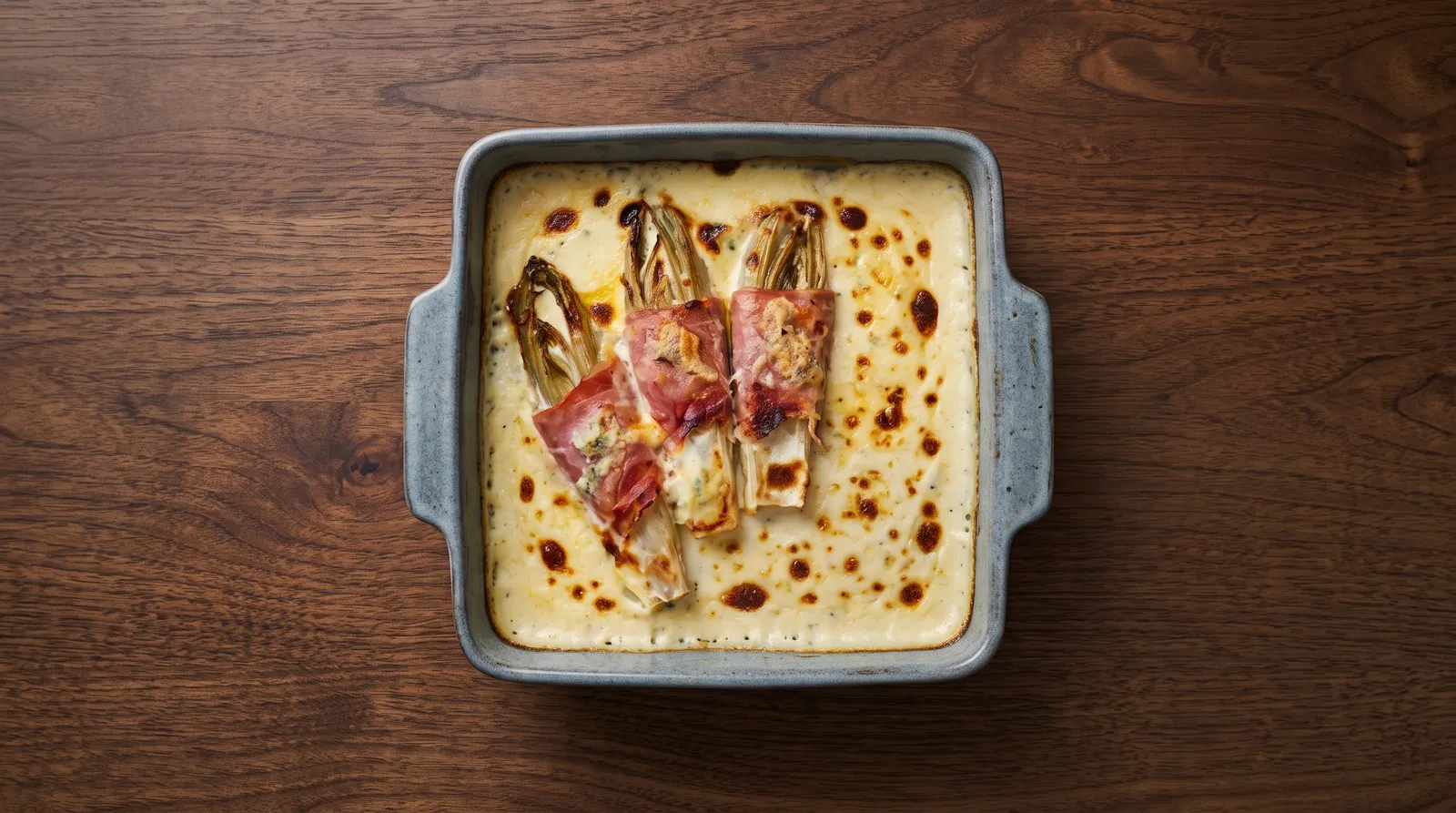
Whole endives are cooked until tender, drained and gently pressed, wrapped in cooked ham, covered with béchamel and Gruyère, then baked until browned and 74 °C at the centre.

French Recipes
Share
Endives au jambon — presented in a serving dish
Prep 25 minutes
Cook 55 minutes
Total 105 minutes
Yield 6 ham-wrapped endives
Introduction and overview

Endives au jambon: northern French ham-wrapped endive gratin

Endives au jambon, often understood in northern France through the chicon gratin tradition, is a casserole built from whole cooked endives rather than chopped leaves. Each tender head is wrapped in cooked ham and laid in one layer under béchamel and grated cheese. The contrast is gentle but specific: the slight bitterness of endive, savoury ham, milk-rich white sauce and browned cheese all remain identifiable.

Water management is the main technical issue. Endives hold a surprising amount of liquid after cooking. If they go straight from the pan into the baking dish, that liquid seeps into the béchamel and turns a coating sauce into thin soup. The 15-minute drain and gentle pressing step is therefore part of the recipe, not optional tidying. The heads should stop dripping while remaining whole enough to wrap.

The béchamel is deliberately measured: equal weights of butter and flour, then 600 ml warm milk. It is cooked until it coats a spoon before the casserole is assembled. In the oven, the cheese should brown and the sauce should bubble, but the food-safety endpoint is the centre of the assembled dish at 74 °C. A ten-minute rest then lets the sauce settle around each roll for cleaner serving.
Success points

Success points

  • Do not cut the endives into pieces; cook each head until a knife enters the base easily but the leaves still hold together.
  • Press gently rather than wringing. The goal is to remove free water without turning the endive into pulp.
  • Thicken the béchamel on the stove before assembly; the oven is for heating and browning, not rescuing a thin sauce.
Ingredients

Ingredients

Endives and wrapping

  • 1200 g whole endives, 6 large heads purchased; trimmed to about 1,050 g
  • 300 g cooked ham, 6 slices, about 50 g each

Béchamel and gratin

  • 50 g unsalted butter
  • 50 g plain wheat flour
  • 600 ml whole milk, warmed
  • 4 g fine salt
  • 1 g black pepper, ground
  • 1 g ground nutmeg
  • 120 g Gruyère, finely grated
Method

Method

Endives

  1. Cook the whole endives until tender. Trim the bases without cutting the heads apart, then steam or cook the six endives covered with minimal water until tender through the core. Use Wide covered pan or steamer. Work at medium-low heat. Allow 20 minutes. A thin knife enters the thick base of each endive with little resistance while the head still holds together. Tenderising the whole head before wrapping ensures the gratin cooks evenly. Use clean tongs and avoid excessive water, which would dilute the finished gratin.

  2. Drain and press out excess water. Set the cooked endives in a colander, cool just enough to handle, then press each gently between clean towels without crushing it. Use Colander and clean kitchen towels. Work under room temperature conditions. Allow 15 minutes draining. The endives are no longer dripping and release only a small amount of moisture when gently pressed. Removing excess water is the main control against a thin, flooded béchamel. Use clean towels and discard any cloth that has become soiled during handling.

Béchamel and assembly

  1. Cook a smooth béchamel. Melt the butter, stir in the flour for 2 minutes, then whisk in the warm milk gradually and simmer until smooth and thick; season with salt, pepper and nutmeg. Use Saucepan and whisk. Work at medium-low heat. Allow 10 minutes. The béchamel is smooth and thick enough to coat the back of a spoon without tasting floury. Cooking the roux and adding milk gradually prevents lumps and gives enough body to cling to the endives. Keep the sauce moving near the base of the pan to prevent scorching.

  2. Wrap and sauce the endives. Wrap each well-drained endive in one 50 g slice of cooked ham, arrange them seam-side down in a 30 × 20 cm baking dish, cover evenly with all the béchamel and scatter over the 120 g Gruyère. Use 30 × 20 cm baking dish. Allow 10 minutes. Six wrapped endives fit snugly in one layer, fully covered with béchamel and an even layer of grated cheese. A single layer lets the centre heat predictably and keeps the sauce around, not underneath, the rolls. Use cooked ham and a clean assembly surface.

  3. Bake the gratin through. Bake in a preheated oven until bubbling and browned, checking the centre between two rolls with a food thermometer. Use Conventional oven and food thermometer. Work at 180 °C oven. Allow 25 minutes. Target 74 °C. The sauce bubbles around the edges, the cheese is browned, and the centre of the assembled casserole reaches 74 °C. The oven reheats all assembled components while gratinating the top. The centre must reach 74 °C; surface browning alone is not the safety endpoint.

  4. Rest before serving. Leave the gratin undisturbed after baking so the béchamel thickens slightly around the endives. Use Baking dish on heatproof surface. Work under room temperature conditions. Allow 10 minutes resting. The bubbling has settled and the sauce stays around each roll when it is lifted from the dish. A short rest makes portioning cleaner without cooling the dish excessively. Keep the hot baking dish on a stable heatproof surface.

Practical guidance

Practical

Serving

Lift one wrapped endive onto each plate and spoon its share of sauce and browned cheese around it. The dish is already substantial from ham, dairy and endive. If potatoes or bread are served alongside, they are separate from the declared serving and nutrition.

Storage, reheating and make-ahead

The endives can be cooked, drained and chilled a day ahead. Assemble from cold and bake until the centre reaches 74 °C. Refrigerate leftovers at 4 °C or below within two hours for up to three days. Reheat covered at 170 °C until 74 °C in the centre, uncovering only near the end to restore some browning. The endives can be cooked and drained a day ahead; chill promptly. Assemble the gratin cold, then bake until the centre reaches 74 °C.

Substitutions

- Emmental for Gruyère: Not identity-preserving. It gives a milder gratin but keeps the same ham-endive-béchamel structure. - Maroilles: Not identity-preserving. Maroilles creates a distinct stronger northern variation and is not substituted here under the unqualified name.

Troubleshooting

Troubleshooting

  • Watery gratin.The cooked endives retained too much water before wrapping. Complete the full draining period and press them gently before adding ham and béchamel.
  • Béchamel becomes loose in the dish.The roux-and-milk sauce was not cooked to its coating consistency before assembly. Cook the béchamel to the stated nappe-like cue before pouring it over the endives.
Nutrition per serving

Nutrition per serving

  • Serving size1 ham-wrapped endive with one sixth of the béchamel and cheese
  • Calories336 kcal
  • Carbohydrate18 g
  • Protein23 g
  • Fat20 g
  • Fibre6 g
  • Sodium1088 mg
Allergens and food safety

Allergens and food safety

Allergens: Milk, Gluten (wheat)

Use cooked ham and clean equipment for assembly.

Bake the assembled casserole until the centre reaches 74 °C.

Refrigerate leftovers at 4 °C or below within 2 hours and reheat leftovers to 74 °C.

FAQ

FAQ

Why is my gratin watery?

The usual cause is endive that was not drained and pressed long enough. A loose béchamel compounds the problem.

Can I use Maroilles?

It makes a stronger northern variation, but the unqualified preparation here uses Gruyère and does not present a Maroilles gratin as identical.

Closing

Closing

  • Tender whole endives wrapped in ham beneath a spoon-coating béchamel and browned Gruyère crust.
  • Drain the cooked endives thoroughly before assembly; that single step controls the final sauce texture.