French National Dishes

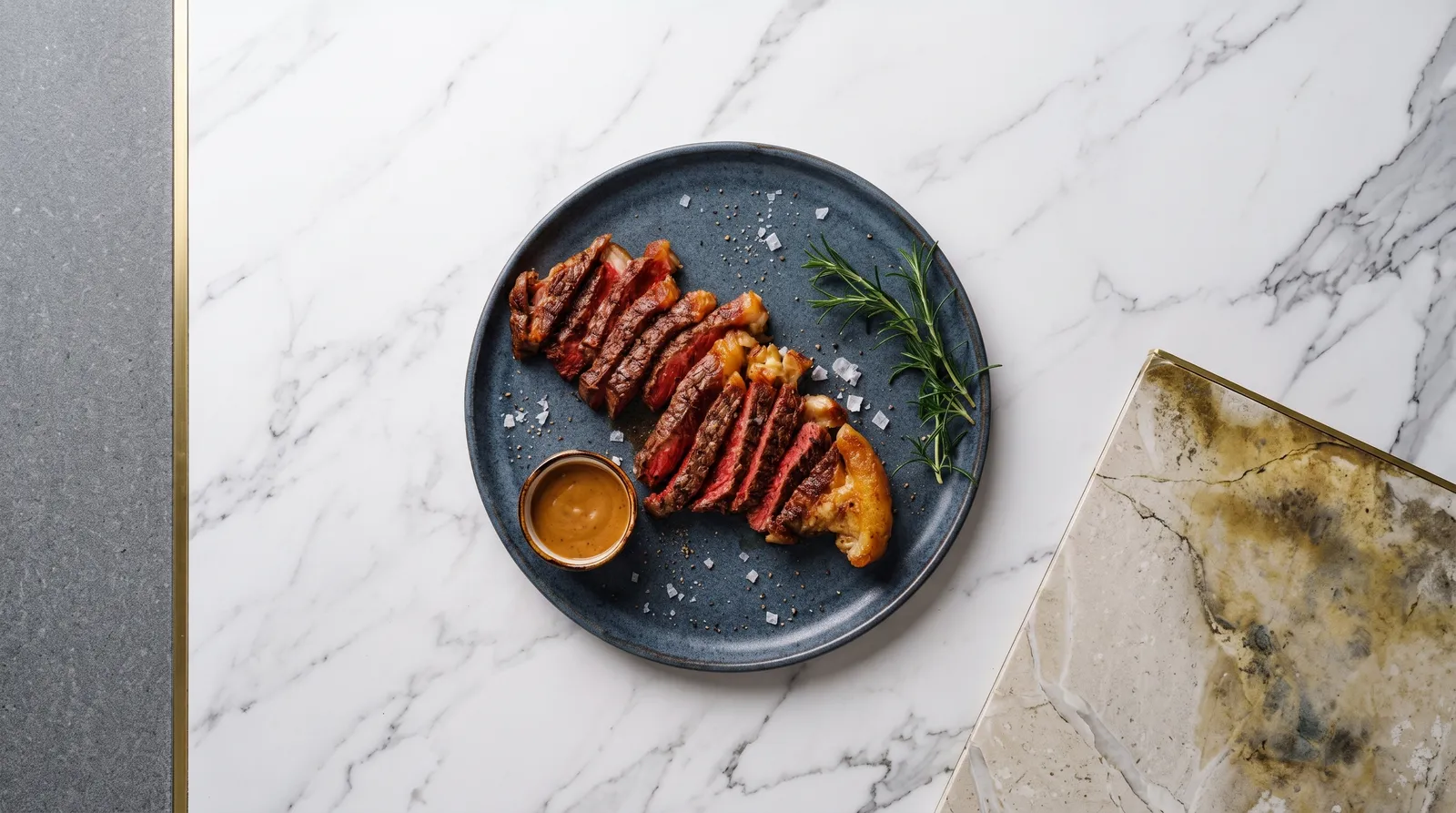
Entrecôte à la bordelaise

Thick intact-beef steaks are cooked to at least 63 °C and rested for three minutes, then served with a reduced Bordeaux red-wine and shallot sauce finished with marrow and butter.

French National Dishes
Share
Entrecôte à la bordelaise — arranged on a board
Prep 25 minutes
Cook 38 minutes
Total 66 minutes
Yield 4 steaks with about 75 ml sauce each
Introduction and overview

Entrecôte à la bordelaise: steak with Bordeaux wine, shallot and marrow sauce

Entrecôte à la bordelaise is not simply steak with brown gravy. Its regional signal comes from a concentrated red-Bordeaux-wine and shallot sauce, with beef marrow giving the finish a particularly rich, silky body. The reduction is left unstrained here so the softened shallots remain in the sauce, and the marrow is warmed gently before cold butter is swirled in off the heat.

The sauce is built before the steaks so its volume can be controlled rather than guessed at the table. Three hundred millilitres of wine is reduced by roughly two thirds, then unsalted beef stock is added and reduced again. The final target is about 300 ml after marrow and butter, enough for roughly 75 ml per serving. Wine is cooked for a meaningful period, but alcohol is not claimed to disappear completely.

Four intact 3 cm entrecôtes are used because the stated safety endpoint applies to intact beef. They are turned repeatedly for even heating and checked from the side with a thermometer at the thickest centre. Each steak must reach at least 63 °C and then rest for a full three minutes. The rest is not optional waiting hidden from the clock; it is part of both safety and serving quality.
Success points

Success points

  • Start the wine reduction early enough that the sauce does not force the cooked steaks to wait.
  • Keep the final sauce below a hard boil once the butter goes in; vigorous boiling encourages the emulsion to break.
  • Insert the thermometer from the side into the steak’s thermal centre and avoid touching the skillet.
Ingredients

Ingredients

Steaks

  • 880 g beef entrecôte steaks, 4 intact, non-mechanically-tenderized steaks, about 220 g and 3 cm thick each
  • 15 g neutral high-heat oil, 8 g estimated to remain on the cooked steaks
  • 6 g fine salt
  • 2 g black pepper, coarsely ground

Bordelaise sauce

  • 300 ml dry red Bordeaux wine, contains sulphites
  • 120 g shallots, finely minced
  • 250 ml unsalted beef stock, prepared with celery
  • 60 g beef marrow, commercially butchered marrow, diced and kept chilled
  • 40 g unsalted butter, cold, diced
  • 2 g fresh thyme leaves
  • 10 g flat-leaf parsley, finely chopped
Method

Method

Sauce

  1. Reduce the Bordeaux wine with shallot. Put the wine, shallots and thyme in a small saucepan and simmer uncovered until the volume is reduced by roughly two thirds. Use Small saucepan. Work at medium heat. Allow 15 minutes. About 100 ml of wine reduction remains, the shallots are soft and the liquid tastes concentrated rather than raw or sharply alcoholic. A strong wine reduction concentrates the Bordelais base before stock is added. Wine alcohol is reduced but not eliminated; keep the pan away from open flames.

  2. Reduce with stock. Add the 250 ml beef stock and simmer until the sauce is lightly syrupy and the combined volume is about 280 ml. Use Same saucepan. Work at medium heat. Allow 10 minutes. The sauce has reduced to about 280 ml and lightly coats the back of a spoon while remaining pourable. Reducing stock supplies body without flour and sets the target serving volume. The stock contains celery; keep that allergen declaration with the finished dish.

  3. Poach the marrow and mount the sauce. Add the chilled diced marrow and simmer gently just until hot through, then take the saucepan off the heat and swirl in the cold butter and parsley; do not strain. Use Same saucepan. Work at low heat then off heat. Allow 4 minutes. The marrow is hot and tender, the butter is emulsified, and the finished unstrained sauce is glossy at about 300 ml total volume. Gentle heat protects the marrow texture, while cold butter rounds and emulsifies the reduced sauce. Handle marrow as a perishable meat product and keep it refrigerated until it enters the hot sauce.

Steaks

  1. Season and sear the intact steaks. Pat the steaks dry, season with all 6 g salt and the pepper immediately before cooking, heat the oil in a heavy skillet and sear, turning every 2 minutes for even browning. Use Heavy skillet and tongs. Work at high heat. Allow 9 minutes. Target 63 °C. The thickest centre of every steak reaches at least 63 °C when the thermometer is inserted from the side, and the exterior is deeply browned. Frequent turning helps the 3 cm steaks heat evenly while developing a crust. The 63 °C endpoint plus rest applies to intact, non-mechanically-tenderized beef; use a clean food thermometer and do not judge safety by colour.

  2. Rest the steaks for three minutes. Transfer the steaks to a clean warm plate and leave them undisturbed before serving; expect a small amount of carryover heat while the juices redistribute. Use Warm clean plate. Work under room temperature conditions. Allow 3 minutes resting. Target 63 °C. The steaks have rested for a full 3 minutes after first reaching at least 63 °C, with only a small amount of juice collecting on the plate. The three-minute rest is part of the safety requirement for intact beef and also reduces juice loss during cutting. Do not shorten the mandatory 3-minute rest.

  3. Finish the plates immediately. Divide the hot sauce evenly over the four rested steaks, giving each about 75 ml and its share of marrow and shallots. Use Warm plates. Work at off heat. Allow 0 minutes. Each steak has an even portion of the glossy unstrained sauce, including marrow and shallot. Immediate plating keeps the mounted butter sauce emulsified. Serve promptly; alcohol may remain in the reduced sauce.

Practical guidance

Practical

Serving

Put one rested steak on each warm plate and divide the sauce so each receives about 75 ml plus an equal share of marrow and shallots. Serve immediately because a mounted butter sauce is glossiest and most stable when freshly finished. Potatoes or bread are optional and are not part of the nutrition values.

Storage, reheating and make-ahead

The wine-and-stock reduction can be made a day ahead and chilled. Reheat it before adding marrow and butter. Cool leftover steak and sauce promptly in separate shallow containers and refrigerate at 4 °C or below within two hours. Reheat sauce gently; repeated hard boiling can split it, and heavy reheating dries the steak. The wine-and-stock reduction can be prepared a day ahead and chilled; reheat gently, then add marrow and mount with butter just before the steaks are cooked.

Substitutions

- Another dry red wine: Not identity-preserving. It can make a red-wine shallot sauce, but using wine outside the Bordeaux identity weakens the specific bordelaise naming. - Omitting marrow: Not identity-preserving. The sauce remains usable but loses a documented classic component and should not be presented as unchanged.

Troubleshooting

Troubleshooting

  • Thin Bordelaise sauce.The wine and stock were not reduced far enough before the finishing butter. Continue the uncovered reduction to the declared final volume before mounting with butter; do not thicken it with flour.
  • Butter separates from the sauce.The reduction was too hot while the butter was being mounted. Take the pan off the heat and swirl in the butter gradually without boiling.
Nutrition per serving

Nutrition per serving

  • Serving size1 steak with about 75 ml bordelaise sauce
  • Calories810 kcal
  • Carbohydrate2 g
  • Protein44 g
  • Fat69 g
  • Fibre0 g
  • Sodium763 mg
Allergens and food safety

Allergens and food safety

Allergens: Milk, Celery, Sulphites

Use intact, non-mechanically-tenderized beef for the 63 °C plus 3-minute-rest rule.

Cook the thickest centre of each steak to at least 63 °C and rest it for a full 3 minutes; colour is not a safety test.

Keep beef marrow refrigerated at 4 °C or below until cooking.

The sauce contains wine and may retain alcohol after reduction; it also contains milk, celery and sulphites.

FAQ

FAQ

Does all the wine alcohol cook away?

No. The wine is reduced substantially, but alcohol can remain after cooking, so the dish should still be treated as containing alcohol.

Why specify non-mechanically-tenderized steak?

The 63 °C plus three-minute-rest rule here is tied to intact beef. Mechanical tenderization can move surface bacteria into the interior and requires different handling.

Closing

Closing

  • A deeply browned entrecôte with a glossy, concentrated Bordeaux-shallot sauce and tender pieces of marrow.
  • Reduce the sauce to its measured volume and give every intact steak the full 63 °C plus three-minute-rest sequence.