French Recipes

Douillon aux pommes

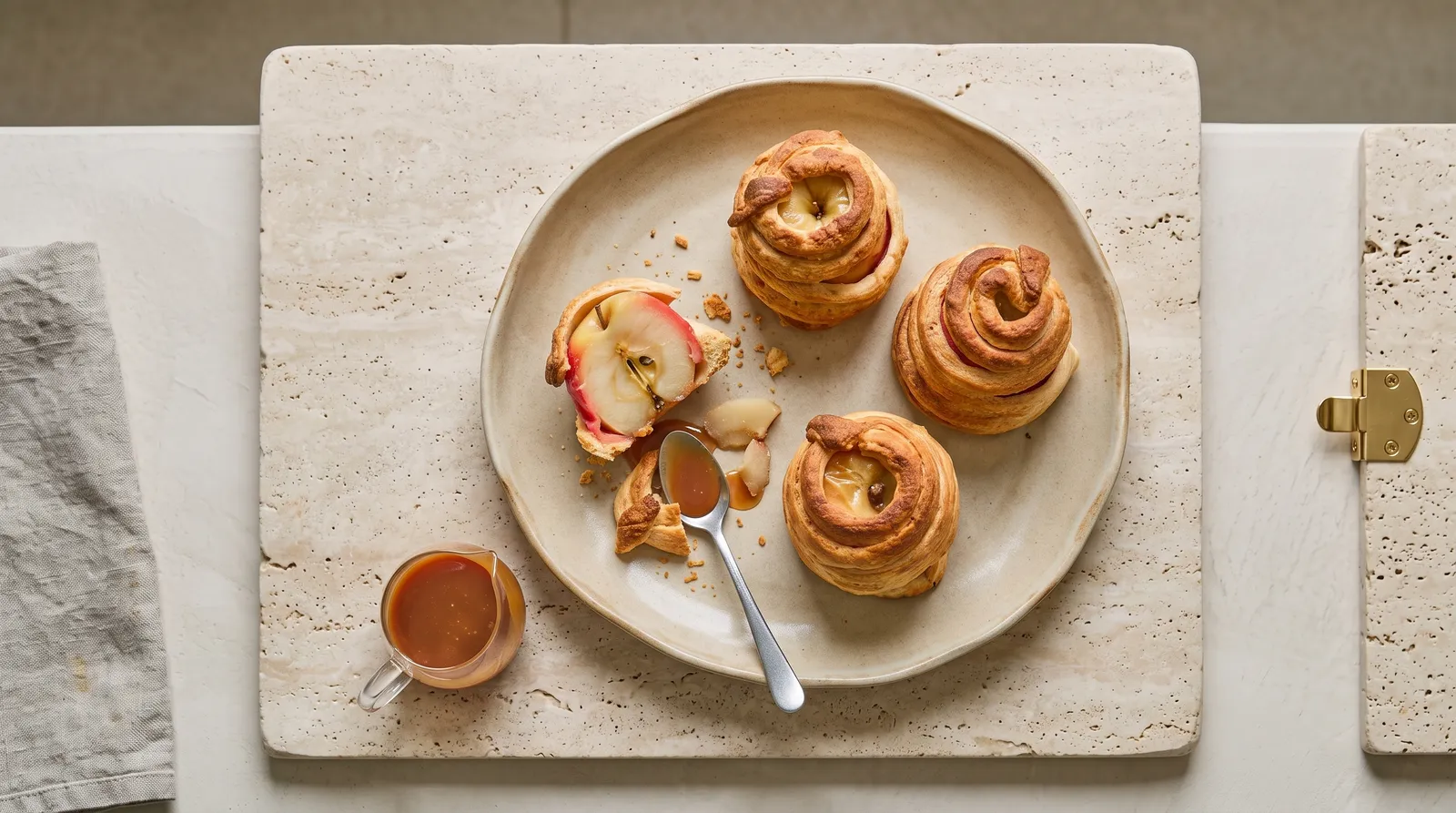
A whole peeled and cored Reinette apple is filled with apricot jam, sugar and cinnamon, enclosed in chilled all-butter puff pastry and baked until the fruit is tender and the pastry crisp.

French Recipes
Share
Douillon aux pommes — served on a plate
Prep 30 minutes
Cook 40 minutes
Total 110 minutes
Yield 4 individual douillons
Introduction and overview

Douillon aux pommes: whole Norman apple baked in puff pastry

A Norman apple douillon is built around one whole fruit. The apple is peeled and cored but kept intact, then enclosed individually in pastry so it softens inside its own small shell. That form is what separates it from a chopped-apple turnover and from tarte normande. The closely related pear bourdelot also has its own identity; replacing the apple with pear changes the pastry rather than simply varying the filling.

Reinette-type apples are useful here because they can become tender without immediately collapsing. The four apples are matched for size, filled through the core with apricot jam and seasoned with sugar and cinnamon. Puff pastry is kept cold through assembly, sealed around the fruit and vented at the top. A pasteurized egg wash gives the exterior an even gloss and colour.

The bake has two simultaneous targets: a skewer should pass through the apple with little resistance, and the pastry should be crisp and deeply golden. One cue without the other is not enough. A 20-minute rack cooling period is counted separately because steam escaping from a just-baked apple can soften the pastry if the douillon is served or stacked too quickly.
Success points

Success points

  • Choose four apples close in diameter; one oversized apple can remain firm after the pastry around the others is done.
  • Seal every pastry seam firmly and make a small vent at the top rather than leaving an open gap around the apple.
  • Move the baked pastries to a wire rack, not a plate, so condensation does not soften the base.
Ingredients

Ingredients

Apples and pastry

  • 800 g Reinette apples, 4 apples purchased; peeled and cored to about 640 g prepared edible weight — Choose similarly sized apples.
  • 320 g all-butter puff pastry, chilled; usable pastry weight
  • 60 g apricot jam
  • 24 g caster sugar
  • 2 g ground cinnamon
  • 50 g pasteurized whole egg, beaten for egg wash
Method

Method

Assembly

  1. Prepare the whole apples. Peel four apples, core each through the centre while keeping it whole, and weigh roughly 640 g prepared fruit in total. Use Peeler, apple corer and scale. Allow 10 minutes. Each apple is whole, peeled and cleanly cored without splitting through the side. An intact apple is central to the douillon form. Use a stable board and keep the cored fruit clean.

  2. Wrap each apple. Divide the chilled pastry into four 80 g squares large enough to enclose one apple; put 15 g jam into each core, combine sugar and cinnamon and divide it over the four apples, then bring the pastry up around each fruit and seal the seams firmly. Use Scale, rolling pin and lined baking tray. Allow 15 minutes. Each apple is completely enclosed in an even pastry layer with a firmly pinched top seam and no exposed fruit. Even pastry thickness and a firm seal limit leaks while allowing the fruit to steam inside. Keep the pastry cold enough to remain firm and workable.

  3. Vent, glaze and chill. Cut a small steam vent in each top, brush the pastry with the 50 g beaten egg, then refrigerate the assembled douillons before baking. Use Pastry brush and refrigerator. Work under cold conditions. Allow 20 minutes chilling. Target 4 °C. The pastry is firm and cold to the touch before it goes into the oven. Chilling firms the butter layers so the pastry lifts cleanly in the oven. Keep the egg wash and assembled pastries at 4 °C or below during the chill.

Baking

  1. Bake until fruit and pastry are ready together. Bake the four douillons in a preheated conventional oven, rotating the tray once only if the oven browns unevenly. Use Conventional oven and lined baking tray. Work at 180 °C oven. Allow 40 minutes. Target 180 °C. The pastry is crisp and deep golden, and a thin skewer passes through the apple with little resistance without collapsing the fruit. The whole apple needs enough time to soften while the pastry becomes crisp. Handle the hot jam and fruit carefully because the filling retains heat.

  2. Cool on a rack. Transfer the baked douillons to a wire rack and let them cool before serving so the pastry base sets. Use Wire cooling rack. Work under room temperature conditions. Allow 20 minutes cooling. The pastry remains crisp and the douillons are warm rather than steaming hot when served. Rack cooling prevents trapped steam from softening the base. Do not stack warm pastries.

Practical guidance

Practical

Serving

Serve one douillon per person after the rack cooling period. Warm is ideal, but room temperature also works because the fruit remains soft while the pastry keeps more of its structure. The declared nutrition covers only the apple pastry, jam, sugar and egg wash; cream, ice cream or caramel added at the table is extra.

Storage, reheating and make-ahead

The pastries can be assembled and refrigerated for up to four hours before baking. Once baked and fully cool, cover and refrigerate leftovers at 4 °C or below for up to two days. Re-crisp at 170 °C for about 10 minutes rather than microwaving, which warms the apple but softens the pastry layers. Assemble and chill the pastries up to 4 hours before baking; do not leave the egg-washed pastries at room temperature.

Substitutions

- Shortcrust pastry: Not identity-preserving. Norman references also document pâte brisée, but it produces a denser, less flaky shell than the puff pastry used here. - Pear: Not identity-preserving. Using a pear moves the pastry toward the separate bourdelot identity rather than preserving this apple douillon.

Troubleshooting

Troubleshooting

  • Dark pastry but a firm apple.The apple was too large or unusually firm for the declared bake. Use evenly sized Reinette apples at the stated prepared weight and confirm tenderness through the vent before ending the bake.
  • Soggy pastry underneath.The pastry warmed too much, the seam was weak or the pastry cooled on a solid plate. Use the full chill, seal the pastry carefully and cool the baked douillons on a wire rack.
Nutrition per serving

Nutrition per serving

  • Serving size1 douillon
  • Calories609 kcal
  • Carbohydrate74 g
  • Protein8 g
  • Fat32 g
  • Fibre5 g
  • Sodium318 mg
Allergens and food safety

Allergens and food safety

Allergens: Egg, Milk, Gluten (wheat)

Keep the egg wash and egg-washed pastries refrigerated at 4 °C or below until baking.

Refrigerate perishable leftovers at 4 °C or below within 2 hours.

FAQ

FAQ

Can I use shortcrust pastry?

Yes. Norman references document both puff and shortcrust forms, but shortcrust gives a more compact, crumbly shell instead of the flaky lift used here.

Why keep the apple whole?

The whole peeled and cored fruit is a defining structural feature of a douillon; chopping it turns the method toward a turnover-style pastry.

Closing

Closing

  • A tender whole apple enclosed in a crisp, deeply golden pastry shell with a small pocket of jam at its centre.
  • Match the apple size to the 40-minute bake and keep the puff pastry cold before it enters the oven.