French National Dishes

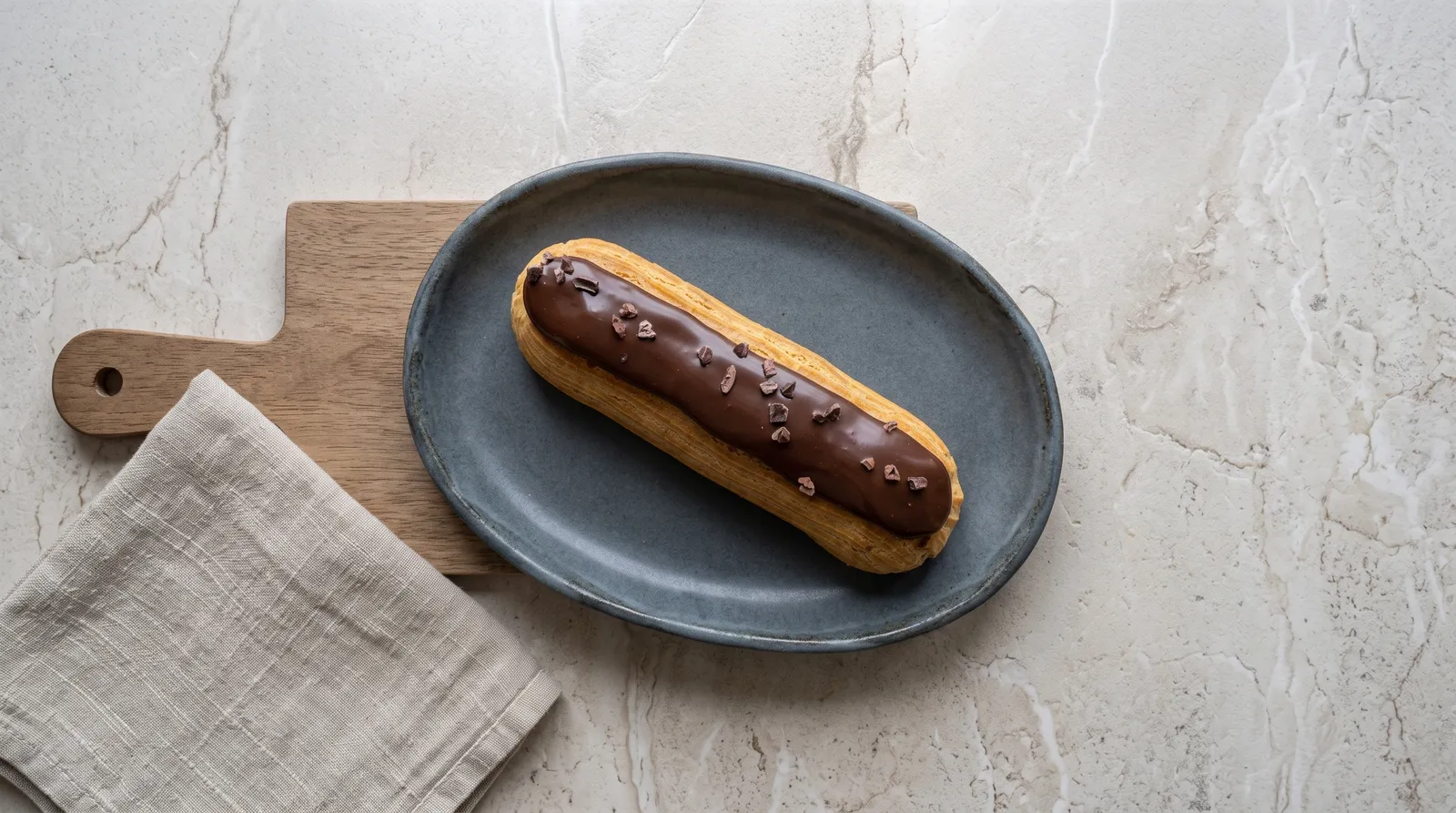
Éclair au chocolat

Elongated choux shells are baked until dry and hollow, filled only after cooling with chilled chocolate pastry cream, then finished with a smooth dark-chocolate glaze.

French National Dishes
Share
Éclair au chocolat — shown in close-up
Prep 60 minutes
Cook 50 minutes
Total 235 minutes
Yield 10 éclairs, about 12 cm long
Introduction and overview

Éclair au chocolat: choux pastry with chocolate crème pâtissière

A chocolate éclair is a sequence of three textures that have to meet at the right temperatures: a dry, light pâte à choux shell, a cold chocolate crème pâtissière that is thick enough to pipe, and a glaze fluid enough to settle into a neat strip without running off. The elongated 12 cm shape matters. A round choux puff or a bar filled only with ganache may be delicious, but it is not the same construction.

Choux paste is governed by consistency more than by a blind egg addition. The panade is cooked until it leaves a film on the saucepan, then pasteurized beaten egg is added gradually. The correct paste is glossy and falls in a slow V from the paddle. Ten ridged lengths are piped with a 15 mm star nozzle and baked until deep golden, light and hollow, then dried briefly with the oven off. Pale shells tend to collapse or turn gummy once filled.

The pastry cream receives equally strict handling. The yolk-and-starch custard is brought to full bubbling and at least 82 °C, then chocolate and butter are added off heat. Spreading it in a shallow tray shortens the cooling path before refrigeration to 4 °C or below. Cold custard is never piped into warm shells. Once filled, the éclairs stay refrigerated and are best within two days, with the shell at its crispest on the first day.
Success points

Success points

  • Stop adding egg when the choux reaches the slow V-shaped ribbon; a slack paste spreads before it can rise.
  • Bake for colour and dryness, not just volume. A properly baked éclair feels unexpectedly light for its size.
  • Spread hot pastry cream shallowly, cover the surface and chill it promptly before filling.
Ingredients

Ingredients

Pâte à choux

  • 125 ml water
  • 125 ml whole milk
  • 100 g unsalted butter, diced
  • 3 g fine salt
  • 5 g caster sugar
  • 150 g plain wheat flour, sifted
  • 250 g pasteurized whole egg, beaten; add by weight as needed for the stated consistency

Chocolate crème pâtissière

  • 500 ml whole milk
  • 100 g pasteurized egg yolk
  • 100 g caster sugar
  • 40 g cornstarch
  • 120 g dark chocolate, about 70% cocoa, finely chopped
  • 30 g unsalted butter, diced

Chocolate glaze

  • 150 g dark chocolate, about 70% cocoa, finely chopped
  • 120 ml double cream, about 35% fat
  • 20 g glucose syrup
Method

Method

Choux shells

  1. Cook the panade. Bring the water, 125 ml milk, 100 g butter, 3 g salt and 5 g sugar just to the boil; add all the flour at once and beat over the heat until a smooth ball forms and a thin film appears on the pan. Use Heavy saucepan and sturdy spatula. Work at medium heat. Allow 5 minutes. The panade forms one smooth ball, pulls cleanly from the sides and leaves a thin film on the base of the pan. Drying the panade removes enough moisture to accept the egg without becoming slack. Keep hands clear of steam and the hot saucepan.

  2. Add the egg by texture. Transfer the hot panade to a bowl and stir it for about 2 minutes to release excess steam, then add the 250 g beaten pasteurized egg in several additions over the remaining time, stopping when the paste is glossy and forms a thick V from the paddle. Use Mixer bowl with paddle or sturdy spatula. Work at off heat. Allow 8 minutes. The finished choux paste is glossy and falls in a slow, thick V from the paddle or spatula without running flat. Gradual egg addition controls the final water content of the choux paste. Use pasteurized egg and keep unused egg refrigerated at 4 °C or below.

  3. Pipe ten even shells. Fit a 15 mm star nozzle and pipe ten straight 12 cm lengths on a lined tray, spacing them well apart. Use Piping bag with 15 mm star nozzle and lined tray. Allow 7 minutes. Ten evenly thick 12 cm strips are piped with clean ridges and enough space to expand without touching. Consistent diameter gives similar baking and internal cavities. Keep the tray clean and free of raw-egg drips around its edges.

  4. Bake and dry the choux. Bake in a fully preheated oven without opening the door during the first 25 minutes; continue until the shells are deeply golden, then pierce each at one end and return them to the switched-off oven with the door ajar for the final drying period. Use Conventional oven. Work at 190 °C oven, then residual heat. Allow 35 minutes. Target 190 °C. The shells are deep golden, feel light for their size and sound hollow when tapped; the interior is dry rather than gummy. A dry shell resists collapse and keeps the filling from soaking through immediately. Use oven gloves and release steam away from the face when opening the oven.

  5. Cool the shells completely. Move the baked shells to a wire rack and leave them unfilled until completely cool. Use Wire cooling rack. Work under room temperature conditions. Allow 30 minutes cooling. The shells are fully cool, dry and firm before any custard is piped inside. Warm shells would soften the custard and create condensation. Do not fill warm shells with chilled custard.

Chocolate pastry cream

  1. Cook the pastry cream thoroughly. Whisk the pasteurized yolks, 100 g sugar and cornstarch smooth; bring the 500 ml milk to steaming, whisk it gradually into the yolk mixture, return everything to the saucepan and cook while whisking until it bubbles throughout and reaches at least 82 °C, then keep it bubbling for 1 minute. Use Saucepan, whisk and food thermometer. Work at medium heat. Allow 7 minutes. Target 82 °C. The cream bubbles across the surface, reaches at least 82 °C and is thick enough for the whisk to leave clear tracks that close slowly. A full starch cook gives a stable pipeable pastry cream and thoroughly heats the egg mixture. Avoid splashing hot custard and verify the centre of the mixture with a clean food thermometer.

  2. Finish and cool the chocolate custard. Off the heat, melt in 120 g dark chocolate and 30 g butter, then spread the custard in a shallow clean tray, cover its surface and cool it promptly before refrigerating until it reaches 4 °C or below. Use Shallow tray, spatula and refrigerator. Work under cold conditions. Allow 20 minutes cooling; 60 minutes refrigeration. Target 4 °C. The custard is smooth, uniformly chocolate-coloured and chilled to 4 °C or below with no warm centre. Shallow cooling lowers the temperature quickly and prevents a skin under the covering. Keep cooked custard at 4 °C or below after chilling and do not leave it at room temperature for more than 2 hours in total.

Glaze and filling

  1. Make a smooth glaze. Heat the cream and glucose just to steaming, pour over 150 g dark chocolate, wait 1 minute, then stir from the centre until smooth and fluid enough to coat without running off. Use Small saucepan and bowl. Work at low heat. Allow 3 minutes. The glaze is glossy and flows in a thick ribbon that settles into an even layer without separating. A gentle emulsion gives a clean top coating without overheating the chocolate. Keep water and steam out of the chocolate bowl.

  2. Fill, glaze and chill. Whisk the cold pastry cream briefly until smooth, pipe it through two or three small holes into each completely cool shell until evenly filled, spread or dip a neat strip of glaze over the top, then refrigerate the finished éclairs before serving. Use Piping bag, small plain nozzle and refrigerator. Work under cold conditions. Allow 15 minutes chilling. Target 4 °C. Each éclair feels evenly filled from end to end, the glaze sits in a clean strip on top, and the finished pastry is chilled to 4 °C or below. Even filling avoids hollow gaps while the short chill firms the glaze. Refrigerate finished éclairs promptly at 4 °C or below and keep them chilled until serving.

Practical guidance

Practical

Serving

Serve one chilled éclair per person. Five to ten minutes outside the refrigerator softens the glaze slightly without warming the custard. The pastry is at its best on the day of filling because moisture gradually migrates from the cream into the choux shell.

Storage, reheating and make-ahead

Bake empty shells a day ahead if needed, cool completely and keep airtight. They can be re-crisped briefly at 160 °C, but must return to room temperature before cold custard is added. Keep pastry cream and finished éclairs at 4 °C or below. Never reheat a filled éclair; heat destabilizes the custard and glaze. Unfilled choux shells can be baked a day ahead and kept airtight once completely cool; re-crisp briefly in a 160 °C oven and cool again before filling. The pastry cream can be prepared a day ahead and kept at 4 °C or below.

Substitutions

- Ganache as the only filling: Not identity-preserving. That changes the characteristic pastry-cream filling and is not equivalent to the chocolate éclair defined here.

Troubleshooting

Troubleshooting

  • Flat choux shells.The panade retained too much moisture, too much egg was forced in or the shells were not baked and dried long enough. Dry the panade as directed, add the measured egg gradually to the V-stage texture and complete the full bake-and-dry sequence.
  • Lumpy pastry cream.The custard heated unevenly or was not whisked continuously as it thickened. Whisk across the whole pan and bring the custard uniformly to the declared 82 °C endpoint before rapid shallow cooling.
  • Split chocolate glaze.The chocolate emulsion was overheated or contaminated with water. Heat the cream only to steaming and stir the chocolate mixture gently from the centre until smooth.
Nutrition per serving

Nutrition per serving

  • Serving size1 of 10 éclairs
  • Calories502 kcal
  • Carbohydrate43 g
  • Protein10 g
  • Fat32 g
  • Fibre3 g
  • Sodium207 mg
Allergens and food safety

Allergens and food safety

Allergens: Egg, Milk, Gluten (wheat)

Use pasteurized egg and yolk; cook the pastry cream to at least 82 °C and a full bubbling consistency.

Cool cooked custard promptly in a shallow tray and refrigerate it at 4 °C or below; do not fill warm shells.

Keep finished éclairs at 4 °C or below and refrigerate them within 2 hours of assembly.

FAQ

FAQ

Why did my éclairs collapse?

Common causes are choux that was too wet, shells that were not baked deeply enough, or opening the oven too early while the structure was still fragile.

Can ganache replace the pastry cream?

Not in this preparation. Ganache is used for the glaze, while the body of the éclair is filled with cooked chocolate crème pâtissière.

Closing

Closing

  • A dry, hollow choux shell filled from end to end with cold chocolate pastry cream and capped with a smooth glaze.
  • Dry the choux fully and keep the cooked custard at 4 °C or below before it ever touches the shell.