French Recipes

Croustade gasconne aux pommes

The Gers apple croustade made from rested dough stretched almost transparent, layered with butter and scented with measured Armagnac.

French Recipes
Share
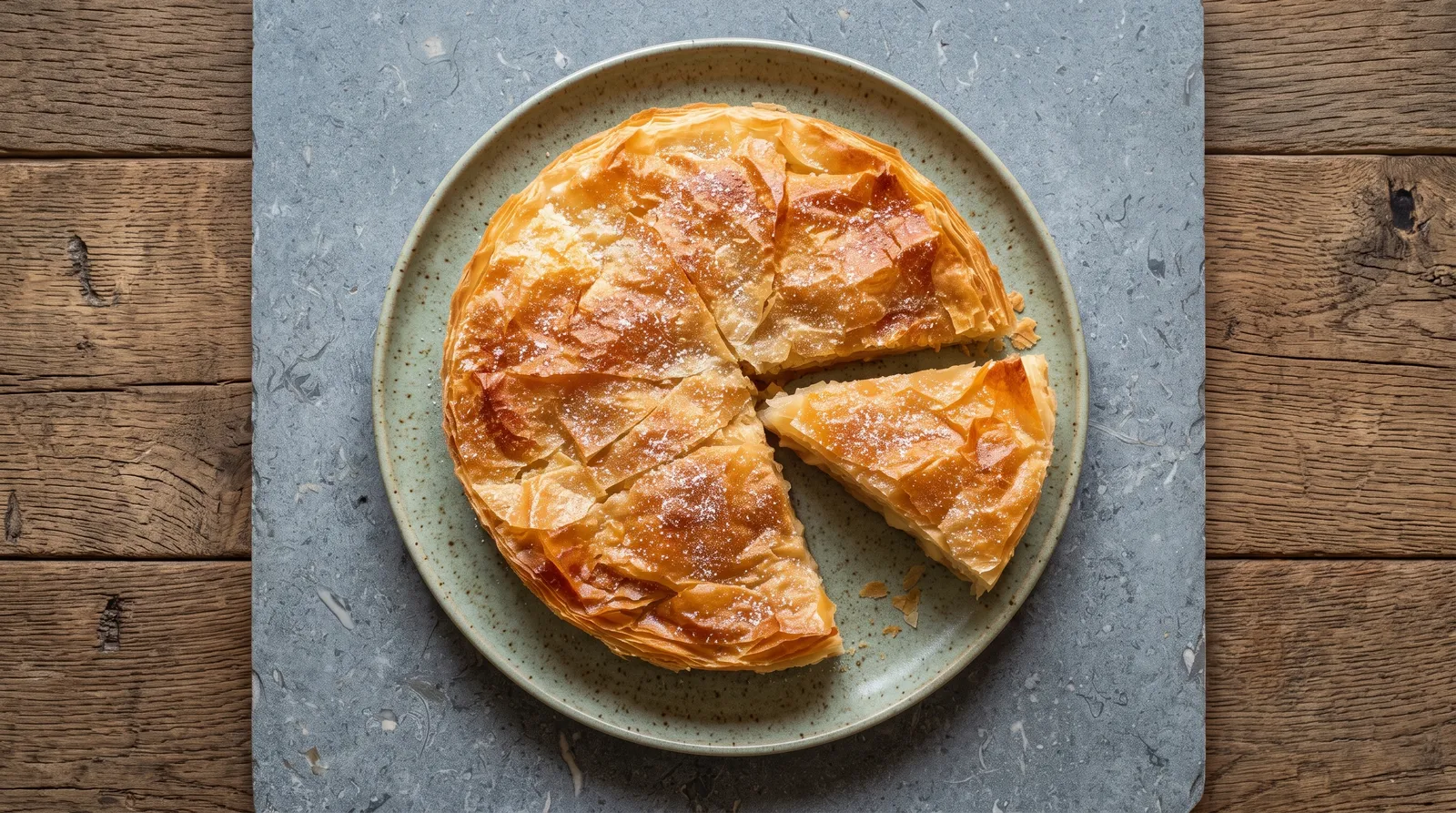
Croustade gasconne aux pommes — shown with a cut section visible
Prep 60 minutes
Cook 40 minutes
Total 210 minutes
Yield 1 round croustade, 8 portions
Introduction and overview

Croustade gasconne aux pommes: hand-stretched apple and Armagnac pastry

Croustade gasconne aux pommes, also called pastis gascon in the Gers, is defined by a dough that is stretched by hand until nearly translucent. Apples scented with vanilla and Armagnac sit between buttered sheets that bake into a fragile, crisp shell. Replacing that dough with commercial puff pastry or filo would make preparation easier, but it would erase the central Gascon technique.

The dough begins simply with flour, egg, oil, warm water and salt, yet the one-hour rest is essential. Once the gluten relaxes, the sheet can be drawn over the backs of the hands on a cloth-covered table until the pattern beneath is visible. Small tears are not a failure; nearby dough can overlap them. Forceful pulling, sharp jewellery and dry edges are the greater risks because they turn manageable pinholes into large rips.

The apples are weighed after peeling and coring, sliced thinly and macerated with sugar, vanilla and a measured 45 ml Armagnac. All 80 g butter belongs in the pastry layers. After a 40-minute bake at 180 °C, the top should be deeply golden and crisp while the fruit is tender. Some alcohol can remain after baking, so the finished dessert should never be described as alcohol-free.
Success points

Success points

  • Macerate the apples. Apple slices are evenly coated and a small amount of aromatic juice collects in the bowl.
  • Stretch the dough. Most of the sheet is thin enough that the cloth pattern is visible through it; only small repair patches remain.
  • Bake until crisp. Top layers are crisp and golden throughout; a thin knife meets tender apple with no raw dough.
Ingredients

Ingredients

Dough

  • 250 g plain wheat flour
  • 1 l arge egg about 50 g without shell
  • 45 ml neutral oil
  • 100 ml warm water
  • 2 g fine salt
  • 20 g plain wheat flour, for dusting the stretching cloth — Not included in nutrition because most remains unused and is brushed away.

Apple filling and layers

  • 900 g firm-tart apples, purchased whole; about 700 g peeled and cored edible weight — Slice 2–3 mm thick.
  • 80 g granulated sugar
  • 45 ml Armagnac, measured — Alcohol may remain after baking.
  • 1 vanilla bean seeds scraped, Use seeds with apples.
  • 80 g unsalted butter, melted — All 80 g is brushed into the pastry layers; pan drips are negligible.
Method

Method

Directions

  1. Knead the dough. Mix the 250 g flour, egg, 45 ml oil, 100 ml warm water and 2 g salt, then knead until smooth, supple and elastic. Allow 12 minutes. Dough is smooth, elastic and no longer rough at the surface. Raw egg and flour remain uncooked at this stage.

  2. Rest the dough. Cover the dough and let it rest. Allow 60 minutes. Dough relaxes and stretches without springing back sharply. Keep the dough covered so the surface does not dry.

  3. Prepare the apples. Peel and core the apples to obtain exactly 700 g edible fruit, slice 2–3 mm thick, and combine with the 80 g sugar, vanilla seeds and 45 ml Armagnac. Allow 12 minutes. Apple slices are uniformly thin and all 700 g of edible fruit is evenly coated. Armagnac is alcoholic; keep away from flame.

  4. Macerate the apples. Let the dressed apple slices rest for maceration. Allow 30 minutes. Apple slices are evenly coated and a small amount of aromatic juice collects in the bowl. Armagnac is alcoholic; note that alcohol may remain after baking.

  5. Stretch the dough. Spread a clean cloth over a table about 120 × 90 cm, dust lightly with the 20 g flour, roll the dough first, then stretch gently over the backs of clean hands from the centre outward until almost translucent; trim only thick edges and patch small tears by overlapping nearby dough. Allow 20 minutes. Most of the sheet is thin enough that the cloth pattern is visible through it; only small repair patches remain. Remove rings and sharp jewellery; do not pull against fingernails or sharp edges.

  6. Layer the croustade. Brush the thin dough with the 80 g melted butter, layer portions into a buttered 24 cm round pan, distribute the macerated apples with their measured juices, and cover with remaining folded sheets. Allow 15 minutes. Apples are enclosed between many thin buttered layers and the top is ruffled rather than compressed. Use all measured butter; do not add unmeasured drizzles.

  7. Bake until crisp. Bake until the top is deeply golden and crisp and the apple slices are tender. Allow 40 minutes. Temperature: 180 °C. Top layers are crisp and golden throughout; a thin knife meets tender apple with no raw dough. Alcohol may remain after the 40-minute bake; do not claim complete evaporation.

  8. Set before slicing. Cool before slicing so the layered pastry can set. Allow 20 minutes. Pastry remains crisp and slices hold together without collapsing. Avoid trapping steam under a cover while still warm.

Serving, storage and make-ahead

Practical

Serving, storage and make-ahead

Serve warm or at room temperature in eight slices; give the layers a 20-minute cooling period before cutting.

Serving, storage and make-ahead

The rested dough can be chilled for a few hours if necessary, then allowed to become pliable enough to stretch without cracking.

Serving, storage and make-ahead

Refrigerate leftovers at 4 °C or below for up to 2 days. Re-crisp at 170 °C for about 8 minutes.

Serving, storage and make-ahead

Filo or puff pastry are convenient but remove the defining hand-stretched technique; they should be presented as different adaptations rather than the same croustade gasconne.

Nutrition per serving

Nutrition per serving

  • Serving size1 slice (1 of 8)
  • Calories335 kcal
  • Carbohydrate46.0 g
  • Protein4.4 g
  • Fat14.8 g
  • Fibre2.9 g
  • Sodium110 mg
Allergens and food safety

Allergens and food safety

Allergens: Egg, Milk, Wheat/gluten, Sulphites may be present in Armagnac depending on product labelling.

Fully bake the raw flour and egg dough.

Armagnac may retain alcohol after the 40-minute bake.

Refrigerate perishable leftovers at 4 °C or below.

Closing

Closing

  • Result: A deeply golden, fragile pastry shell around tender Armagnac-scented apples.
  • Decisive technique: Rest the dough fully and stretch it nearly translucent rather than replacing it with commercial pastry.