French National Dishes

Daube provençale

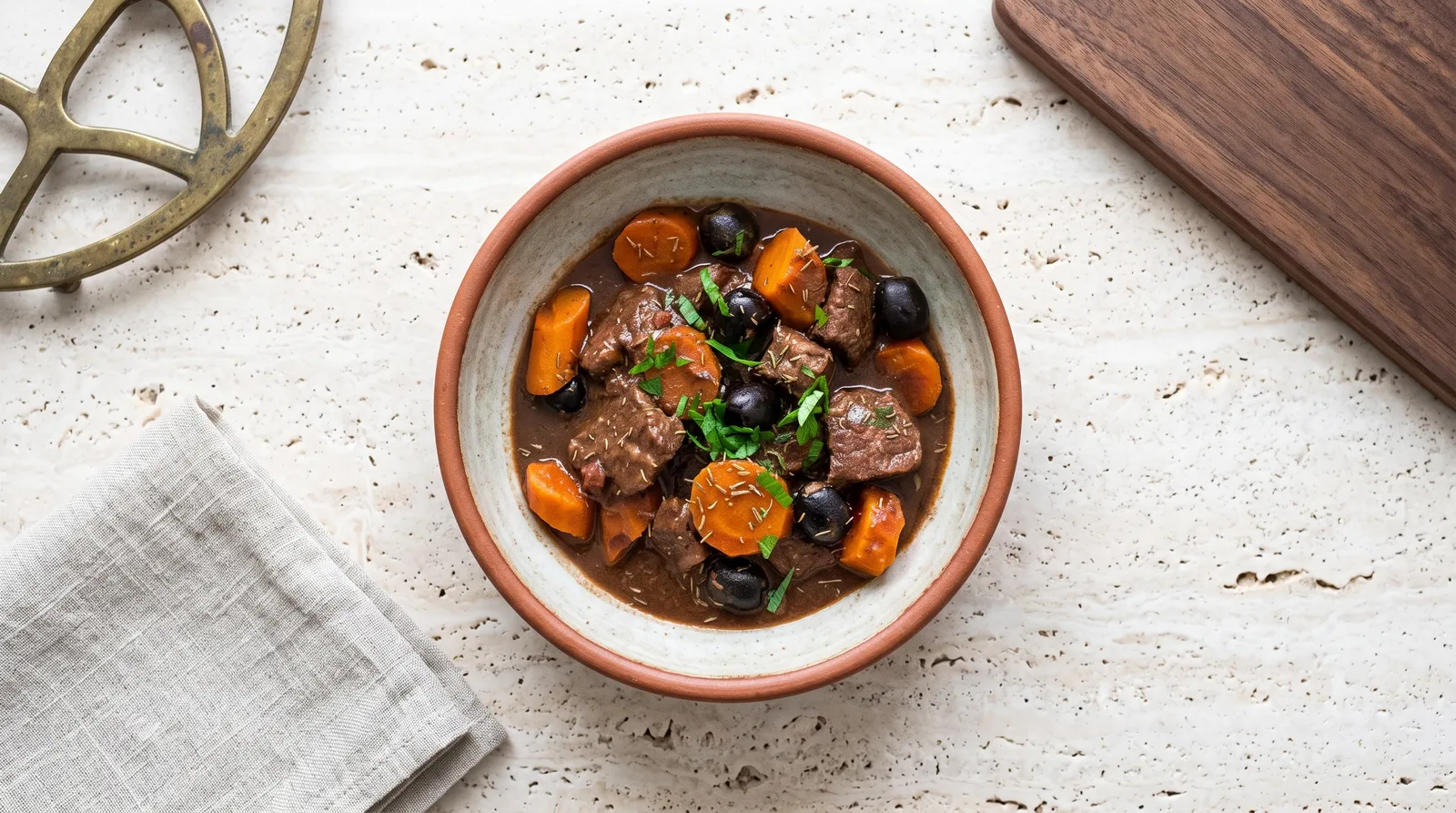
Beef chuck marinated twelve hours in red wine and Provençal aromatics, then browned and gently braised until fork-tender.

French National Dishes
Share
Daube provençale — served on a plate
Prep 20 minutes
Cook 197 minutes
Total 937 minutes
Yield 6 main-course portions
Introduction and overview

Daube provençale: red-wine-marinated beef braise

Daube provençale is a slow Provençal beef braise in which the wine marinade is part of the cooking structure rather than a last-minute flavouring. Large 5 cm pieces of beef chuck spend twelve hours at 4 °C or below with red wine, carrot, onion, garlic, thyme, bay and orange peel. The long cold contact seasons both meat and liquid before the braise begins.

The raw-beef marinade must be handled deliberately. Drain and dry the meat so it can brown, but keep the liquid and vegetables. Once browning is complete, bring that used marinade to a full boil for five minutes before it returns to the cocotte. That step treats liquid that touched raw beef and lets the browned fond join the sauce rather than discarding the regional wine-and-aromatic base.

The covered cocotte then spends most of its time at 150 °C, where collagen softens gradually. Black olives enter only for the final twenty minutes, and the lid can be opened or shifted then so the sauce tightens around the meat. The endpoint is fork-tender beef in a glossy, lightly reduced sauce, not a thin soup. After about three hours of wine cooking only a small fraction of the original alcohol is expected to remain, but it is not treated as zero.
Success points

Success points

  • Marinate the beef. Beef pieces are submerged or mostly covered and the container remains cold throughout.
  • Boil the used marinade. Marinade is at a full boil for the entire final minute and no raw-meat juices remain unheated.
  • Braise gently. Beef is becoming tender, sauce is gently simmering, and the pot has not dried out.
Ingredients

Ingredients

Beef and marinade

  • 1200 g beef chuck, trimmed purchased edible weight; cut into 5 cm pieces — Raw weight used for nutrition; after braising expect roughly 840–900 g cooked meat plus sauce.
  • 750 ml dry Provençal or Rhône-style red wine — Main marinade and braising liquid; sulphites present on typical labels and alcohol may remain.
  • 250 g carrots, peeled and sliced
  • 200 g yellow onion, sliced
  • 15 g garlic, crushed
  • 5 g fresh thyme
  • 2 g bay leaves, about 2 leaves
  • 8 g orange peel, thin strips with minimal white pith
  • 5 g fine salt

For braising

  • 30 g olive oil — For browning; nutrition assumes all 30 g remains in the finished sauce/meat system.
  • 30 g tomato paste
  • 120 g pitted black olives, drained — Added for the final 20 minutes.
Method

Method

Directions

  1. Marinate the beef. Combine the raw beef, wine, carrots, onion, garlic, thyme, bay, orange peel and salt in a non-reactive covered container and refrigerate. Allow 720 minutes. Temperature: 4 °C. Beef pieces are submerged or mostly covered and the container remains cold throughout. Marinate only at 4 °C or below and keep raw beef separate from ready-to-eat foods.

  2. Drain and dry the beef. Lift the beef from the marinade, drain well and pat dry; strain and reserve all marinade liquid and vegetables separately. Allow 10 minutes. Beef surfaces are visibly dry enough to brown rather than steam. Treat marinade, vegetables and utensils as contaminated by raw beef until fully cooked.

  3. Brown the beef. Heat the olive oil in a heavy 5-litre cocotte and brown the beef in portions without crowding. Use medium-high heat. Allow 12 minutes. Beef has a well-browned surface on several sides while remaining undercooked inside. Do not taste partially cooked beef.

  4. Boil the used marinade. Bring the reserved marinade liquid and vegetables to a full boil for 5 minutes, scraping any browned residue into the liquid. Use high heat. Allow 5 minutes. Temperature: 100 °C. Marinade is at a full boil for the entire final minute and no raw-meat juices remain unheated. Never use raw marinade as a finishing sauce without this full boil.

  5. Set up the braise. Return beef to the cocotte, add the boiled marinade and 30 g tomato paste, and arrange so liquid reaches roughly two-thirds up the meat. Allow 5 minutes. Meat is in a single deep layer and mostly surrounded, not completely drowned, by braising liquid. Use only the fully boiled marinade.

  6. Braise gently. Cover and braise in the oven, checking once that the liquid stays at a gentle simmer and adding no extra water unless necessary to prevent scorching. Allow 160 minutes. Temperature: 150 °C. Beef is becoming tender, sauce is gently simmering, and the pot has not dried out. Use oven gloves and avoid steam when opening the lid.

  7. Add the olives and finish. Add the 120 g drained olives and continue braising uncovered or partly covered until the beef is fork-tender and the sauce lightly coats the meat. Allow 20 minutes. Temperature: 150 °C. A fork enters the beef easily, pieces hold shape but yield readily, and sauce is glossy and lightly thickened. Wine alcohol is greatly reduced but not assumed to be zero.

Serving, storage and make-ahead

Practical

Serving, storage and make-ahead

Serve one sixth of the beef with a proportional share of sauce, vegetables and olives.

Serving, storage and make-ahead

Daube is well suited to making a day ahead. Cool promptly, refrigerate at 4 °C or below, then reheat gently to at least 74 °C throughout.

Serving, storage and make-ahead

Keep refrigerated for up to 3 days. If a firm fat layer forms after chilling, it may be lifted away before reheating without changing the underlying sauce.

Serving, storage and make-ahead

A non-alcoholic red wine can provide acidity and fruit but not the same aroma. Omitting olives gives another family variation; do not compensate by casually adding petit salé without recalculating salt and nutrition.

Nutrition per serving

Nutrition per serving

  • Serving size1 of 6 portions
  • Calories540 kcal
  • Carbohydrate10.2 g
  • Protein41.3 g
  • Fat37.3 g
  • Fibre2.3 g
  • Sodium630 mg
Allergens and food safety

Allergens and food safety

Allergens: Sulphites from red wine.

Marinate raw beef only at 4 °C or below and prevent cross-contamination.

Used raw-beef marinade must receive a full 5-minute boil before reuse.

Cool leftovers promptly at 4 °C or below and reheat to at least 74 °C.

Red wine may retain alcohol after cooking.

Closing

Closing

  • Result: Fork-tender beef in a glossy Provençal red-wine sauce with orange peel and olives.
  • Decisive technique: Boil the used marinade before reuse and keep the 150 °C braise gentle until fork-tender.