French Recipes

Croquembouche

A 36-choux household croquembouche with vanilla pastry cream, strict 4 °C cold holding and tool-only caramel assembly.

French Recipes
Share
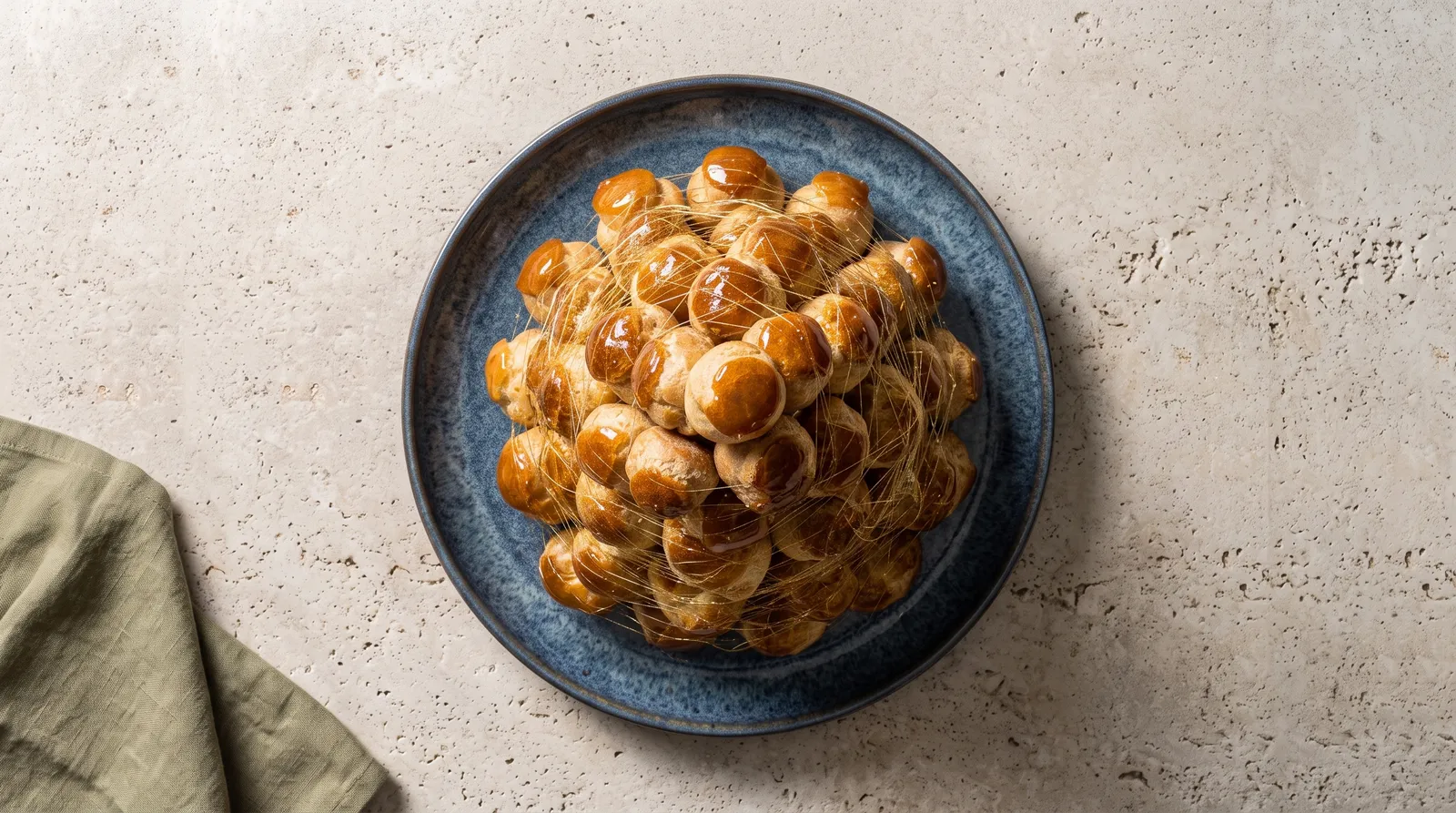
Croquembouche — displayed on a cake stand
Prep 70 minutes
Cook 72 minutes
Total 282 minutes
Yield 1 cone of 36 filled choux
Introduction and overview

Croquembouche: choux, vanilla pastry cream and caramel cone

Croquembouche is a French celebration piece made by stacking filled choux puffs into a cone and bonding them with caramel. A household-scale version still demands the same three technical foundations as a larger ceremonial piece: hollow dry choux, properly cooked and rapidly chilled pastry cream, and caramel strong enough to glue the structure without requiring bare-hand contact with molten sugar.

The cream is the food-safety clock for the whole dessert. It is cooked to at least 82 °C, spread in a shallow tray, cooled rapidly and held at 4 °C or below before it touches the choux. Each of the thirty-six shells receives exactly 18 g filling. Once filled, they return to refrigeration until the brief assembly period, and the completed cone is served the same day rather than left at room temperature as a decorative display.

Caramel deserves its own safety procedure. Sugar cooked to about 170 °C sticks to skin and can cause severe burns. Keep cool water immediately available, work with long-handled tongs and a spoon, and dip only the base edge of each chou. Do not spin sugar by hand and do not test caramel with fingers. A broad 20 cm base and tight rings allow the thirty-six puffs to rise into a stable cone about 28 cm high without elaborate sugar decoration.
Success points

Success points

  • Bake and dry the choux. Choux are deeply golden, light, crisp-shelled and hollow rather than wet inside.
  • Cook the caramel. Caramel is clear amber with no sugar crystals and flows in a thin thread from a tool.
  • Build the cone. The 36 choux form a stable tapered cone with firm caramel joins and no large gaps.
Ingredients

Ingredients

Pâte à choux

  • 150 ml water
  • 150 ml whole milk
  • 120 g unsalted butter, cut into cubes
  • 180 g plain wheat flour, sifted
  • 5 l arge eggs whole; about 250 g without shell, Add gradually; exact use may depend on panade dryness, but all 250 g is incorporated gradually.
  • 10 g granulated sugar
  • 3 g fine salt

Vanilla pastry cream

  • 600 ml whole milk
  • 6 l arge egg yolks about 108 g
  • 120 g granulated sugar
  • 45 g cornstarch
  • 1 vanilla bean split and scraped, Use pod and seeds during milk infusion, then discard pod.
  • 30 g unsalted butter — Produces about 800 g pastry cream; pipe exactly 18 g into each of 36 choux = 648 g used.

Caramel

  • 300 g granulated sugar — Nutrition assumes about 250 g sugar-equivalent caramel is incorporated; hardened pan residue is excluded.
  • 90 ml water — Most evaporates during caramelisation and contributes no calories.
Method

Method

Directions

  1. Cook the pastry cream. Heat the 600 ml milk with the vanilla pod and seeds; whisk the yolks, 120 g sugar and 45 g cornstarch separately, temper with the hot milk, return to the saucepan and cook while whisking until thick, bubbling and at least 82 °C; continue for 1 minute, then whisk in 30 g butter. Use medium heat. Allow 15 minutes. Temperature: 82 °C. Cream is glossy, thick enough to hold whisk tracks and bubbles steadily for the final minute. Avoid splashes of hot cream and use a clean thermometer.

  2. Chill the pastry cream. Spread the pastry cream no deeper than 2 cm in a clean shallow tray, cover the surface, and cool rapidly before refrigerating until fully cold. Allow 90 minutes. Temperature: 4 °C. Cream is cold throughout and measures 4 °C or below before filling. Keep the cooled cream at 4 °C or below.

  3. Cook the panade. Bring the 150 ml water, 150 ml milk, 120 g butter, 10 g sugar and 3 g salt to a full boil; add the 180 g flour at once and stir over heat until a smooth panade forms and a light film appears on the pan. Use medium heat. Allow 10 minutes. Temperature: 100 °C. Panade pulls into a smooth ball and leaves a thin film on the saucepan. The mixture is very hot; keep hands clear of steam.

  4. Let the panade lose excess heat. Spread the hot panade in the mixing bowl and cool it undisturbed briefly before adding the eggs. Allow 5 minutes. Panade is warm but no longer gives off visible steam. Keep the bowl on a stable heatproof surface.

  5. Add the eggs and pipe. Beat in all five eggs gradually until the dough is glossy and falls from the spatula in a thick V; pipe 36 mounds about 3 cm wide, spacing them apart. Allow 20 minutes. Dough is glossy, holds a soft peak and forms 36 even mounds. Keep raw egg dough away from the chilled pastry cream.

  6. Bake and dry the choux. Bake at 200 °C for 15 minutes without opening the oven, reduce to 170 °C for 15 minutes, then dry for 5 minutes with the oven switched off and door slightly ajar. Allow 35 minutes. Temperature: 200 °C then 170 °C. Choux are deeply golden, light, crisp-shelled and hollow rather than wet inside. Fully bake the raw flour and egg dough.

  7. Cool the choux. Cool the baked choux completely on a rack. Allow 30 minutes. Shells are completely cool and remain dry and crisp. Do not fill warm choux.

  8. Fill the choux. Pipe exactly 18 g cold pastry cream into each of the 36 choux through a small hole in the base; return each filled chou immediately to the 4 °C holding tray as you work. Allow 20 minutes. Temperature: 4 °C. Each chou feels filled but not split, and all 36 receive the same 18 g cream. Return filled choux to 4 °C or below promptly.

  9. Cook the caramel. Combine the 300 g sugar and 90 ml water in a clean saucepan and cook without stirring once boiling until a clear amber caramel reaches about 170 °C. Use medium-high heat. Allow 12 minutes. Temperature: 170 °C. Caramel is clear amber with no sugar crystals and flows in a thin thread from a tool. Molten sugar causes severe burns: keep a bowl of cool water nearby, use long-handled tools, keep children away, and never touch or spin hot caramel with bare fingers.

  10. Build the cone. Set a 20 cm round base guide on the serving plate and build a cone about 28 cm high by dipping only the base edge of each chilled filled chou into caramel with tongs, then placing it immediately; continue in tight concentric rings. Allow 25 minutes. The 36 choux form a stable tapered cone with firm caramel joins and no large gaps. Use tools rather than fingers near caramel; if caramel contacts skin, cool the burn under cool running water and seek care for significant burns.

  11. Chill briefly before service. Refrigerate the assembled croquembouche briefly until service and serve the same day. Allow 15 minutes. Temperature: 4 °C. Pastry cream remains cold and the cone is stable at service. Do not leave the cream-filled croquembouche at room temperature for ceremonial display.

Serving, storage and make-ahead

Practical

Serving, storage and make-ahead

Plan three choux per person and serve the completed cone the same day.

Serving, storage and make-ahead

Unfilled choux may be baked a day ahead; recrisp briefly, cool completely, then fill. Pastry cream may be made a day ahead if continuously held at 4 °C or below.

Serving, storage and make-ahead

Fill and assemble close to service. The completed dessert is not for reheating and should not stand at room temperature as a ceremonial centrepiece.

Serving, storage and make-ahead

Refrigeration protects the pastry cream but can soften caramel over time, which is why same-day, near-service assembly is the practical compromise.

Nutrition per serving

Nutrition per serving

  • Serving size3 filled choux (1 of 12 servings)
  • Calories355 kcal
  • Carbohydrate46.9 g
  • Protein7.1 g
  • Fat15.6 g
  • Fibre0.4 g
  • Sodium155 mg
Allergens and food safety

Allergens and food safety

Allergens: Egg, Milk, Wheat/gluten.

Pastry cream must reach at least 82 °C, be spread shallow, cooled rapidly and held at 4 °C or below.

Filled choux and the assembled piece must remain at 4 °C or below except for brief assembly and service.

Molten caramel at about 170 °C can cause severe burns; use tools, keep cool water immediately available, and never handle or spin hot sugar with bare fingers.

Closing

Closing

  • Result: A stable 36-choux cone with crisp shells, cold vanilla cream and firm caramel joins.
  • Decisive technique: Keep pastry cream at 4 °C or below and handle 170 °C caramel only with tools.