French Recipes

Croque-madame

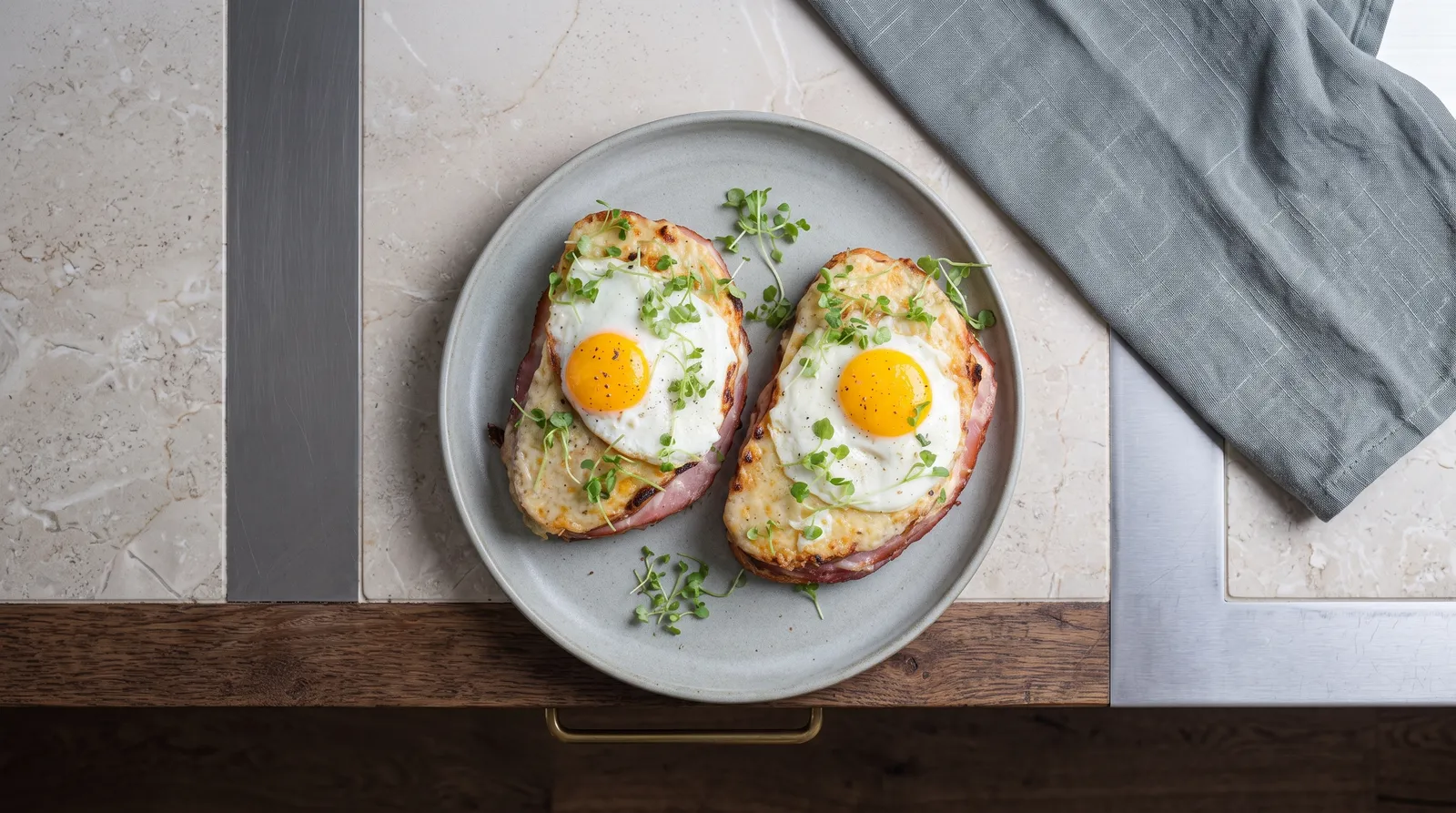
A béchamel-gratinated ham-and-Gruyère croque topped with one pasteurized soft-yolk fried egg per sandwich.

French Recipes
Share
Croque-madame — served on a plate
Prep 15 minutes
Cook 30 minutes
Total 45 minutes
Yield 4 sandwiches
Introduction and overview

Croque-madame: ham, Gruyère, béchamel and fried egg

A croque-madame starts from the same hot ham-and-cheese sandwich family as a croque-monsieur, but the visible egg on top is not a garnish that can be omitted without changing the dish. This bistro build uses pain de mie, cooked ham, Gruyère, Dijon mustard and béchamel, then finishes each sandwich with one fried egg. The egg makes the plate richer and creates the clear identity boundary from the simpler croque-monsieur that follows in this pair of recipes.

Béchamel is used in a controlled amount rather than as a blanket of loose sauce. Cook the butter and flour gently, whisk in cold milk and stop when the sauce clings to a spoon. Exactly 60 g goes on each sandwich, enough to carry the cheese into a gratinated top while leaving the bottom bread crisp. The oven should deliver bubbling sauce, melted cheese and browned edges in the same short window.

The egg needs an explicit safety choice. Here the yolk is deliberately left soft, so the recipe requires pasteurized shell eggs. Fry until the whites are fully opaque and set, then place one egg on each croque and serve immediately. Ordinary unpasteurized eggs should instead be cooked until both white and yolk are firm; a vague choice between runny and fully cooked eggs would not be safe enough for an executable recipe.
Success points

Success points

  • Cook the béchamel. Béchamel is smooth, hot and thick enough to cling to the bread without running off.
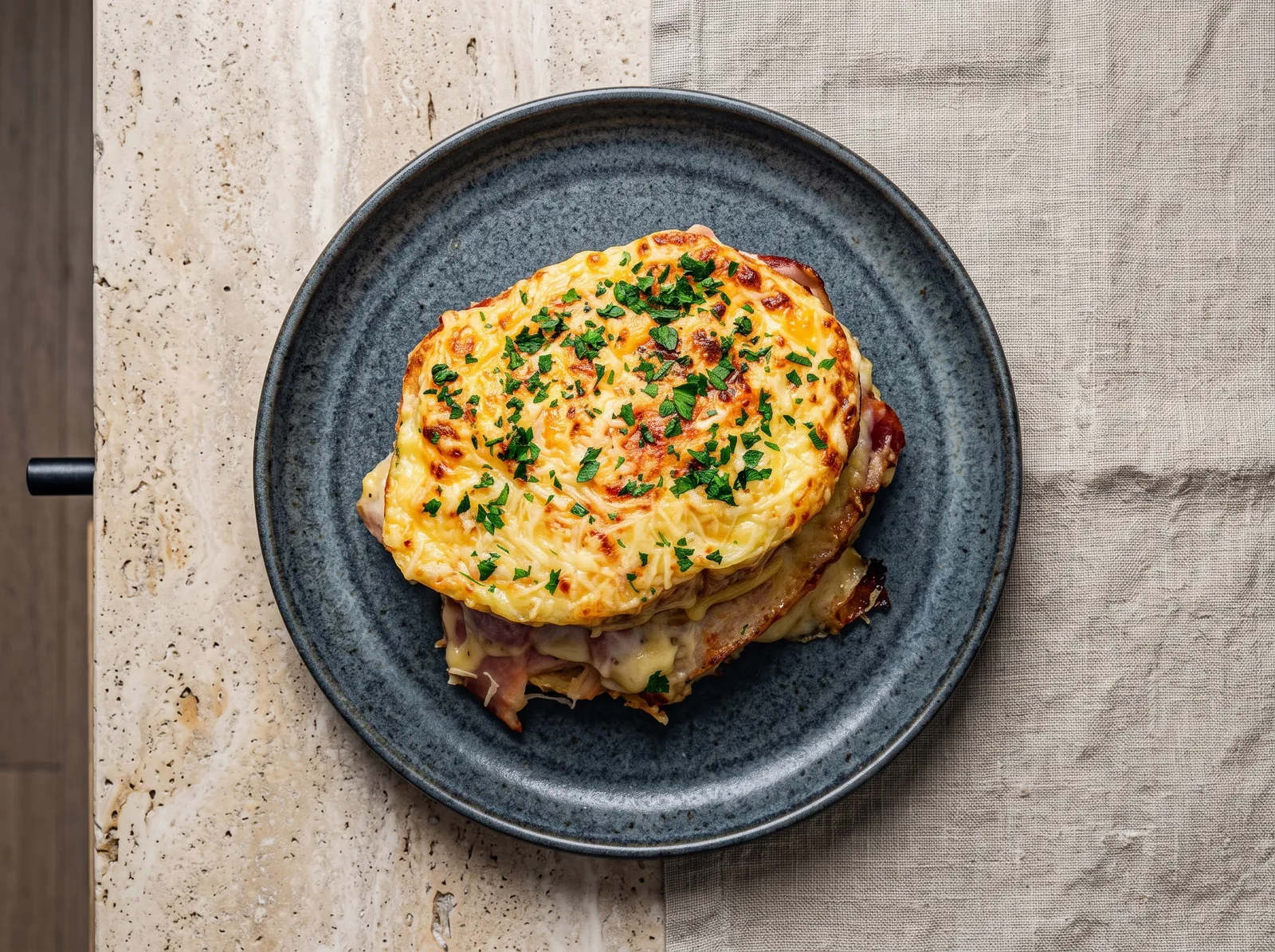
  • Gratinate the croques. Bread is crisp, cheese is fully melted, and béchamel is bubbling with browned spots.
  • Fry the eggs. Whites are completely set with no translucent patches; yolks remain soft and visibly distinct.
Ingredients

Ingredients

Béchamel

  • 25 g unsalted butter
  • 25 g plain wheat flour
  • 250 ml whole milk, cold — Produces about 270 g sauce; use exactly 240 g, leaving about 30 g unused.
  • 1 g ground nutmeg
  • 2 g fine salt

Sandwiches

  • 8 slices pain de mie, 40 g each; about 11 × 11 cm — 320 g total.
  • 160 g ready-to-eat cooked ham, 4 portions of 40 g
  • 120 g Gruyère, coarsely grated
  • 20 g Dijon mustard
  • 20 g unsalted butter, softened, for bread and frying surface

Egg topping

  • 4 l arge eggs pasteurized shell eggs; about 200 g without shell, Pasteurization is mandatory because the yolks are deliberately left soft.
Method

Method

Directions

  1. Cook the béchamel. Melt 25 g butter, stir in 25 g flour and cook gently without browning; whisk in the 250 ml cold milk and cook until smooth and thick enough to coat a spoon, then season with nutmeg and 2 g salt. Allow 12 minutes. Béchamel is smooth, hot and thick enough to cling to the bread without running off. Keep dairy sauce hot or cool promptly; do not leave it lukewarm.

  2. Assemble the sandwiches. Spread the inside faces of four bread slices with the 20 g Dijon mustard, add 40 g ham and 15 g Gruyère to each, close with the remaining bread, butter the outer faces, then spread exactly 60 g béchamel over each top and divide the remaining Gruyère over the sauce. Allow 10 minutes. Each sandwich is evenly filled and the topping reaches close to the edges without flooding the tray. Use separate utensils for ready-to-eat ham and raw egg handling later.

  3. Gratinate the croques. Bake and gratinate the sandwiches until the bread is crisp at the edges and the topping is bubbling and browned. Allow 14 minutes. Temperature: 210 °C. Bread is crisp, cheese is fully melted, and béchamel is bubbling with browned spots. Serve only when the ham and cheese filling is uniformly hot.

  4. Fry the eggs. While the sandwiches finish, fry the four pasteurized eggs in the remaining butter until the whites are fully opaque and set but the yolks remain soft. Use medium-low heat. Allow 4 minutes. Whites are completely set with no translucent patches; yolks remain soft and visibly distinct. Use pasteurized eggs for this soft-yolk version; with ordinary eggs, cook both white and yolk firm instead.

  5. Top and serve. Place one fried egg visibly on top of each hot sandwich and serve immediately. Allow 2 minutes. One egg sits intact on each sandwich and the croque is served while crisp and hot. Do not hold the finished egg-topped sandwiches at room temperature.

Serving, storage and make-ahead

Practical

Serving, storage and make-ahead

Serve one sandwich per person immediately after the egg is placed on top.

Serving, storage and make-ahead

Béchamel can be prepared 1 day ahead, rapidly cooled, covered and refrigerated at 4 °C or below, then rewarmed gently.

Serving, storage and make-ahead

A finished croque-madame is poor make-ahead food because the egg and crisp bread deteriorate quickly. If leftovers must be kept, chill promptly and use within 1 day.

Serving, storage and make-ahead

Another melting Alpine cheese can work technically, but it will shift flavour and salt; keep the name of the actual cheese clear.

Nutrition per serving

Nutrition per serving

  • Serving size1 complete sandwich with 1 egg
  • Calories600 kcal
  • Carbohydrate47.5 g
  • Protein33.5 g
  • Fat30.1 g
  • Fibre2.5 g
  • Sodium1125 mg
Allergens and food safety

Allergens and food safety

Allergens: Egg, Milk, Wheat/gluten, Mustard.

Ready-to-eat ham must remain refrigerated at 4 °C or below until assembly.

The deliberately soft yolk requires pasteurized eggs; otherwise cook both white and yolk firm.

Refrigerate perishable leftovers promptly at 4 °C or below.

Closing

Closing

  • Result: A crisp, hot ham-and-Gruyère croque crowned with one clearly visible soft-yolk egg.
  • Decisive technique: Use measured béchamel and pasteurized eggs for the deliberately soft yolks.