French Recipes

Civet de sanglier corse

A specifically Corsican wild-boar civet with a 24-hour red-wine and eau-de-vie marinade, slow braise and tender chestnuts added at the end. The method keeps game safety and chestnut texture separate and measurable.

French Recipes
Share
Civet de sanglier corse — shown in a cooking pot
Prep 45 minutes
Cook 190 minutes
Total 1675 minutes
Yield 6 main-course portions
Introduction and overview

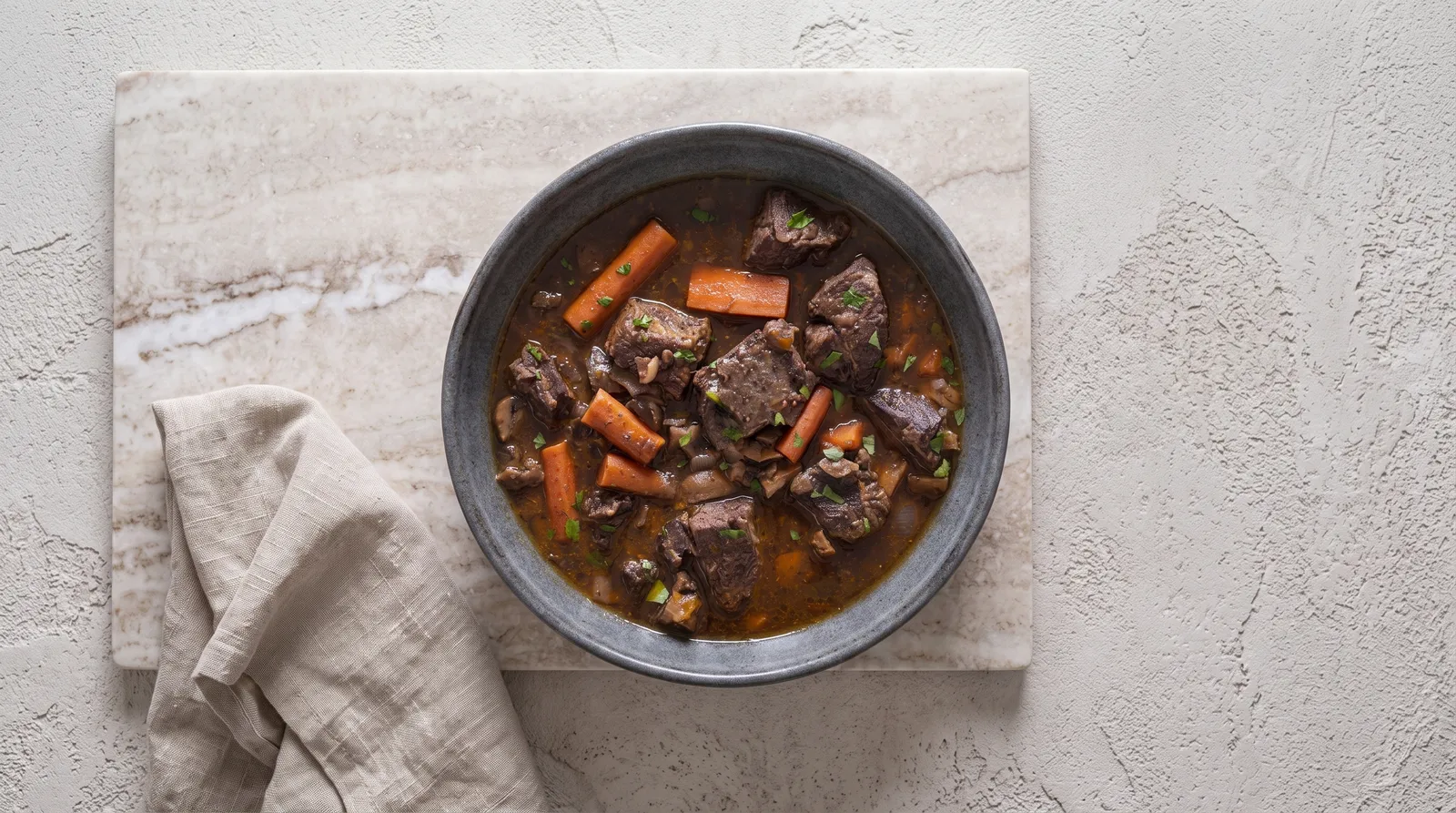
Civet de sanglier corse with chestnuts

Corsican civet de sanglier is built around game, a dark wine sauce and patient braising; the chestnut form is especially coherent with the island’s strong chestnut tradition. Here the chestnuts are not a generic garnish: they are cooked separately, peeled and folded into the stew late enough to remain recognizable.

The 24-hour marinade is about flavour and texture, not sanitation. Raw wild boar deserves stricter handling than supermarket beef: the bowl stays refrigerated, the retained wine mixture is brought fully to the boil, and a thermometer verifies at least 71 °C in every piece even though the meat continues cooking well beyond that point for tenderness.

A successful civet should not be soupy. Flour gives the braising liquid a little body, while long cooking contributes gelatin from the meat. The final chestnut simmer should leave a glossy sauce that clings to both meat and nuts, with pieces of boar soft enough to cut with a fork but not shredded into the sauce.
Success points

Success points

  • Keep the marinade at 4 °C or below for all 24 hours.
  • Dry the game before browning so the stew develops a dark savoury base.
  • Add chestnuts only for the final simmer so they stay distinct.
Ingredients

Ingredients

Civet and marinade

  • 1500 g boneless wild boar shoulder or leg, trimmed and cut into 45–50 g pieces — Purchased boneless weight; all 1,500 g enters the marinade.
  • 1000 ml dry red wine — Marinade is retained and fully cooked in the sauce.
  • 60 ml eau-de-vie — Cooked with the wine; alcohol is not assumed to disappear completely.
  • 100 g yellow onion, 5 mm dice
  • 100 g carrot, 5 mm dice
  • 10 g garlic, finely chopped
  • 1 bouquet garni, thyme, bay and parsley tied together
  • 100 ml olive oil — Used for browning; about 45 g is estimated to remain in the served stew.
  • 50 g plain wheat flour
  • 8 g fine salt
  • 2 g black pepper, freshly ground

Chestnuts

  • 1000 g fresh chestnuts in shell — About 600 g cooked peeled kernels are expected from this starting weight.
  • 1500 ml water — For boiling chestnuts; discarded.
  • 1 fennel sprig
Method

Method

Marinate

  1. Cut and marinate. Trim the wild boar, cut it into 45–50 g pieces, combine with the wine, eau-de-vie, onion, carrot, garlic, bouquet garni and black pepper, then cover. The pieces are evenly coated and fully surrounded by the aromatic wine marinade. Keep raw game and its juices away from ready-to-eat foods.

  2. Refrigerate the game. Refrigerate the covered bowl for the full marinade period. Target temperature: 4 °C or below. The meat has marinated for a full 24 hours while remaining continuously chilled. Marinating, alcohol, salting, smoking and freezing are not substitutes for Trichinella control or cooking.

Braise and finish

  1. Drain and dry. Lift out the meat and aromatics, strain and reserve every drop of marinade, and dry the meat thoroughly with disposable paper. The meat surface is dry enough to brown rather than steam. Treat the raw marinade and anything it touches as raw-meat contact.

  2. Brown the wild boar. Heat the olive oil in a heavy cocotte and brown the meat in a single layer, working in two loads if necessary. The wild-boar pieces have a deep brown crust on several sides without scorching. Do not taste partially cooked game.

  3. Sweat and flour. Add the drained onion, carrot and garlic, cook until softened, then scatter in the flour and stir to coat the meat and vegetables. The vegetables are softened and the flour has lost its raw white appearance.

  4. Boil the marinade and braise. Pour in the reserved marinade, bring the entire liquid to a full boil, then cover and maintain a very gentle simmer for 2 hours. Target temperature: 71 °C. The marinade has reached a full boil before the covered braise begins. Every wild-boar piece reaches at least 71 °C and becomes fork-tender. The sauce is glossy and lightly thickened rather than watery. Legally sourced, traceable wild boar with documented negative Trichinella testing is required, yet every piece must still reach at least 71 °C.

  5. Cook the chestnuts. Boil the chestnuts with the fennel sprig in the measured water until a knife enters the kernels without resistance. The chestnut skins loosen and the kernels are tender enough to pierce easily. Discard the chestnut cooking water.

  6. Peel the chestnuts. Drain just enough chestnuts to handle safely, remove shell and inner skin, and keep the kernels intact where possible. About 600 g of clean, tender chestnut kernels remain after peeling.

  7. Finish together. Fold the peeled chestnuts into the civet and simmer uncovered until the chestnuts are hot and the sauce coats them lightly. Target temperature: 71 °C. The chestnuts are heated through without collapsing into purée. The sauce coats the meat and chestnuts in a thin glossy layer. Every wild-boar piece still registers at least 71 °C at service. Use a clean thermometer probe and clean serving utensils after checking the game.

Practical guidance

Practical

Practical guidance

Serving: bring the cocotte to the table while the sauce is still glossy and very hot; the chestnuts already provide a substantial starch component.

Practical guidance

Make-ahead: braise the game through the tender stage, cool quickly, chill, then reheat thoroughly before adding freshly cooked chestnuts.

Practical guidance

Storage: divide leftovers into shallow containers, refrigerate promptly at 4 °C or below, and use within 3 days.

Practical guidance

Reheating: warm gently until the sauce loosens and the centre of the meat reaches 74 °C; avoid a hard boil that would break the chestnuts.

Practical guidance

Substitution: vacuum-packed cooked chestnuts are workable at about 600 g drained weight, but they should be added only for the last 10–15 minutes.

Troubleshooting

Troubleshooting

  • Issue 1Sauce too thick: loosen with a small amount of hot water and simmer briefly. Sauce too thin: remove the meat and chestnuts and reduce the sauce before recombining.
Nutrition per serving

Nutrition per serving

  • Serving size1 of 6 portions, about 520 g finished stew
  • Calories620 kcal
  • Carbohydrate52 g
  • Protein52 g
  • Fat18 g
  • Fibre8 g
  • Sodium650 mg
Allergens and food safety

Allergens and food safety

Allergens: Gluten from wheat flour; Sulphites from red wine

Use only legally sourced, traceable wild boar with documented negative Trichinella testing.

Freezing, salting, smoking, marinating and alcohol are not reliable parasite controls for wild boar.

Keep the raw game marinade at 4 °C or below and fully boil/cook any retained marinade.

Every piece of wild boar must reach at least 71 °C and also become tender.

Prevent cross-contamination from raw game and reheat leftovers to 74 °C.

FAQ

FAQ

Can the wild boar be frozen instead of tested for Trichinella?

No. Domestic freezing is not a dependable parasite-control substitute for legally sourced, tested meat and thorough cooking.

Why cook the chestnuts separately?

Their cooking time and peeling needs are different from the game, and separate cooking keeps the sauce from becoming starchy and muddy.

Closing

Closing

  • Result: A successful civet should not be soupy.
  • Decisive technique: Keep the marinade at 4 °C or below for all 24 hours.