French National Dishes

Clafoutis aux cerises

Limousin cherry clafoutis with pitted cherries, a simple flour-and-milk batter and a 40-minute bake in a 26 cm ceramic dish, followed by enough cooling for clean, custardy slices.

French National Dishes
Share
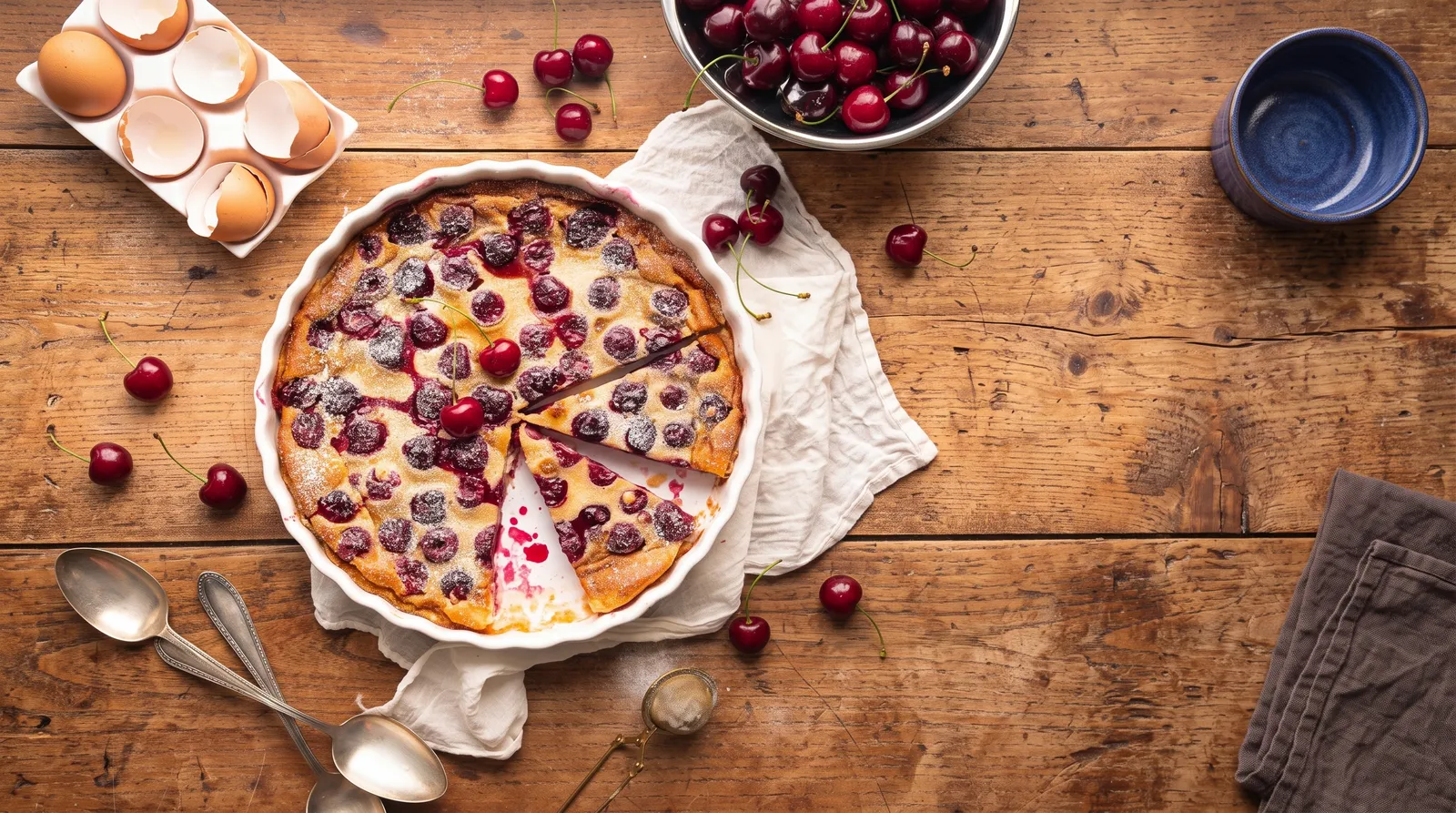
Clafoutis aux cerises — shown with a cut section visible
Prep 20 minutes
Cook 40 minutes
Total 105 minutes
Yield 6 dessert portions
Introduction and overview

Clafoutis aux cerises — Limousin cherry clafoutis

In Limousin, clafoutis is first and foremost a cherry dessert: fruit sits in a simple batter that bakes into something between a flan and a soft cake. Flour provides more structure than a pure custard, but the centre should still feel tender rather than bready.

The traditional argument over cherry stones is real, because many older forms bake the fruit whole. The practical choice here is different: the cherries are pitted before weighing. That avoids a choking and dental hazard and also makes every serving predictable, even though pitting can release more juice. Draining and drying the fruit answers that technical problem.

The pan matters. A shallow ceramic dish encourages an even, gentle set over about 40 minutes at 180 °C. The visual cues are a puffed, lightly browned rim and a centre that barely trembles, while 71 °C at the centre provides the separate safety check for the egg batter. A short cooling period is part of the texture, not dead time.
Success points

Success points

  • Use 600 g cherries after pitting and draining so the fruit-to-batter ratio stays predictable.
  • Whisk the milk in gradually to avoid flour lumps.
  • Judge quality by a softly set centre, but verify the egg-safety endpoint with temperature.
Ingredients

Ingredients

Fruit and dish

  • 600 g sweet cherries, pitted, then drained and patted dry — Weight is after pitting and draining.
  • 25 g unsalted butter, softened, for the dish
  • 20 g caster sugar, for coating and finishing

Batter

  • 100 g plain wheat flour
  • 120 g caster sugar
  • 10 g vanilla sugar
  • 2 g fine salt
  • 2 l arge eggs, about 100 g without shell
  • 330 ml whole milk
Method

Method

Assemble

  1. Prepare the dish and cherries. Butter a 26 cm shallow ceramic baking dish, dust it with part of the 20 g finishing sugar, spread in the pitted drained cherries, and reserve the remaining finishing sugar. The cherries form an even single layer and there is no pool of cherry juice in the dish. Pitting removes a choking and dental hazard present in whole-stone versions.

  2. Mix the batter. Whisk the flour, 120 g sugar, vanilla sugar and salt, add the eggs, then gradually whisk in the milk until smooth. The batter is smooth, pourable and free of dry flour pockets. Keep raw egg batter away from foods that will not be cooked.

Bake and cool

  1. Bake the clafoutis. Heat the oven to 180 °C, pour the batter over the cherries, and bake on the centre rack. The rim is puffed and lightly browned. The centre is softly set and trembles only slightly when the dish is nudged. The centre reaches at least 71 °C. Egg dishes should reach at least 71 °C at the centre.

  2. Cool on a rack. Set the dish on a wire rack, scatter over the remaining finishing sugar while warm, and let the clafoutis cool before cutting. The clafoutis has settled, is warm rather than hot, and slices without liquid batter running from the centre. Do not leave the dairy-and-egg dessert at room temperature for extended periods.

Practical guidance

Practical

Practical guidance

Serving: offer it warm or cool, cut into six wedges after the 45-minute settling period.

Practical guidance

Storage: cover and refrigerate at 4 °C or below for up to 3 days.

Practical guidance

Make-ahead: pit and dry the cherries earlier in the day; keep them chilled and mix the batter close to baking.

Practical guidance

Reheating: not required; a refrigerated slice can stand briefly until it loses its hard chill.

Practical guidance

Substitution: sour cherries may change acidity and sugar balance, so they are not a silent one-for-one change to this sweet-cherry formula.

Troubleshooting

Troubleshooting

  • Issue 1Watery centre: cherries were too wet or the clafoutis was cut before settling. Lumpy batter: milk was added too quickly to the flour-and-egg base.
Nutrition per serving

Nutrition per serving

  • Serving size1 of 6 wedges
  • Calories315 kcal
  • Carbohydrate55 g
  • Protein7 g
  • Fat8 g
  • Fibre2 g
  • Sodium150 mg
Allergens and food safety

Allergens and food safety

Allergens: Egg; Milk; Gluten from wheat flour

Use pitted cherries in this household recipe to remove the choking and dental hazard of stones.

Raw batter contains egg and must be baked to at least 71 °C at the centre.

Keep milk, eggs and the finished dessert refrigerated at 4 °C or below when not being prepared or served.

FAQ

FAQ

Do cherry stones belong in traditional clafoutis?

Many traditional versions leave them in, but pitting is safer for eating and is the required choice here.

Why is another fruit not simply called clafoutis?

In the Limousin framing, cherry is the defining fruit, while similar bakes with other fruits are often called flognarde.

Closing

Closing

  • Result: The pan matters.
  • Decisive technique: Use 600 g cherries after pitting and draining so the fruit-to-batter ratio stays predictable.