French Recipes

Chouquettes

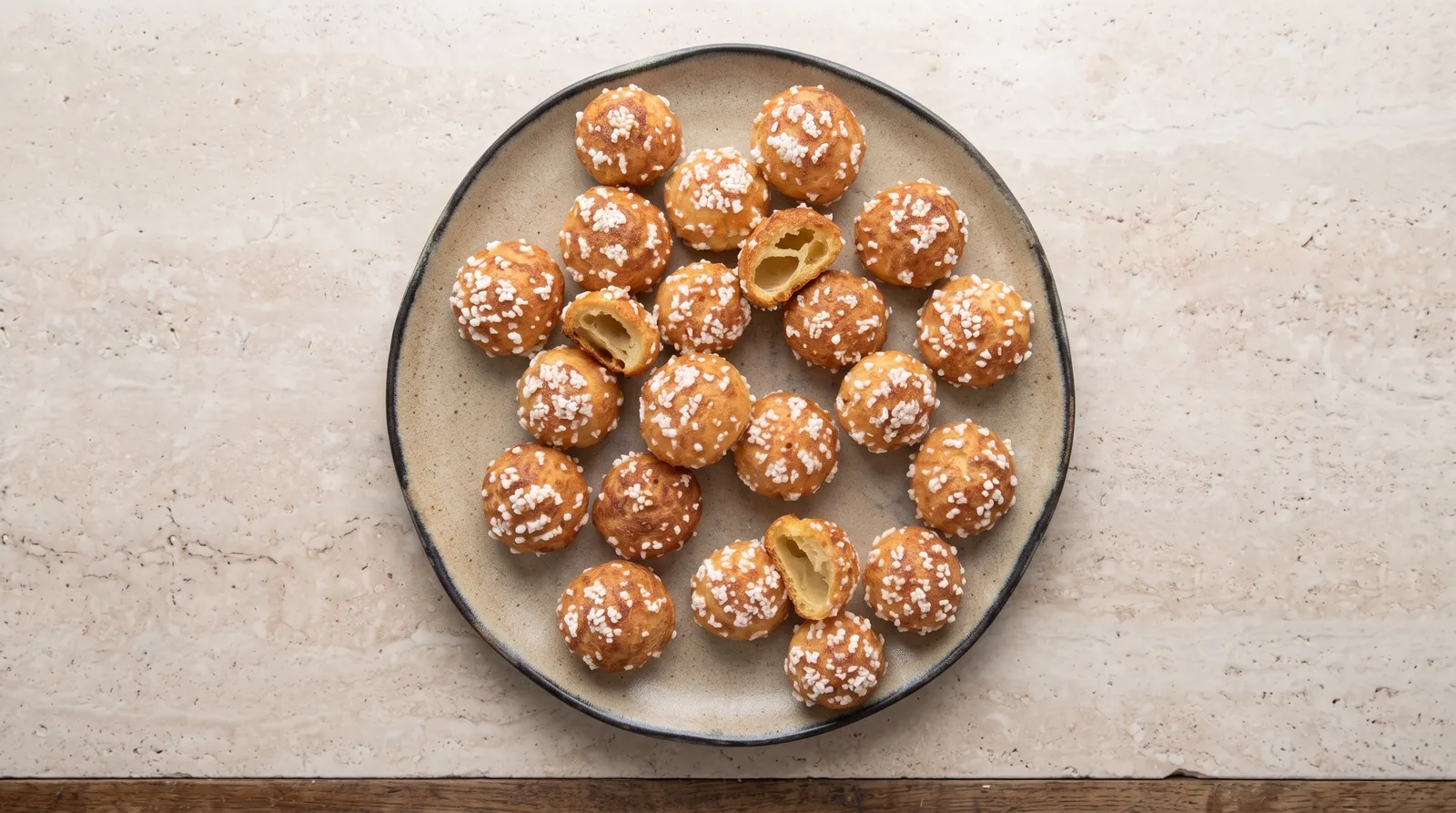
Thirty-six small unfilled chouquettes made from classic pâte à choux, with the panade dried thoroughly, egg added by texture, generous pearl sugar and a deep-golden bake followed by a short drying stage.

French Recipes
Share
Chouquettes — several baked pastries on display
Prep 22 minutes
Cook 31 minutes
Total 78 minutes
Yield 36 small chouquettes
Introduction and overview

Chouquettes — crisp pearl-sugar pâte à choux

Chouquettes are small unfilled French choux pastries whose identity is carried by two things: a light hollow shell and a generous crust of pearl sugar. They should not be treated as miniature cream puffs waiting for filling. The dough is ordinary pâte à choux, but the execution is unforgiving: too much water left in the panade or too much egg added afterward can turn neat piped mounds into flat discs.

The liquid base combines equal parts water and milk with butter, a small amount of sugar and salt. Flour goes in all at once, and the panade returns to the heat until it forms a smooth ball and leaves a thin dry film on the saucepan. After a short cool to about 45–50 °C, beaten egg is incorporated gradually. Begin with 180 g and use the final 20 g only as the dough demands; a smooth V-shaped ribbon from the spatula is more reliable than forcing every last gram into the dough.

Pipe 36 mounds of similar size so they expand at the same rate, then add pearl sugar generously without flattening the tops. Bake at 170 °C and resist opening the oven during the first 15 minutes, when steam is driving expansion. The shells need a deep golden colour, followed by five minutes of residual-heat drying and a full rack cool. Same-day service gives the best contrast between crisp shell and light interior.
Success points

Success points

  • Dry the panade until it leaves a film on the saucepan.
  • Add egg gradually and stop at the V-shaped ribbon cue.
  • Pipe a consistent 3 cm size.
  • Bake deeply golden and dry the shells before rack cooling.
Ingredients

Ingredients

Pâte à choux

  • 125 ml water
  • 125 ml whole milk
  • 100 g unsalted butter, cubed
  • 3 g fine salt
  • 5 g caster sugar
  • 150 g plain wheat flour, sifted
  • 200 g whole egg, beaten; begin by incorporating 180 g and use up to the remaining 20 g by texture

Finish

  • 80 g pearl sugar
Method

Method

Panade

  1. Boil the liquids. Bring the 125 ml water, 125 ml milk, 100 g butter, 3 g salt and 5 g caster sugar to a full boil so the butter is completely melted. Heat: medium. Timing: 4 minutes. Purpose: The flour must meet fully hot liquid for the panade to gelatinise evenly. The liquid is bubbling across the surface and no solid butter remains.

  2. Add flour and dry the panade. Take the pan briefly off heat, add the 150 g flour at once, stir smooth, then return to medium heat and cook while stirring. Heat: medium. Timing: 2 minutes. Purpose: Drying removes enough moisture to accept eggs without becoming slack. The dough forms one smooth ball, pulls from the pan and leaves a thin dry film on the base.

Eggs and piping

  1. Cool the panade slightly. Cool the panade in a mixing bowl to about 45–50 °C before adding egg. Heat: room temperature. Timing: 5 minutes passive cooling. Purpose: A slightly cooled panade prevents the eggs from setting on contact. The panade is warm but no longer steaming hard, at about 45–50 °C.

  2. Add egg by texture. Beat in 180 g of the egg gradually, then add only as much of the final 20 g as needed for the correct piping texture. Timing: 5 minutes. Purpose: Pâte à choux hydration varies with flour and panade drying, so texture decides the final egg addition. A lifted spatula leaves a smooth V-shaped ribbon of dough that bends slowly without running. Safety. Do not force in egg that would make the dough fluid.

  3. Pipe the chouquettes. Pipe 36 mounds about 3 cm wide onto two lined baking trays, leaving expansion space. Timing: 12 minutes. Purpose: Consistent size gives even oven spring. Thirty-six evenly sized mounds stand upright with rounded tops and clear spacing between them.

  4. Apply pearl sugar. Brush the tops lightly with any reserved beaten egg from the measured 200 g, if available, and press the 80 g pearl sugar onto the mounds. Timing: 5 minutes. Purpose: Good adhesion keeps the sugar on during oven spring. Pearl sugar adheres generously to the tops without flattening the mounds.

Bake and dry

  1. Bake without opening early. Bake at 170 °C until the chouquettes are deeply golden and well expanded; do not open the oven during the first 15 minutes. Heat: 170 °C oven. Timing: 20 minutes. Purpose: Early door opening can collapse steam-inflated shells. The shells are deeply golden, firm and visibly expanded rather than pale or soft.

  2. Dry with residual heat. Turn the oven off, crack the door and leave the trays inside briefly to dry the interiors. Heat: residual oven heat. Timing: 5 minutes. Purpose: A short residual-heat dry reduces internal moisture. The shells feel light and crisp and the interior is dry and hollow rather than gummy.

  3. Cool on a rack. Transfer the chouquettes to a rack and cool before serving. Heat: room temperature. Timing: 20 minutes passive cooling. Purpose: Rack cooling prevents condensation underneath. The shells stay crisp as steam escapes and the pearl sugar remains dry.

Serving

Practical

Serving

Serve the same day at room temperature; three small chouquettes make one declared nutrition serving.

Make-ahead

Pipe and bake rather than holding raw pâte à choux for long periods. If necessary, the baked pastries can be refreshed shortly before service.

Storage and reheating

Store completely cooled chouquettes airtight at room temperature for up to 1 day. To recrisp, bake at 160 °C for 5 minutes and cool briefly on a rack. Freezing baked chouquettes is possible for short storage but pearl sugar may lose some crispness.

No ordinary granulated sugar for the pearl-sugar topping.

Granulated sugar melts differently and does not reproduce the characteristic crunchy finish.

The chouquettes spread flat.

Cause: Too much egg was added or the panade was insufficiently dried. Correction: Dry until a film forms and stop egg addition at the V-shaped ribbon cue.

The shells collapse after baking.

Cause: They were too pale or still wet inside when removed. Correction: Bake to a deep golden colour and complete the residual-heat drying step.

Technique in focus

Dry the panade properly and let the V-shaped ribbon cue decide the last egg addition; those two controls determine whether the shells rise and stay hollow.

Nutrition per serving

Nutrition per serving

  • Serving size1 of 12 servings, 3 chouquettes
  • Calories165 kcal
  • Carbohydrate18 g
  • Protein4 g
  • Fat9 g
  • Fibre0.5 g
  • Sodium115 mg
Allergens and food safety

Allergens and food safety

Allergens: Gluten; Egg; Milk.

Egg is fully baked in the choux; avoid tasting raw dough.

Cool on a rack before storage so condensation does not soften the shells.

Recrisp stored pastries at 160 °C for 5 minutes.

FAQ

FAQ

Why might some of the final egg not go into the dough?

Flour absorption and panade drying vary. The dough should stop at the V-shaped ribbon cue; any measured remainder can be used as a very light glaze.

Can granulated sugar replace pearl sugar?

Not without changing the result. Granulated sugar melts differently and does not give the characteristic crunchy white finish.

Closing

Closing

  • Result: Thirty-six small unfilled chouquettes made from classic pâte à choux, with the panade dried thoroughly, egg added by texture, generous pearl sugar and a deep-golden bake followed by a short drying stage.
  • Decisive technique: Dry the panade properly and let the V-shaped ribbon cue decide the last egg addition; those two controls determine whether the shells rise and stay hollow.