French Recipes

Chou farci auvergnat

An Auvergne-focused chou farci built as one reconstructed Savoy cabbage around a pork, smoked belly, chard, bread, milk, egg and herb filling, then covered and braised until the centre reaches 71 °C.

French Recipes
Share
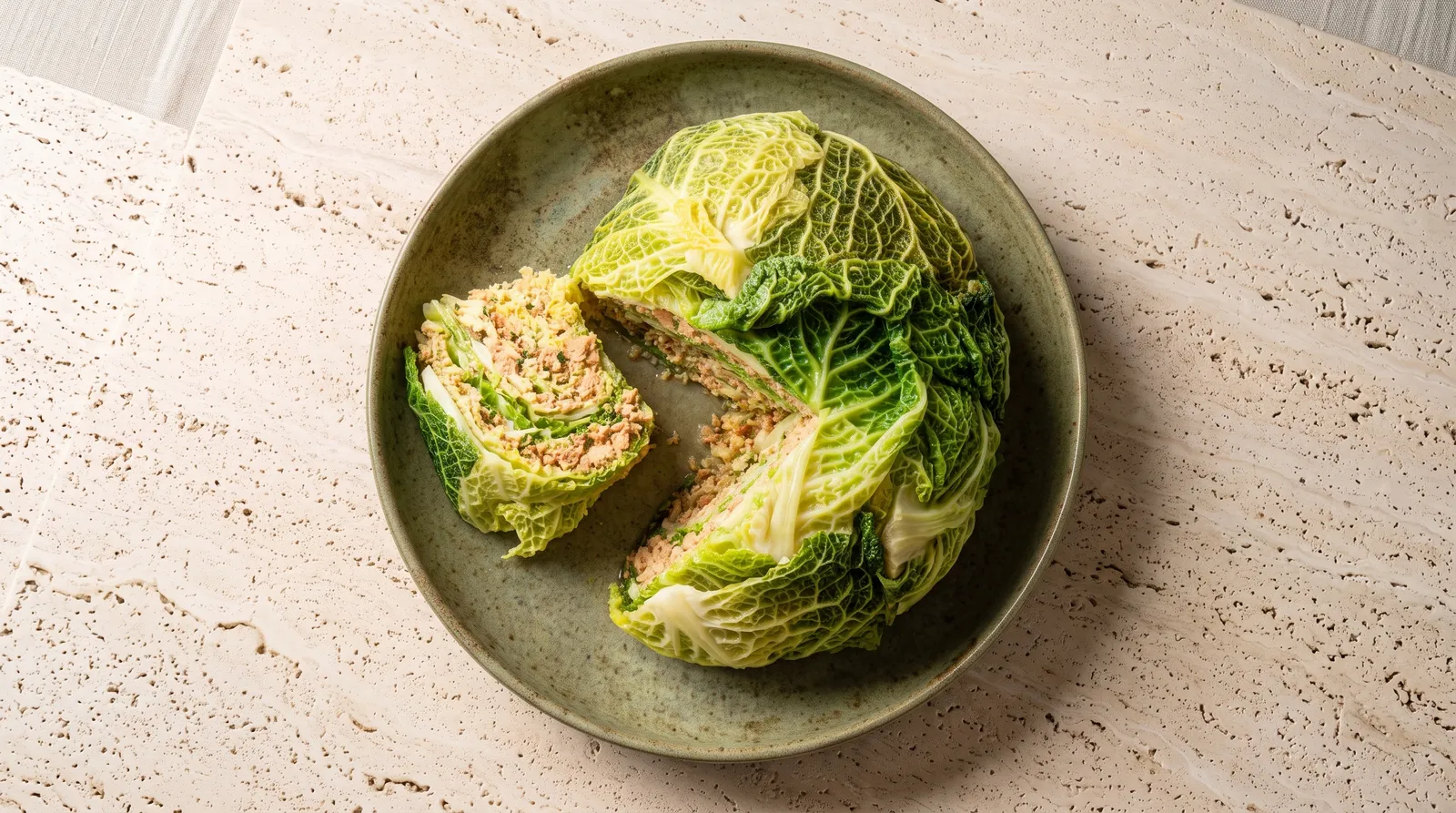
Chou farci auvergnat — shown with a cut section visible
Prep 25 minutes
Cook 116 minutes
Total 176 minutes
Yield 1 reconstructed stuffed cabbage, 6 portions
Introduction and overview

Chou farci auvergnat — whole reconstructed cabbage with pork and greens

Chou farci has several regional French identities, and the shape matters here. The Auvergnat preparation is built as one compact reconstructed cabbage rather than copied from the individual Limousin parcels in the next recipe. Blanched Savoy leaves line a deep casserole, enclose a pork-based filling and fold back over the top so the cooked dish can be turned out or cut into generous wedges.

The filling combines ground pork with smoked belly, chard, onion, garlic and parsley. Stale bread softened with milk, beaten egg and a modest amount of flour give cohesion without turning the centre dense. Cooked vegetables should cool enough that they do not warm the raw pork prematurely, and the meat mixture should be combined just until even. Packing too hard produces a rubbery centre and slows heat penetration.

Covered baking at 160 °C softens the overlapping cabbage while retaining moisture around the filling. The centre of the ground-pork stuffing must reach 71 °C; leaf tenderness alone is not a safety test. A 20-minute rest then firms the structure so wedges hold together. Cool leftovers in smaller portions, refrigerate promptly and reheat to 74 °C.
Success points

Success points

  • Blanch leaves only until flexible.
  • Drain cabbage thoroughly before filling.
  • Mix pork filling lightly rather than kneading.
  • Check 71 °C at the centre before resting.
Ingredients

Ingredients

Cabbage and filling

  • 1600 g large Savoy cabbage, about 1200 g trimmed edible leaves after core and tough waste
  • 600 g ground pork
  • 150 g smoked pork belly, finely diced
  • 120 g Swiss chard leaves, finely chopped
  • 150 g onion, finely chopped
  • 15 g garlic, minced
  • 25 g flat-leaf parsley, chopped
  • 100 g egg, about 2 large eggs, beaten
  • 120 g stale country bread, crumbled
  • 120 ml whole milk
  • 30 g plain wheat flour
  • 6 g fine salt
  • 1.5 g black pepper

Braising base

  • 150 g carrot, sliced
  • 20 g lard
  • 300 ml water, hot
Method

Method

Cabbage

  1. Blanch the cabbage leaves. Remove the core and separate large leaves; blanch them in boiling water until flexible, then drain. Heat: boiling. Timing: 8 minutes. Purpose: Blanching makes a reconstructed cabbage possible without turning the leaves mushy. The leaves bend without cracking but remain strong enough to wrap the filling.

  2. Drain and cool the leaves. Spread the blanched leaves to cool and drain thoroughly. Heat: room temperature. Timing: 10 minutes passive cooling. Purpose: Dry leaves grip the filling and keep the parcel compact. The leaves are cool enough to handle and no longer shed visible water.

Filling

  1. Soften the aromatics. Melt the 20 g lard and cook onion, garlic, carrot and chard gently until softened; transfer to a shallow plate. Heat: medium-low. Timing: 8 minutes. Purpose: Soft aromatics integrate into the pork filling. The onion and carrot are tender and the chard has wilted without browning.

  2. Cool the cooked vegetables. Cool the softened onion, garlic, carrot and chard before mixing them with raw pork. Heat: room temperature. Timing: 5 minutes passive cooling. Purpose: Cooling protects the texture and cold chain of the filling. The vegetables are no longer hot enough to warm the raw pork mixture. Safety. Do not leave the cooked vegetables at room temperature longer than needed.

  3. Mix the stuffing. Moisten the 120 g bread with 120 ml milk, then combine it with ground pork, smoked belly, cooled vegetables, parsley, egg, flour, salt and pepper. Timing: 10 minutes. Purpose: Bread, milk, egg and flour bind the filling while retaining tenderness. The stuffing is evenly mixed, moist and cohesive without being kneaded into a paste. Safety. Keep the raw pork mixture chilled if assembly pauses.

Reconstruct and cook

  1. Build the cabbage. Line a 24 cm deep casserole with overlapping cabbage leaves, pack in the stuffing, fold leaves over the top and shape into one compact reconstructed cabbage. Timing: 15 minutes. Purpose: The whole reconstructed format keeps the Auvergnat presentation distinct from the smaller Limousin parcels. The filling is completely enclosed by overlapping leaves and the bundle holds a rounded compact shape.

  2. Braise in the oven. Pour the 300 ml hot water around the cabbage, cover and bake at 160 °C until the centre of the filling reaches 71 °C. Heat: 160 °C oven. Timing: 100 minutes. Purpose: Long covered cooking tenderises the leaf layers while the centre cooks safely. A skewer meets little resistance through the cabbage and the centre of the pork filling reaches 71 °C. Safety. Measure 71 °C in the centre of the ground-pork filling.

  3. Rest before slicing. Rest the cooked cabbage in its casserole before turning out or cutting into wedges. Timing: 20 minutes passive rest. Purpose: Resting firms the hot filling enough for clean portions. The reconstructed cabbage remains intact when cut and excess braising liquid has settled around it.

Serving

Practical

Serving

Serve in wedges with a spoonful of its light braising juices; the cut should show clear layers of cabbage and filling.

Make-ahead

Blanch the cabbage and prepare the cooked vegetable component earlier the same day; keep both chilled and mix raw pork filling shortly before assembly.

Storage and reheating

Cool cut portions promptly and refrigerate at 4 °C or below for up to 3 days. Reheat covered to 74 °C in the centre.

Fresh unsmoked pork belly for smoked belly.

The filling loses smoke and salt intensity but the structure remains workable; adjust only within the fixed salt quantity.

The cabbage falls apart.

Cause: Leaves did not overlap enough or the parcel was cut immediately from the oven. Correction: Overlap leaves fully and observe the 20-minute rest.

The centre cooks slowly.

Cause: The filling was packed too tightly or the cabbage is unusually large. Correction: Use the stated 24 cm vessel and rely on the 71 °C centre reading rather than extending time blindly.

Technique in focus

The defining execution is the whole reconstructed-cabbage form, with flexible well-drained leaves and a lightly mixed pork filling.

Nutrition per serving

Nutrition per serving

  • Serving size1 of 6 equal wedges
  • Calories560 kcal
  • Carbohydrate30 g
  • Protein35 g
  • Fat34 g
  • Fibre6 g
  • Sodium1100 mg
Allergens and food safety

Allergens and food safety

Allergens: Egg; Milk; Gluten.

Keep raw pork at 4 °C or below and prevent cross-contamination.

Ground-pork filling must reach 71 °C in the centre.

Cool leftovers promptly and reheat to 74 °C.

FAQ

FAQ

Why is this not made as small parcels?

The whole reconstructed format keeps this Auvergne preparation distinct from the Limousin parcel format used separately.

Can the rest be skipped?

It is important for clean slicing. The hot filling is much more likely to spill if the cabbage is cut immediately.

Closing

Closing

  • Result: An Auvergne-focused chou farci built as one reconstructed Savoy cabbage around a pork, smoked belly, chard, bread, milk, egg and herb filling, then covered and braised until the centre reaches 71 °C.
  • Decisive technique: The defining execution is the whole reconstructed-cabbage form, with flexible well-drained leaves and a lightly mixed pork filling.