French National Dishes

Choucroute garnie

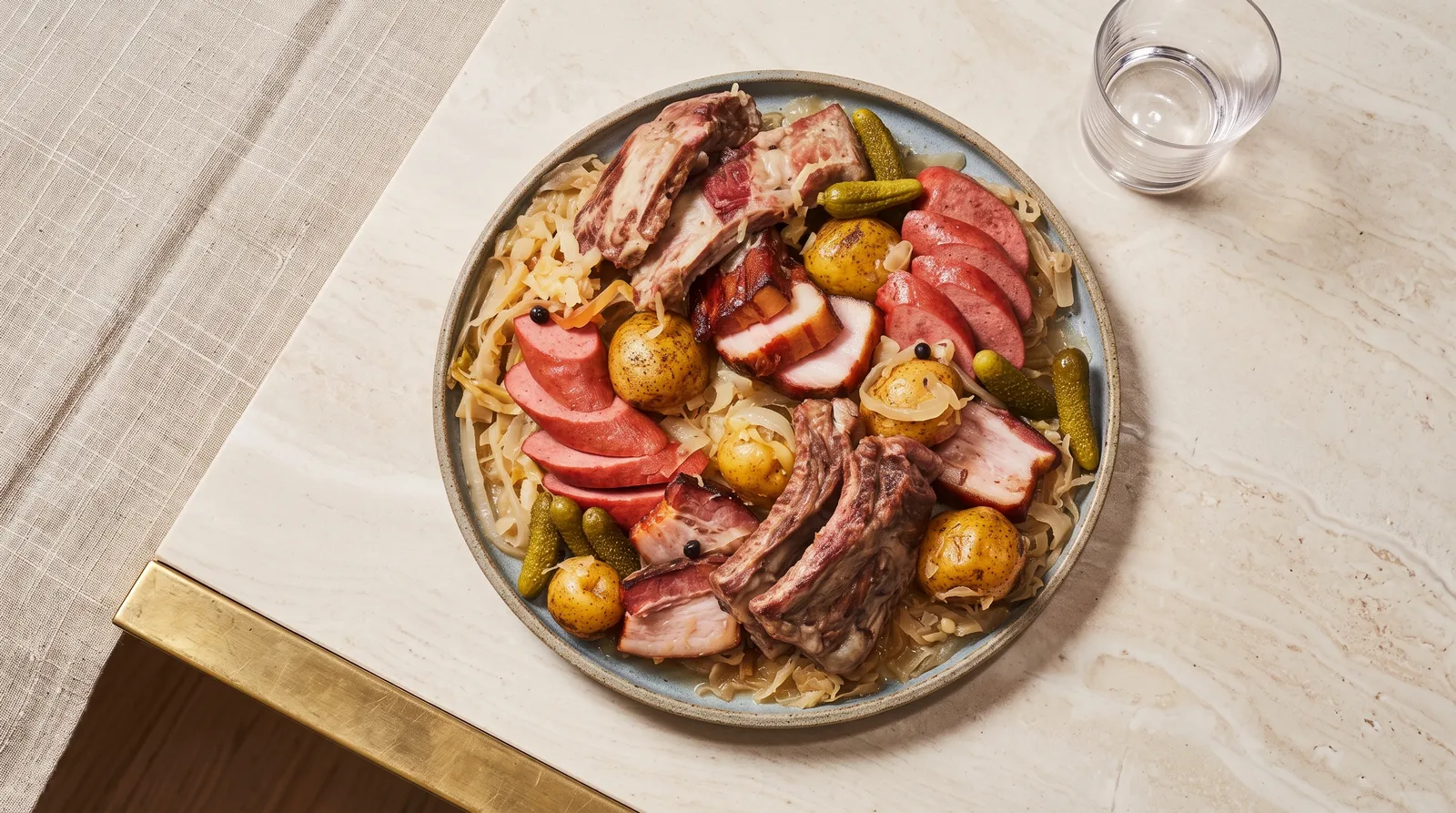
Purchased fermented sauerkraut is braised with Riesling, onion, juniper and staged pork cuts, while two sausage styles are heated separately below a boil and added with potatoes for hot Alsatian service.

French National Dishes
Share
Choucroute garnie — presented in a serving dish
Prep 15 minutes
Cook 125 minutes
Total 205 minutes
Yield 6 generous main-course portions
Introduction and overview

Choucroute garnie — Alsatian sauerkraut with pork, sausages and potatoes

Choucroute garnie begins with sauerkraut, but the protected identity and the assembled dish should not be confused. Choucroute d’Alsace IGP refers to the fermented cabbage product; the garniture of pork, sausages and potatoes has many legitimate variations. The preparation starts from purchased raw fermented sauerkraut and does not teach home fermentation. The cabbage is drained and rinsed only enough to moderate excessive salt or acidity.

Goose fat, onion, garlic, juniper, clove, bay and pepper build the aromatic base. Riesling and a little water provide the braising liquid for uncooked, ready-to-cook smoked shoulder, salted pork belly and smoked bacon slab. The dense pork cooks first; potatoes join later. The sausages are deliberately held back from the oven because long boiling or braising would split their casings and drive out fat. They are warmed separately in water around 80–85 °C.

Each sausage is heated to 74 °C, then arranged over the silky cabbage with the pork and potatoes. Packaged sausages differ in formulation, so labels still matter for mustard, celery, milk or gluten. Riesling supplies sulphites and retains some alcohol after cooking; neither point should be hidden. The finished platter is rich, salty and substantial, so portion size and prompt cooling of leftovers matter.
Success points

Success points

  • Use purchased fermented sauerkraut.
  • Rinse only enough to moderate, not erase, acidity.
  • Stage meats and sausages by required cooking time.
  • Keep sausage-heating water below a boil to reduce splitting.
Ingredients

Ingredients

Sauerkraut base

  • 1500 g purchased raw Choucroute d’Alsace IGP or comparable raw fermented sauerkraut, drained and lightly rinsed
  • 200 g onion, thinly sliced
  • 30 g goose fat
  • 12 g garlic, crushed
  • 4 g juniper berries, lightly crushed
  • 1 g whole cloves
  • 1 g bay leaf
  • 1 g black peppercorns
  • 500 ml dry Alsace Riesling, about 12% ABV
  • 250 ml water

Meats and potatoes

  • 400 g smoked pork shoulder, uncooked, ready-to-cook
  • 250 g salted pork belly, uncooked, ready-to-cook
  • 250 g smoked bacon slab, uncooked, ready-to-cook
  • 300 g Montbéliard-style smoked sausage
  • 300 g Strasbourg-style sausage
  • 2000 ml cold water, for a 1-hour soak of the salted belly if notably salty
  • 1500 ml water, for gentle sausage heating
  • 900 g waxy potatoes, peeled
Method

Method

Prepare base

  1. Moderate the salted belly. If the 250 g salted belly is strongly cured, soak it in 2000 ml cold water, then drain; if it is mild, use the same measured hour as a conservative desalting step. Heat: cold water. Timing: 60 minutes passive soaking. Purpose: A measured soak controls salt without teaching curing or fermentation. The belly remains firm but no longer has a heavily salty surface taste. Safety. Keep the pork refrigerated during soaking.

  2. Prepare the sauerkraut. Drain the purchased sauerkraut and rinse it briefly under cold water only until its acidity and salt are moderated; squeeze gently, not dry. Heat: cold water. Timing: 10 minutes. Purpose: Rinsing is adjusted to the starting product, but the purchased fermented cabbage remains the defining base. The cabbage remains pleasantly sour and moist rather than washed bland.

  3. Start the aromatic base. Melt the goose fat and cook the 200 g onion until translucent; add garlic, juniper, clove, bay and peppercorns. Heat: medium-low. Timing: 5 minutes. Purpose: Gentle aromatics season the cabbage without masking fermentation. The onion is soft and the spices smell aromatic without browning.

Braise

  1. Layer cabbage and pork. Add sauerkraut, Riesling and 250 ml water, then nestle in the uncooked, ready-to-cook smoked shoulder, salted pork belly and smoked bacon slab. Cover and cook in a 150 °C oven. Heat: 150 °C oven. Timing: 60 minutes. Purpose: Staged cooking gives dense pork time without exposing sausages to the full braise. The cabbage is steaming, the pork has released flavour into the braising liquid and the pot remains moist. Safety. Treat the three whole pork cuts as uncooked/ready-to-cook products and keep them under temperature control until braising.

  2. Add potatoes. Add the 900 g potatoes around the cabbage and continue covered until the potatoes are tender and the thickest part of each whole pork cut reaches at least 63 °C. Heat: 150 °C oven. Timing: 30 minutes. Purpose: Potatoes finish in the aromatic braising environment without dissolving. The potatoes are tender to a knife, the cabbage is silky but still distinct, and each whole pork cut reaches at least 63 °C in its thickest part. Safety. Verify at least 63 °C in the smoked shoulder, salted pork belly and smoked bacon slab with a clean food thermometer.

Sausages

  1. Heat the smoked sausage. Warm 750 ml of the sausage-heating water to 80–85 °C and heat the 300 g Montbéliard-style sausage gently without boiling until the centre reaches 74 °C. Heat: 80–85 °C water. Timing: 20 minutes. Purpose: Sub-boiling water limits splitting and fat loss. The sausage is hot through, the casing remains intact and the centre reaches 74 °C. Safety. Use a food thermometer; packaged sausage instructions take precedence if stricter.

  2. Heat the Strasbourg sausage. Use the remaining 750 ml sausage-heating water at about 80 °C to heat the 300 g Strasbourg-style sausage until the centre reaches 74 °C. Heat: about 80 °C water. Timing: 10 minutes. Purpose: Short gentle heating protects the finer sausage texture. The sausage is plump, intact and reaches 74 °C without boiling. Safety. Use a food thermometer; packaged sausage instructions take precedence if stricter.

Serve

  1. Rest and arrange. Rest the casserole and whole pork cuts for 5 minutes, then slice the pork and sausages and arrange them over the sauerkraut with potatoes. Timing: 5 minutes passive rest. Purpose: A short rest makes the assembled platter easier to serve. The whole pork cuts have rested at least 3 minutes after reaching 63 °C, the braising liquid has settled into the cabbage and the meats can be sliced cleanly. Safety. Do not slice the whole pork cuts until at least 3 minutes have elapsed after they reached 63 °C.

Serving

Practical

Serving

Pile sauerkraut in the centre of a warm platter and arrange sliced pork, whole or halved sausages and potatoes around it; serve very hot.

Make-ahead

The casserole portion can be braised a day ahead, cooled promptly and reheated to 74 °C; heat sausages fresh just before serving for better texture.

Storage and reheating

Cool cabbage and meats promptly in shallow containers and refrigerate at 4 °C or below for up to 3 days. Reheat leftovers to 74 °C.

Comparable purchased raw fermented sauerkraut when IGP product is unavailable.

The dish remains choucroute garnie in a broad culinary sense, but it must not be labelled as using Choucroute d’Alsace IGP.

The cabbage tastes washed out.

Cause: It was rinsed repeatedly until its fermentation character disappeared. Correction: Rinse briefly and taste the starting product rather than soaking it bland.

The sausages split.

Cause: They were boiled vigorously. Correction: Keep the water around 80–85 °C and heat only until the centre reaches 74 °C.

Technique in focus

Treat the sauerkraut as a purchased fermented ingredient, stage the meats by cooking time, and heat sausages gently rather than boiling them.

Nutrition per serving

Nutrition per serving

  • Serving size1 of 6 generous portions
  • Calories1080 kcal
  • Carbohydrate45 g
  • Protein54 g
  • Fat69 g
  • Fibre10 g
  • Sodium2800 mg
Allergens and food safety

Allergens and food safety

Allergens: Sulphites from Riesling; Possible mustard, celery, milk or gluten from packaged sausages; verify labels.

Use purchased sauerkraut rather than unvalidated home fermentation.

Keep pork refrigerated during any desalting soak.

Treat the smoked pork shoulder, salted pork belly and smoked bacon slab as uncooked/ready-to-cook whole pork cuts; cook each to at least 63 °C in the thickest part and rest at least 3 minutes before slicing.

Heat sausages and any fully assembled leftovers to 74 °C.

Keep stored leftovers at 4 °C or below.

The Riesling is cooked but the dish should not be described as alcohol-free. Check packaged sausages for mustard, celery, milk or gluten where present.

FAQ

FAQ

Is Choucroute d’Alsace IGP the same as choucroute garnie?

No. The IGP protects the fermented cabbage product; garnie refers to the assembled dish with meats and accompaniments.

Why are the sausages cooked separately?

Gentle separate heating keeps the casings intact and prevents the finer sausages from drying during the long cabbage braise.

Closing

Closing

  • Result: Purchased fermented sauerkraut is braised with Riesling, onion, juniper and staged pork cuts, while two sausage styles are heated separately below a boil and added with potatoes for hot Alsatian service.
  • Decisive technique: Treat the sauerkraut as a purchased fermented ingredient, stage the meats by cooking time, and heat sausages gently rather than boiling them.