French Recipes

Cabri en sauce

A French Antillean goat stew with a refrigerated red-wine and lime marinade, browned bone-in shoulder, Creole aromatics and a long covered simmer until fork-tender.

French Recipes
Share
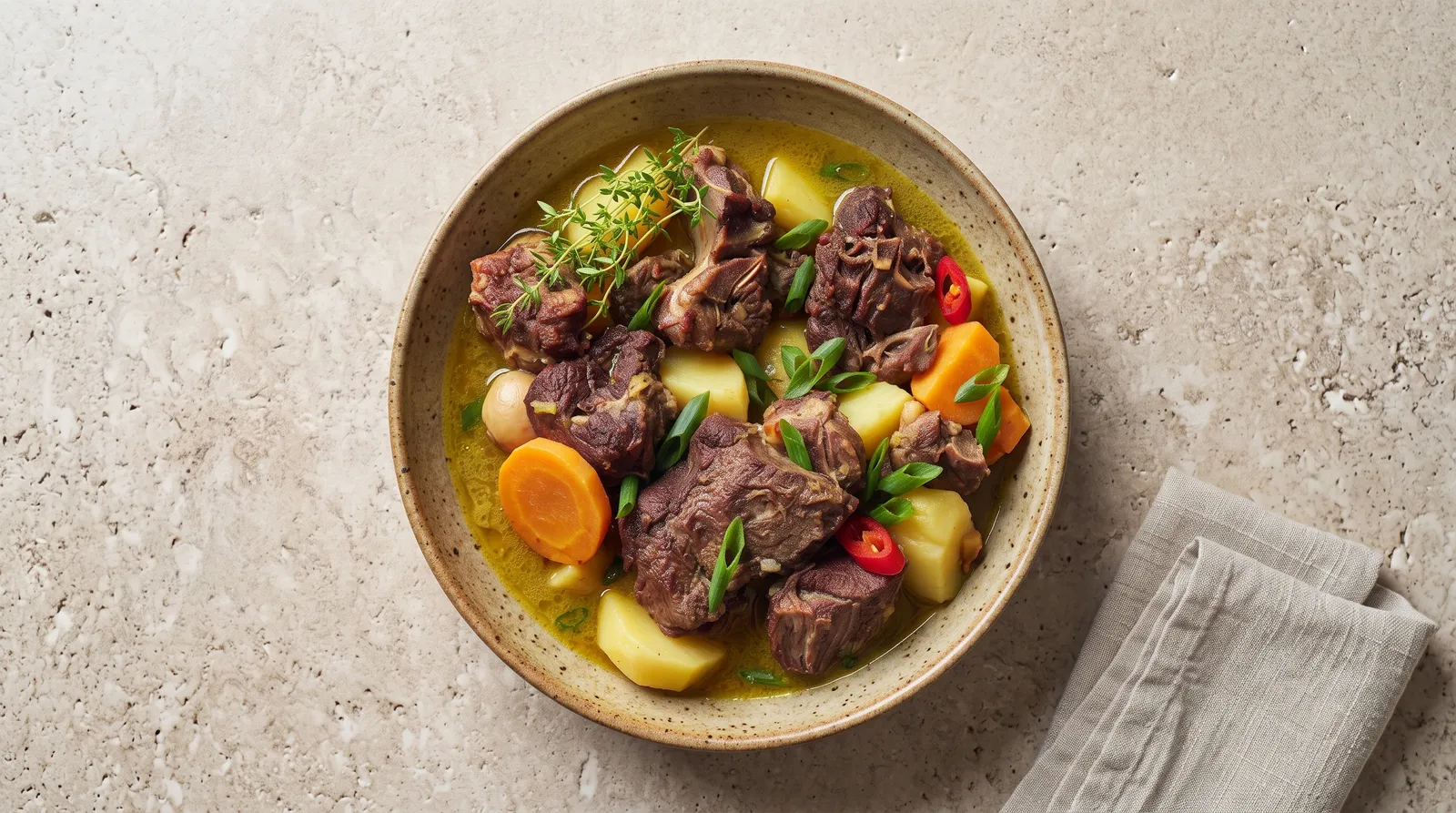
Cabri en sauce — served in a bowl
Cook 125 minutes after 35 minutes of active preparation
Passive 360 minutes, in addition to 125 minutes of cooking
Calories per serving 272 kcal; total elapsed time 520 minutes
Yield 6 main-course portions
Introduction and overview

Martinique-Style Cabri en Sauce (Goat Ragoût)

Cabri en sauce in this preparation is treated as a French Antillean goat ragoût, with a Martinique-style profile rather than the massalé seasoning associated with Réunion. Bone-in goat shoulder is marinated with red wine, lime, onion, garlic, ginger, chilli, allspice and clove, then browned before the marinade is cooked into the braising liquid. The finished sauce should be savoury and lightly thickened, not a spice-powder curry.

The six-hour marinade is both seasoning and cooking liquid, so it stays at 4 °C or below from the moment it touches raw goat. Before browning, the meat is drained and patted dry. This prevents the pot from steaming and allows real browned patches to develop. The reserved marinade is still raw-meat liquid at this stage; it is brought to a full boil in the pot before water is added, and it is never used uncooked as a finishing sauce.

Goat shoulder becomes tender through time and moist heat rather than a quick internal-temperature target. The stew simmers gently for roughly 95 minutes after the sauce is built, until a fork enters easily and meat near the bone loosens without springy resistance. Whole-cut goat has a lower safety minimum, but this dish is intentionally cooked well beyond that threshold to soften connective tissue. A short uncovered reduction at the end gives the sauce enough body to cling to the meat.
Success points

Success points

  • Keep the entire marinade stage refrigerated at 4 °C or below.
  • Drain and dry the goat before browning, and work in batches so the pot stays hot.
  • Boil reserved raw-meat marinade thoroughly in the stew before treating it as cooked liquid.
Ingredients

Ingredients

Goat and sauce

  • 1200 g bone-in goat shoulder, cut into 4–5 cm stew pieces
  • 250 ml dry red wine
  • 40 ml lime juice
  • 200 g onion, sliced
  • 20 g garlic, crushed
  • 15 g fresh ginger, grated
  • 5 g fresh mild chilli, finely chopped
  • 2 g allspice berries, crushed
  • 1 g whole cloves
  • 5 g thyme and parsley stems, tied as a bouquet
  • 30 ml neutral oil
  • 600 ml water
  • 12 g fine salt
  • 2 g black pepper, freshly ground
  • 15 g flat-leaf parsley, chopped, to finish
Method

Method

Marinate and brown

  1. Marinate under refrigeration. Combine the goat with the red wine, lime juice, half the onion, garlic, ginger, chilli, allspice, cloves, pepper and half the salt; cover and refrigerate. Leave it for 360 minutes. Temperature target: 4 °C. The meat is evenly coated with the aromatic marinade and remains thoroughly chilled. Cold marination seasons the meat without holding raw goat at room temperature. Marinate at 4 °C or below.

  2. Drain and dry the goat. Lift the goat from the marinade, drain well and pat the surface dry; reserve the marinade for cooking and keep it chilled. Continue for about 10 minutes. Temperature target: 4 °C. The meat surface is damp but no longer dripping, which allows it to brown rather than steam. A drier surface browns more efficiently. Keep the reserved raw-meat marinade at 4 °C or below until it is boiled in the stew.

  3. Brown in batches. Heat the oil in a heavy covered pot and brown the goat in batches, then remove it temporarily. Continue for about 15 minutes. The meat has browned patches on several sides and the pot has a dark aromatic fond without burnt black spots. Browning builds roasted flavour before long simmering.

Build and simmer the sauce

  1. Boil the marinade into the sauce. Lower the heat, soften the remaining onion for 5 minutes, return the goat and pour in the reserved marinade; boil the marinade thoroughly before adding the water, herb bouquet and remaining salt. Continue for about 10 minutes. Temperature target: 100 °C. The raw-meat marinade reaches a full boil before extra water is added and the pan fond has dissolved into the liquid. Reserved marinade must be cooked, not used as a raw finishing sauce. Bring reserved raw-meat marinade to a full boil as part of the stew.

  2. Simmer to tenderness. Cover and simmer gently until the goat is fork-tender and loosens easily near the bone. Continue for about 95 minutes. Temperature target: 95 °C. A fork enters the thickest meat with little resistance and meat near the bone pulls away without toughness. The cooking liquid has become a savoury, lightly thickened sauce. Long moist heat tenderizes goat shoulder connective tissue. The stew will normally exceed the 63 °C whole-cut goat safety minimum during the long simmer.

  3. Reduce and finish. Uncover, reduce the sauce until it coats the meat lightly, remove the herb bouquet and stir in the parsley. Continue for about 5 minutes. The sauce clings to the goat instead of running like thin broth and no raw alcohol aroma remains. A short final reduction concentrates the braising liquid.

Practical guidance

Practical

Practical guidance

Serve hot with plain rice, yam, sweet potato or another mild starch that can absorb the sauce. These accompaniments are optional and are not included in the stated nutrition.

Practical guidance

The six-hour marinade gives a useful same-day schedule, while the cooked stew can also be made a day ahead. Cool it promptly in shallow containers before refrigeration rather than leaving a deep hot pot at room temperature.

Practical guidance

Refrigerate cooked cabri at 4 °C or below for 3–4 days. Reheat leftovers to 74 °C throughout, loosening the sauce with a small amount of water only if it has tightened in the refrigerator.

Practical guidance

Boneless shoulder can be used by keeping the edible meat weight comparable. It usually becomes tender sooner and gives the sauce less body from bones, so start checking texture earlier.

Troubleshooting

Troubleshooting

  • The goat stays chewy.The simmer ended before connective tissue softened. Continue the gentle covered simmer and check again at 15-minute intervals.
  • The sauce is bitter.The fond or aromatics scorched during browning. Brown in batches over controlled heat and do not scrape truly burnt black deposits into the sauce.
Nutrition per serving

Nutrition per serving

  • Serving size1 of 6 portions
  • Calories272 kcal
  • Carbohydrate7 g
  • Protein33 g
  • Fat8 g
  • Fibre1 g
  • Sodium922 mg
Allergens and food safety

Allergens and food safety

Allergen note: Sulphites from red wine.

Safety: Keep raw goat and marinade at 4 °C or below.

Safety: Do not use uncooked reserved marinade as a sauce; boil it thoroughly in the stew.

Safety: Whole-cut goat has a minimum 63 °C safety endpoint with a rest, while the long stew is cooked substantially beyond that for tenderness.

Safety: Reheat leftovers to 74 °C.

Frequently asked questions

Frequently asked questions

Why is the goat still chewy after the stated simmer?

Age, cut size and connective tissue vary. Keep the simmer gentle and continue in 15-minute increments until a fork enters the meat with little resistance.

Can I serve the marinade as a cold sauce?

No. Once it has contacted raw goat it must be treated as raw and cooked thoroughly; it belongs in the braise, not on the table uncooked.

Closing

Closing

  • Result — fork-tender bone-in goat coated in a dark, aromatic Antillean ragoût sauce with wine, lime and warm spice.
  • Decisive technique — marinate cold, brown the drained goat properly and boil the raw-meat marinade before the long gentle simmer.