French Recipes

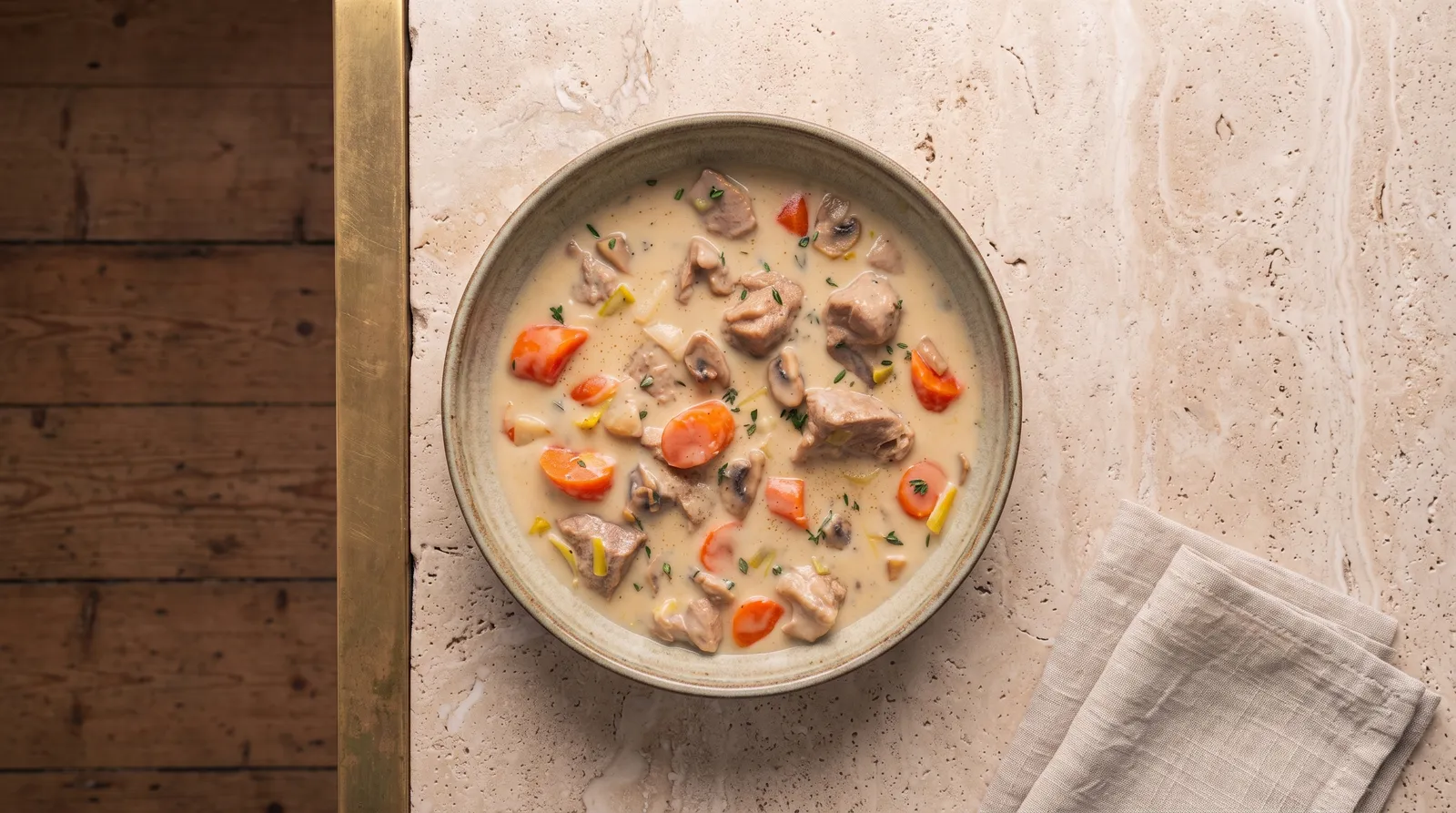
Blanquette de veau

Veal shoulder gently poached without browning in an aromatic broth, then served with pale mushrooms and pearl onions in a white roux sauce finished with cream, pasteurized egg yolks and lemon below a boil.

French Recipes
Share
Blanquette de veau — shown in a cooking pot
Prep 40 minutes
Cook 165 minutes
Total 205 minutes
Yield 6 main-course servings
About this dish

Classic blanquette de veau with mushrooms, pearl onions and cream-yolk liaison

Blanquette de veau depends on restraint. Unlike a browned veal stew, the meat begins in cold water and stays pale as it comes slowly to a simmer. Foam is skimmed, aromatic vegetables are added, and the shoulder cooks gently until fork-tender. This produces both tender meat and a light broth that can become the body of the sauce without carrying roasted colour or flavour.

The garnish is treated with the same pale approach. Button mushrooms are cooked gently without a dark crust, while pearl onions soften in a little broth. The sauce starts with a white roux: butter and flour are cooked long enough to lose rawness but not long enough to tan. Hot strained broth is whisked in gradually and simmered until the sauce coats the back of a spoon with a clean, thin film.

The final liaison is where temperature matters most. Cream and pasteurized egg yolks are tempered with hot sauce, then returned to the pan and heated gently to about 75 °C without boiling. Pasteurized yolks are used precisely because the sauce is not subjected to a hard boil after they enter. Lemon is added at the end with the veal and garnish, giving lift to a sauce that should remain pale, smooth and silky rather than curdled.
Success points

Success points

  • Do not brown the veal or white roux.
  • Skim early and keep the poach gentle.
  • Temper the pasteurized yolks gradually and keep the liaison below a boil.
Ingredients

Ingredients

Veal and aromatic broth

  • 1200 g veal shoulder, 4–5 cm cubes
  • 1500 ml water, cold, plus a little extra only if needed to keep meat barely covered
  • 200 g carrots, thick slices
  • 150 g leeks, washed, thick slices
  • 120 g yellow onion, halved
  • 1 whole clove
  • 2 bay leaves
  • 4 g fresh thyme
  • 10 g flat-leaf parsley stems
  • 8 g fine salt
  • 2 g white peppercorns

Garnish

  • 250 g small button mushrooms, trimmed
  • 200 g pearl onions, peeled
  • 20 g unsalted butter, for garnish cooking

Sauce and liaison

  • 60 g unsalted butter
  • 60 g wheat flour
  • 200 ml heavy cream, 30–35% fat
  • 3 pasteurized egg yolks
  • 30 ml fresh lemon juice
Method

Method

Poach the veal

  1. Start without browning. Put the veal in the pot with the cold water and bring slowly toward a 95 °C simmer, skimming foam as it rises for about 15 minutes. The liquid is clear enough to see the meat between small patches of foam after skimming, with no browning on the veal.

  2. Poach until tender. Add the carrots, leeks, onion with clove, bay, thyme, parsley stems, salt and peppercorns. Keep at a gentle 95 °C simmer for about 90 minutes. The veal is fork-tender with moist fibres, and the broth remains pale rather than aggressively reduced. Whole-cut veal must reach at least 63 °C; the long simmer takes it far beyond this minimum before the tenderness endpoint.

Cook garnish

  1. Cook the mushrooms gently. Melt half the garnish butter in a sauté pan and cook the mushrooms for about 10 minutes over medium-low heat. The mushrooms are tender and glossy, with little or no brown crust.

  2. Keep the pearl onions pale. Cook the pearl onions gently with the remaining garnish butter and a small ladle of strained broth for about 15 minutes. A knife enters the pearl onions easily and their surfaces remain pale.

Sauce and liaison

  1. Build a white roux. Lift out the veal and strain the broth. Melt the 60 g butter, stir in the flour and cook gently for about 10 minutes without colouring. The butter-flour paste smells lightly cooked but remains ivory, not tan or brown.

  2. Thicken the white sauce. Whisk about 900 ml of the hot strained broth gradually into the roux, then simmer for about 15 minutes. The sauce coats the back of a spoon in a thin even layer and a finger drawn through it leaves a clean path.

  3. Finish the liaison gently. Whisk the cream with the pasteurized yolks, then whisk in two ladles of hot sauce gradually. Return this mixture to the pan and heat gently to about 75 °C for up to 5 minutes without boiling. The finished sauce is smooth, glossy and lightly thickened with no curdled egg granules.

  4. Bring the blanquette together. Return the veal, mushrooms and pearl onions to the sauce, add the lemon juice and warm gently for about 5 minutes at about 75 °C. The veal, mushrooms and onions are hot throughout and evenly coated in a pale, silky sauce.

Practical guidance

Practical

Practical guidance

Serve with plain rice or boiled potatoes, which absorb sauce without competing with its delicate flavour. For make-ahead cooking, poach the veal and strain the broth one day in advance, then cool both promptly and refrigerate at 4 °C or colder. Prepare the roux and liaison during reheating for the cleanest texture. Fully assembled leftovers should be cooled within 2 hours, refrigerated for up to 3 days and reheated gently while stirring until meat and sauce reach 74 °C. Avoid a rolling boil, which can tighten veal and split the egg-enriched sauce. Substituting another meat may make a good white stew, but it is no longer blanquette de veau.

Troubleshooting

Troubleshooting

  • Sauce turns beige or brownVeal, mushrooms or roux were coloured too aggressively; lower heat and keep every component pale.
  • Sauce remains thinToo much broth entered the roux; use the measured amount and simmer until it coats the spoon.
  • Liaison forms eggy specksYolks were heated too quickly or the sauce boiled; use pasteurized yolks, temper gradually and stop at gentle heat.
Nutrition per serving

Nutrition per serving

  • Serving size1 main-course portion
  • Calories650 kcal
  • Carbohydrate18 g
  • Protein56 g
  • Fat39 g
  • Fibre3 g
  • Sodium820 mg
Allergens and food safety

Allergens and food safety

Allergens: Milk, Wheat/gluten, Egg.

Whole-cut veal must reach at least 63 °C; the dish continues cooking well beyond that until tender.

Use pasteurized egg yolks for the gently heated liaison.

Cool leftovers within 2 hours, refrigerate at 4 °C or colder and reheat to 74 °C.

FAQ

FAQ

Why use pasteurized egg yolks?

The liaison is intentionally kept below a hard boil, so pasteurized yolks give a conservative safety basis without sacrificing texture.

Can the finished blanquette be frozen?

It is possible from a safety standpoint after proper cooling, but the cream-and-yolk sauce can separate on thawing; refrigeration is preferred for quality.

Closing

Closing

  • Result: Fork-tender pale veal with mushrooms and pearl onions coated in a smooth, lightly lemony white sauce.
  • Decisive technique: Preserve whiteness from start to finish and treat the final cream-yolk liaison as a gentle temperature-controlled enrichment, never a boiling step.