French National Dishes

Tarte à l’oignon alsacienne

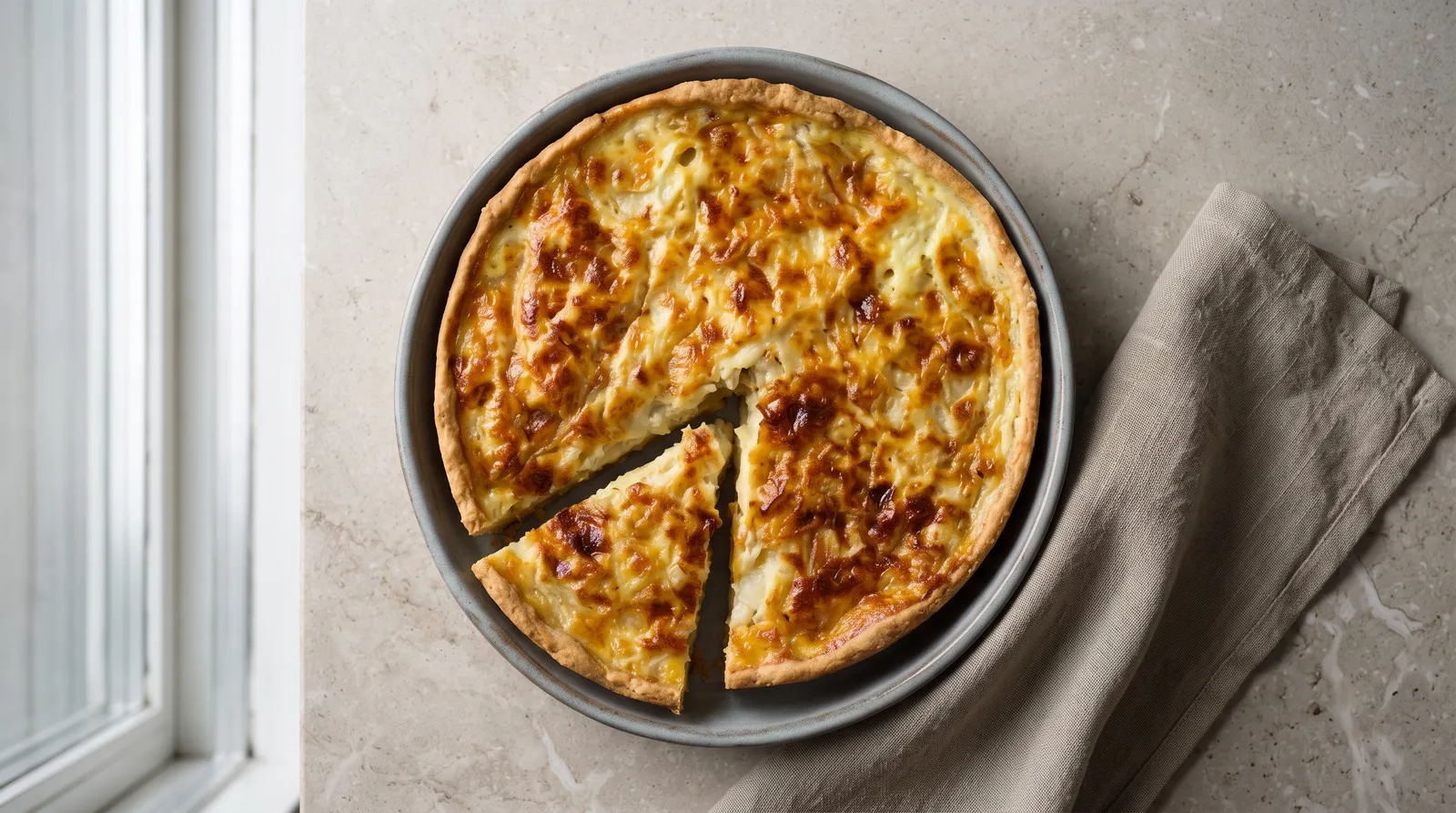
An Alsatian onion tart with a 3 mm shortcrust shell, slowly softened onions, smoked lardons and a restrained egg-cream custard baked to a safe set.

French National Dishes
Share
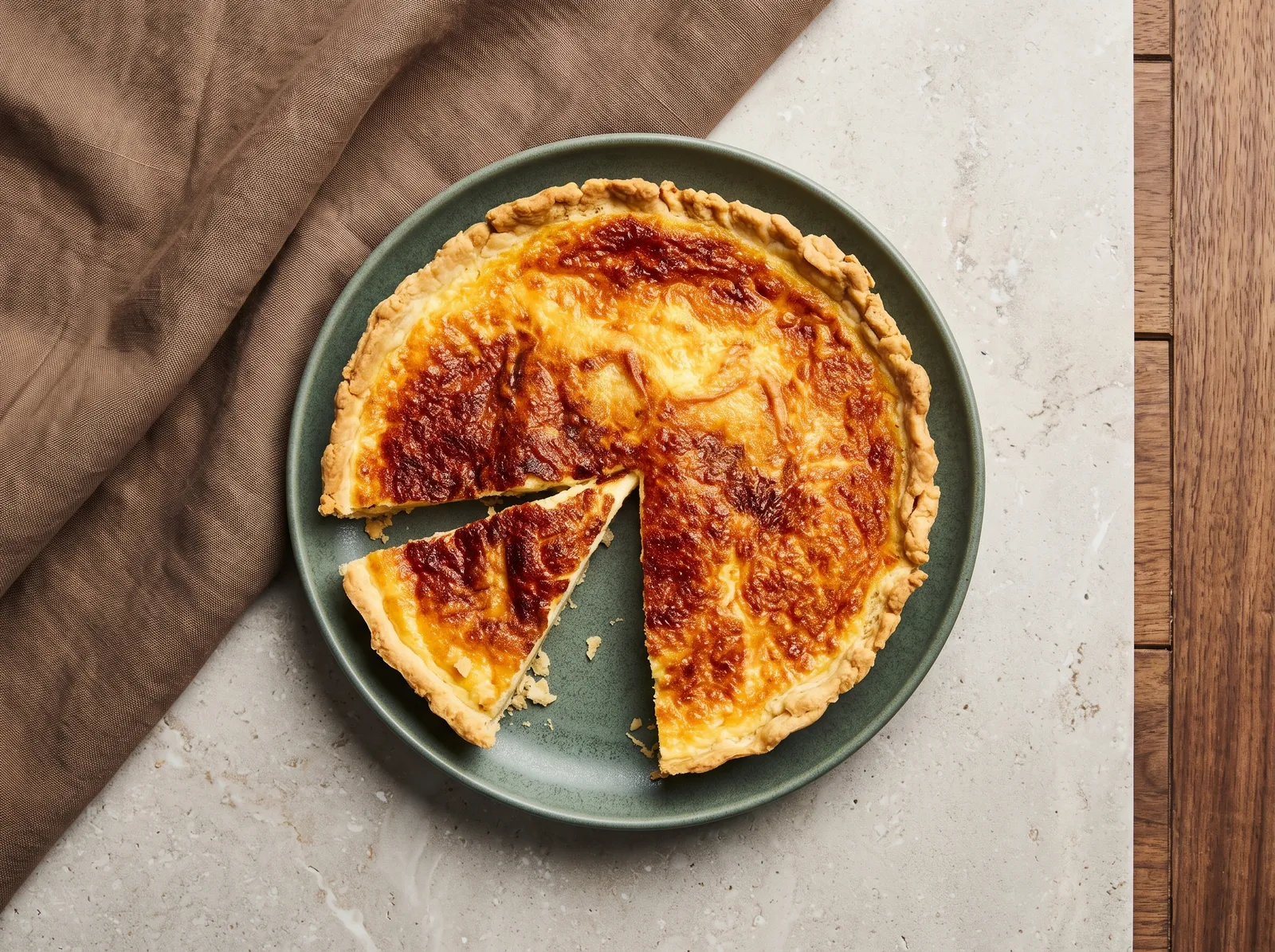
Tarte à l’oignon alsacienne — shown with a cut section visible
Prep 25 minutes
Cook 75 minutes
Total 190 minutes
Yield 1 × 28 cm tart, 8 slices
Introduction and overview

Tarte à l’oignon alsacienne — onion, lardon and custard tart

Alsatian tarte à l’oignon is a filled onion tart, not tarte flambée. The distinction matters in both construction and eating texture: a shortcrust shell supports a deep layer of cooked onions and an egg-dairy mixture, whereas tarte flambée is built on a very thin bread-like base and is baked as a flat, open topping.

The onions carry most of the volume, so they need patient heat. Their purpose is to soften, lose their harsh raw edge and become glossy without drying into a dark caramelised mass. A modest quantity of smoked lardons supplies savoury depth, while cream and milk keep the custard rich enough to bind the onions without turning the tart into a cheese-heavy quiche.

Two temperature changes protect the structure. First, the cooked onions are cooled before they meet the eggs, which prevents premature curdling. Second, the shell receives a blind bake before the wet filling is added. The final tart is ready when the centre has only a slight wobble and reaches at least 71 °C; resting for 15 minutes then gives neat slices.
Keys to success

Keys to success

  • Cook the onions slowly and stop before they become dry or deeply browned.
  • Blind-bake the 3 mm shell until the base looks dry.
  • Cool the onions before mixing them with the custard components.
Ingredients

Ingredients

Pastry

  • 250 g plain wheat flour
  • 125 g unsalted butter, cold, diced
  • 5 g fine salt — all allocated to the pastry; no additional salt is added to the custard
  • 80 ml cold water

Filling

  • 600 g yellow onions, peeled and thinly sliced — prepared weight from about 675 g purchased onions; about 11% peel/trim
  • 100 g smoked lardons
  • 10 ml neutral oil — retained with the onions
  • 200 g whole egg, beaten — about 4 large eggs without shell
  • 150 ml double cream or heavy cream — about 35% fat
  • 150 ml whole milk
  • 1 g ground nutmeg
  • 1 g black pepper, freshly ground
Method

Method

Directions

  1. Make the short pastry. Rub the butter into the flour and salt, add the cold water and bring the dough together without kneading it smooth. The dough forms a cohesive ball with visible small butter streaks and no dry flour. Minimal mixing keeps the crust tender. Keep the butter cool enough that it does not become oily.

  2. Rest the pastry. Wrap the dough and refrigerate it for a full hour. The dough is firm and relaxed enough to roll without sticking badly. A cold rest hydrates the flour and firms the butter. Keep the dough chilled until rolling.

  3. Soften the onions slowly. Heat the 10 ml neutral oil in a large sauté pan over low heat. Add the onions and lardons and cook for 25 minutes, stirring often so the onions collapse and sweeten without frying dry. The onions are soft and translucent with only light golden edges, and the lardons are cooked without the onions drying out. Slow cooking removes raw onion bite while preserving moisture for the filling. Cook pork fully and avoid splattering hot fat.

  4. Cool the onion filling. Spread the onions and lardons on a wide tray and cool for 15 minutes before they meet the custard. The onion mixture is warm rather than steaming and no pool of hot fat sits on the tray. Cooling protects the egg-cream mixture from premature setting. Do not leave the cooked filling at room temperature beyond this 15-minute cooling interval.

  5. Blind-bake the shell. Roll the cold pastry to about 3 mm, line the 28 cm tart tin, prick the base and blind-bake at 180 °C for 20 minutes. The base looks dry and pale-gold, with the sides set and no raw-looking patches. Blind baking gives the wet onion custard a head start against a soggy base. Handle the hot baking weights and tin with oven gloves.

  6. Mix the custard. Whisk the measured eggs with the cream, milk, nutmeg and pepper for 5 minutes, until completely uniform. Do not add salt here; all 5 g is already in the pastry. The custard is uniform, with no visible streaks of egg white. A homogeneous custard sets evenly around the onions. Keep the dairy and eggs chilled until mixing.

  7. Fill and bake the tart. Distribute the cooled onions and lardons evenly in the shell, pour in the custard and bake at 180 °C for 30 minutes. The centre is set with only a slight wobble, the surface is golden, and the custard reaches at least 71 °C. The temperature confirms the egg custard is safely set. Measure the centre with a clean thermometer without touching the metal tin.

  8. Rest before cutting. Leave the tart in its tin for 15 minutes so the custard settles before slicing. The custard has stopped actively bubbling and slices hold their shape when cut. A short rest stabilises the custard and keeps the filling from spilling out. Refrigerate leftovers within 2 hours.

Serving

Practical

Serving

Serve warm after the 15-minute rest. A sharp green salad provides contrast to the butter, cream and lardons without competing with the onion filling.

Storage and reheating

Refrigerate leftovers within 2 hours at 4 °C or below for up to 3 days. Reheat slices in a moderate oven until the centre reaches 74 °C; this is kinder to the crust than a microwave.

Make-ahead and substitutions

The dough and cooked onions can be prepared separately the day before and chilled. Omitting lardons makes a meat-free onion tart but removes smoke and cured-pork salt; crème fraîche of similar richness can replace the cream, bringing more tang and a slightly thicker set.

Troubleshooting

Troubleshooting

  • Soggy pastryThe shell was not sufficiently blind-baked or the onions carried too much hot moisture. Dry the shell properly and cool the filling before assembly.
  • Custard leaks from the first sliceThe tart was cut too soon. Leave it for the full 15-minute rest so the proteins finish settling.
Nutrition per serving

Nutrition per serving

  • Serving size1 slice, 1 of 8
  • Calories422 kcal
  • Carbohydrate32.6 g
  • Protein10.2 g
  • Fat28.0 g
  • Fibre2.1 g
  • Sodium500 mg
Allergens and food safety

Allergens and food safety

Allergens: egg, milk, gluten.

Bake the egg custard until the centre reaches at least 71 °C.

Refrigerate the finished tart within 2 hours and keep at 4 °C or below.

Reheat leftover filling to 74 °C.

FAQ

FAQ

Is this the same as tarte flambée?

No. The pastry, depth and egg-based filling make it a different Alsatian preparation.

Must the onions caramelise?

No. They should soften and sweeten gently, with only light colour at the edges.

Closing

Closing

  • Result: A crisp shortcrust base carrying soft onions, smoky lardons and a just-set savoury custard.
  • Decisive technique: Soften and cool the onions, then give the pastry a head start with a proper blind bake.