French National Dishes

Tarte au citron meringuée

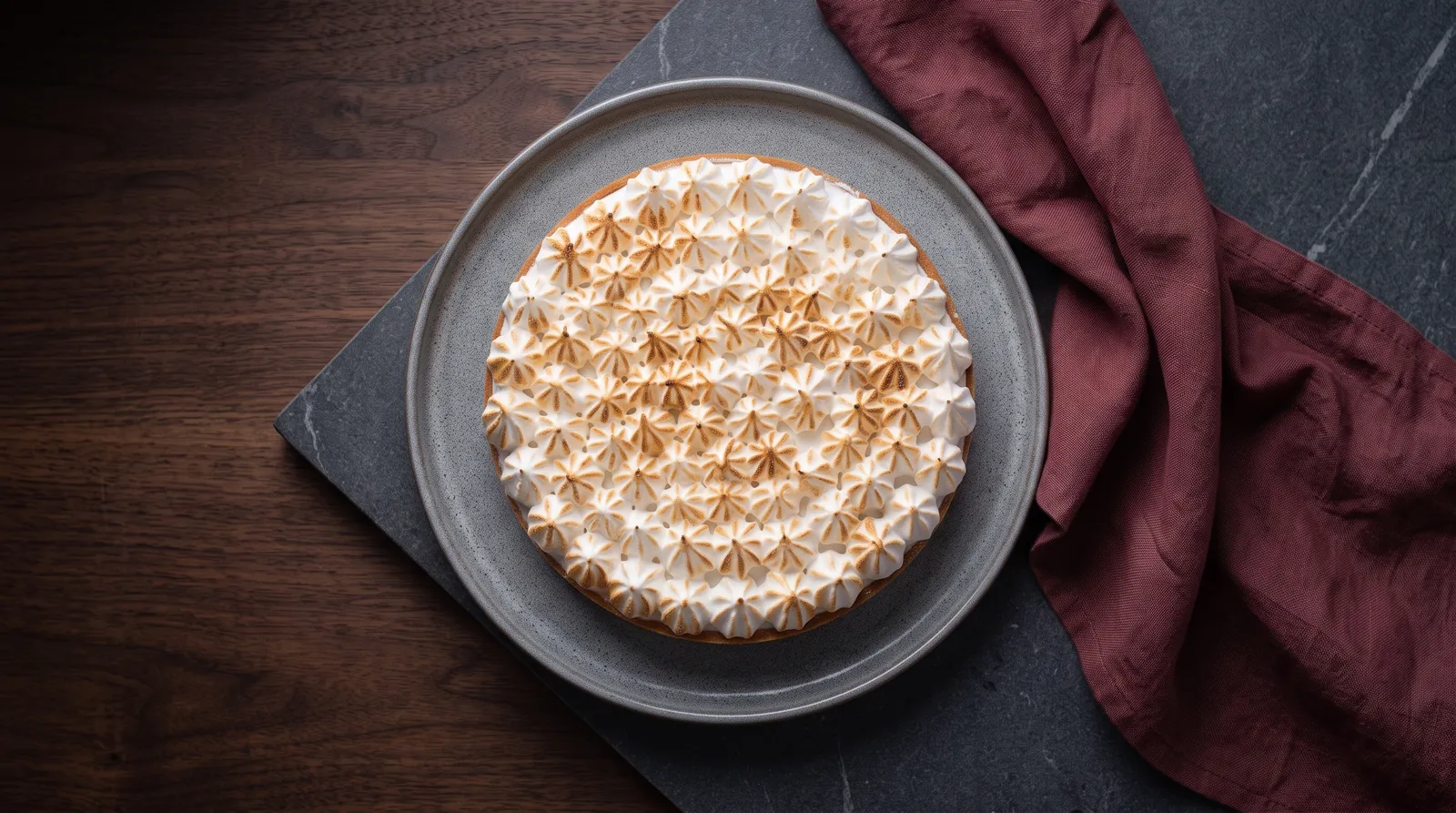
A fully baked sweet shell filled with sharp cooked lemon curd and topped with stable Italian meringue, browned briefly only after the filling is thoroughly cold.

French National Dishes
Share
Tarte au citron meringuée — displayed on a cake stand
Prep 20 minutes
Cook 50 minutes
Total 340 minutes
Yield 1 × 24 cm tart, 8 slices
Introduction and overview

Tarte au citron meringuée — lemon tart with Italian meringue

Tarte au citron meringuée depends on three different textures staying distinct: a crisp sweet pastry shell, a concentrated lemon curd and a soft, stable meringue. The filling is not cheesecake and should not rely on cream cheese for body. Eggs, lemon, sugar and butter make the curd, while a small amount of cornstarch adds insurance for clean slicing without muting the acidity.

The shell is baked completely before it meets the filling. That matters because the curd is poured in hot and later held cold; an under-baked crust has no chance to dry once it is filled. The curd is cooked with constant stirring to 82 °C, high enough for a safe egg set and a glossy spoon-coating texture, then finished with cold butter away from direct heat.

Italian meringue gives the tart a more stable topping than raw French meringue. Sugar syrup at 118 °C is poured into pasteurized whites while they whip, then the foam is beaten until thick and glossy. The syrup is dangerously hot, so precision is a safety issue as well as a pastry technique. The topping goes onto fully chilled curd and is browned only briefly, preserving the clean lemon layer underneath.
Keys to success

Keys to success

  • Bake the shell until genuinely golden and dry, not merely set.
  • Stir the curd continuously and use a thermometer rather than judging safety by thickness alone.
  • Put meringue only on cold curd and brown it quickly.
Ingredients

Ingredients

Sweet pastry

  • 200 g plain wheat flour
  • 100 g unsalted butter, cold, diced
  • 70 g icing sugar
  • 50 g whole egg, beaten — about 1 large egg without shell
  • 2 g fine salt

Lemon curd

  • 150 ml fresh lemon juice — from about 4–5 lemons
  • 8 g finely grated lemon zest — yellow zest only
  • 150 g granulated sugar
  • 150 g whole egg, beaten — about 3 large eggs without shell
  • 100 g unsalted butter, cold, diced
  • 10 g cornstarch

Italian meringue

  • 90 g pasteurized egg whites, room temperature
  • 180 g granulated sugar
  • 60 ml water
Method

Method

Directions

  1. Make the sweet pastry. Rub the butter into the dry ingredients, add the measured egg and bring the pastry together without prolonged kneading. The pastry forms a smooth disc with no dry flour and is not elastic or greasy. Short mixing keeps the baked shell crisp and tender. Keep the remaining eggs and whites refrigerated until needed.

  2. Chill the pastry. Flatten the dough into a disc, wrap it and refrigerate for 1 hour. The pastry is firm enough to roll cleanly without sticking or smearing butter. Chilling relaxes gluten and firms the butter. Keep the egg-rich pastry cold.

  3. Blind-bake the shell. Roll the cold pastry to 3 mm, line the ring and blind-bake until the base is dry and golden. The shell is evenly golden, dry on the base and firm at the rim. A fully baked shell resists the moisture of the lemon curd. Use oven gloves when handling the hot ring and baking weights. Keep the oven at 180 °C.

  4. Cool the shell. Move the shell to a rack and leave it until no warmth remains. The shell is completely cool and crisp to a light touch. A cool shell prevents the butter-rich curd from softening the pastry immediately. Keep the shell in a clean area while it cools.

  5. Cook the lemon curd. Whisk the eggs, sugar and cornstarch first, then add lemon juice and zest; cook with constant stirring until thick and 82 °C before blending in the butter off the heat. The curd reaches 82 °C, thickens enough to leave a clear whisk trail, and looks glossy after the butter is incorporated. The higher-than-minimum egg temperature gives a stable curd while keeping the lemon flavour bright. Beware hot acidic steam and stir continuously to avoid scorching or curdling.

  6. Chill the filled tart. Fill the cool shell with the hot curd, smooth the surface and refrigerate until fully set. The lemon layer is cold, firm to a gentle touch and does not ripple when the tart is moved. A fully chilled curd supports the meringue cleanly. Refrigerate at 4 °C or below.

  7. Make the Italian meringue. Cook the sugar syrup precisely, start the pasteurized whites before the syrup is ready, then stream the 118 °C syrup into the moving whites and whip until glossy and firm. The syrup reaches 118 °C and the finished meringue is thick, glossy and forms firm peaks while the bowl has cooled noticeably. Hot syrup creates a stable Italian meringue; pasteurized whites add a safety margin. Boiling sugar causes severe burns: pour in a thin stream down the side of the bowl and keep hands clear of splashes.

  8. Brown the meringue. Cover the cold lemon layer with meringue and place it under a hot grill only long enough to toast the peaks. The meringue has an even toasted surface with pale-gold peaks and no blackened patches. Brief top heat colours the meringue without reheating the curd deeply. Watch continuously under the grill because sugar browns quickly.

  9. Set before slicing. Chill the decorated tart for another hour before cutting with a clean hot knife. The tart is cold throughout, the curd cuts cleanly and the meringue stays attached to the lemon layer. A final chill gives the cleanest slices. Keep at 4 °C or below and return leftovers to the refrigerator promptly.

Serving

Practical

Serving

Serve the tart cold in 8 slices. Warm a knife in hot water, wipe it dry and cut straight down for the cleanest layers.

Storage and reheating

Because the tart contains egg, butter and meringue, keep it at 4 °C or below and use within 3 days. Reheating ruins the set and can make the meringue weep, so serve directly from refrigeration after a brief slicing setup.

Make-ahead and substitutions

The shell and lemon layer can be completed a day ahead. Add the meringue on the serving day if appearance matters most. Fresh lemon juice gives the clearest aroma; bottled pure lemon juice can supply acidity in a pinch, but it cannot replace the fragrance of fresh zest.

Troubleshooting

Troubleshooting

  • Curd remains fluid after chillingIt probably did not reach 82 °C, or it was sliced before the full chill. Recheck temperature control on the next batch.
  • Meringue slides or releases syrupThe lemon layer was too warm or the meringue was under-whipped. Chill the curd fully and whip until the bowl cools and firm peaks form.
Nutrition per serving

Nutrition per serving

  • Serving size1 slice, 1 of 8
  • Calories514 kcal
  • Carbohydrate71.8 g
  • Protein7.2 g
  • Fat23.0 g
  • Fibre0.7 g
  • Sodium157 mg
Allergens and food safety

Allergens and food safety

Allergens: egg, milk, gluten.

Cook the lemon curd to 82 °C, above the 71 °C minimum used for egg custards.

Use pasteurized egg whites for the Italian meringue.

Keep the finished tart at 4 °C or below and refrigerate within 2 hours of serving.

Handle the 118 °C sugar syrup as a severe burn hazard.

FAQ

FAQ

Why use pasteurized whites if the syrup is hot?

The topping is served cold and the syrup may not heat every part of the whites uniformly to the egg-dish safety threshold, so pasteurized whites provide a conservative basis.

Can the meringue be browned with a torch?

A torch is technically valid, but a short grill finish gives consistent browning with common household equipment.

Closing

Closing

  • Result: Crisp pastry, a bright firm lemon layer and a glossy toasted meringue that cuts without sliding.
  • Decisive technique: Fully bake and cool the shell, cook the curd to temperature, then keep the filling cold before adding hot-syrup meringue.