French National Dishes

Saucisson brioché

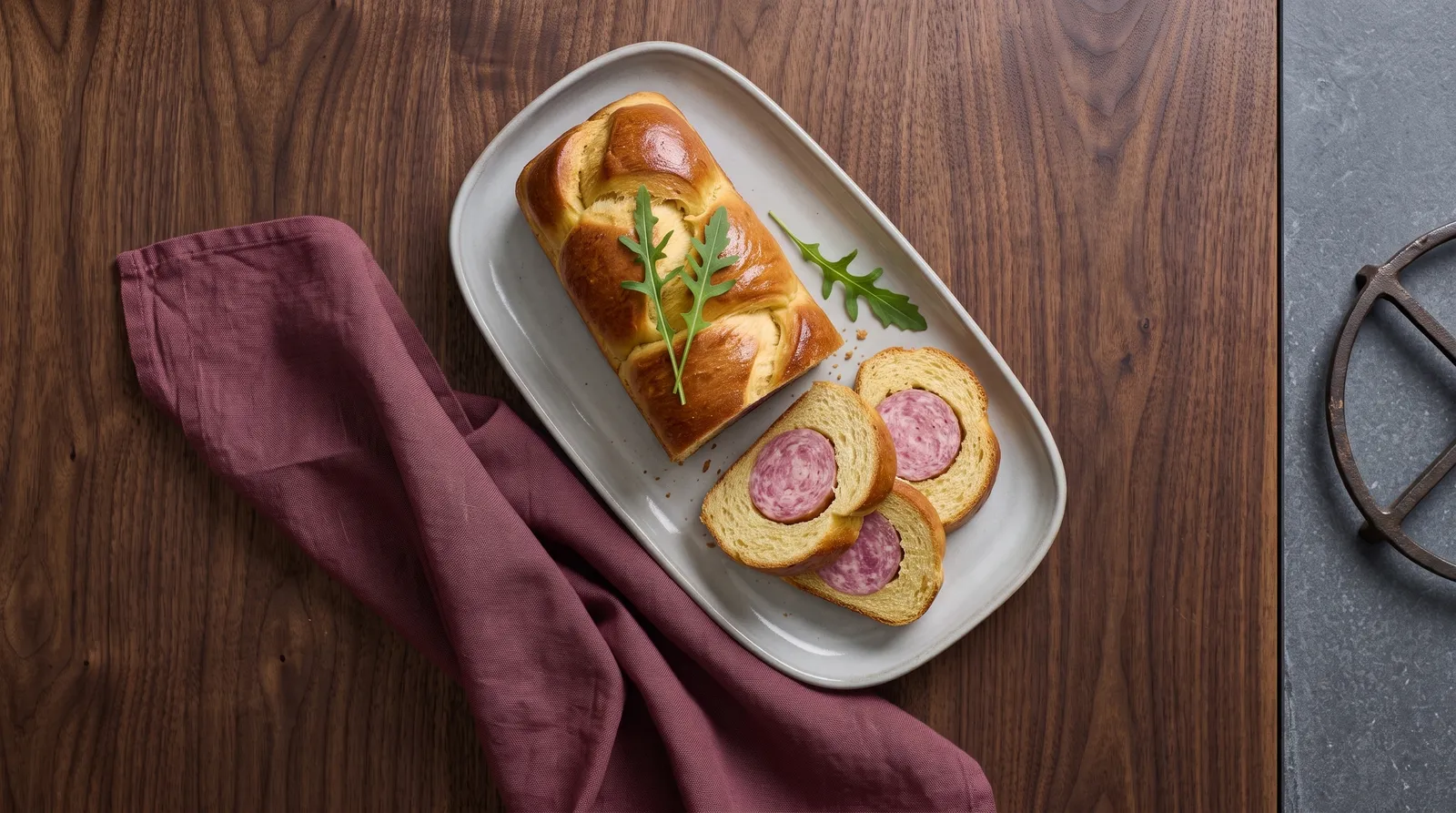
A cooked Lyon-style sausage enclosed in buttery yeasted brioche, proofed as one loaf and baked until the crumb is set.

French National Dishes
Share
Saucisson brioché — shown with a cut section visible
Prep 30 minutes
Cook 65 minutes
Total 220 minutes
Yield 1 loaf, 8 thick slices
Introduction and overview

Lyonnais saucisson brioché

Saucisson brioché is a Lyonnais preparation built as one loaf: a substantial cooked sausage sits inside enriched brioche, rather than appearing as slices in a sausage roll. The contrast depends on two components being handled separately before assembly. The sausage is gently poached, cooled and dried; the brioche is kneaded until elastic and given a full first rise.

The timings overlap by design. While the brioche spends 75 minutes on its first proof, the sausage can simmer for 30 minutes and cool for another 30. That overlap is already reflected in the total schedule, so the loaf does not require adding those two periods again. A dry sausage surface matters because wet casing makes the enriched dough slip and can leave a gummy seam.

Once wrapped, the loaf receives a 30-minute final proof before egg glaze and baking at 180 °C. The brioche should be deep golden and fully set beside the sausage, while the centre of the assembled loaf reaches at least 74 °C. A 20-minute rest after baking is not optional dead time: it allows the enriched crumb to stabilise so the slices stay neat around the sausage.

Success points

Success points

  • Knead until the enriched dough is smooth, elastic and glossy.
  • Poach the sausage without piercing, then cool and dry it thoroughly before wrapping.
  • Centre the sausage and seal the brioche seam underneath.
  • Let the baked loaf rest for 20 minutes before cutting thick slices.
Ingredients

Ingredients

Saucisson

  • 450 g Lyon-style saucisson à cuire, 1 plain raw cooking sausage

Brioche

  • 250 g plain wheat flour, plus 10 g counted separately for dusting
  • 8 g instant dry baker's yeast
  • 150 g whole eggs, 3 large eggs for the dough
  • 50 ml whole milk, lukewarm
  • 15 g caster sugar
  • 5 g fine salt
  • 125 g unsalted butter, soft, cut into cubes
  • 10 g plain wheat flour, for dusting and the sausage surface
  • 50 g whole egg, 1 egg, beaten, for glazing
Method

Method

Prepare the dough and sausage

  1. Mix and knead the brioche. Mix 250 g flour, yeast, sugar, salt, 150 g egg and 50 ml milk until no dry flour remains, then knead while adding the 125 g soft butter gradually until the dough is smooth, elastic and glossy. Use stand mixer with dough hook. Allow 15 minutes. The dough is smooth, elastic and glossy, and stretches thinly without immediately tearing. Gradual butter incorporation lets the gluten structure form before enrichment fully coats it. Keep raw egg refrigerated until mixing.

  2. First proof. Cover the dough and let it rest while it rises at a moderate room temperature. Use mixing bowl. Allow 75 minutes passive rest. The dough has expanded to roughly twice its starting volume and feels aerated. A full first proof gives the enriched dough enough gas and extensibility for wrapping. Keep the proofing area below 24 °C.

  3. Poach and cool the saucisson. While the dough proofs, place the saucisson in barely simmering water and cook for 30 minutes, then lift it out, confirm 71 °C, cool for 30 minutes, peel and dry it thoroughly. Use large saucepan, rack, thermometer. Keep to gentle simmer. Allow 30 minutes cooking plus 30 minutes cooling concurrent with the first proof. The sausage centre reaches 71 °C, and after cooling its surface is dry enough for flour to cling. Cooling and drying prevent steam and surface moisture from creating a gummy tunnel inside the brioche. After cooling, refrigerate the cooked sausage if the dough is not ready; cumulative room-temperature exposure must remain under 2 hours.

Wrap, proof and bake

  1. Wrap the sausage. Knock back the dough, roll it to an even rectangle, dust the cooled dry sausage lightly with the 10 g flour, enclose it completely and place seam-side down in a buttered or lined 23 × 10 cm loaf tin. Use rolling pin, 23 × 10 cm loaf tin. Allow 15 minutes. The sausage is centred and fully enclosed by an even layer of dough with the seam sealed underneath. An even dough envelope promotes a regular slice and limits empty gaps. Use the cooked, cooled sausage rather than warm meat.

  2. Final proof. Cover the loaf loosely and let it rest while it rises again at no more than 24 °C. Use loaf tin. Keep to room temperature. Allow 30 minutes passive rest. The brioche looks visibly puffy and a light fingertip press springs back slowly. A short final proof gives the wrapped loaf volume without holding cooked meat warm for too long. Keep this final proof to 30 minutes and within the cumulative two-hour room-temperature limit for the cooked sausage.

  3. Glaze and bake. Brush with the 50 g beaten egg and bake at 180 °C until the brioche is deeply golden and fully set around the sausage. Use oven, pastry brush, loaf tin, thermometer. Keep to 180 °C oven. Allow 35 minutes. The crust is deep golden, the brioche at the side of the sausage is set rather than gummy and the loaf centre is at least 74 °C. The 74 °C centre criterion safely reheats the previously cooked meat while the crumb finishes baking. Steam escapes when the loaf is cut; check the centre temperature before removing from the oven.

  4. Rest before slicing. Move the loaf to a rack and rest it before cutting into eight thick slices. Use wire rack, serrated knife. Allow 20 minutes passive rest. The crumb has settled enough to slice cleanly without compressing around the sausage. A short rest sets the enriched crumb and reduces tearing. Do not leave the meat-filled loaf at room temperature for extended holding.

Serving

Practical

Serving

Cut the loaf into eight thick slices after the 20-minute rest. Serve warm rather than piping hot so the brioche crumb and sausage stay distinct when cut.

Make-ahead

The sausage may be poached and chilled one day ahead, then dried before use. The complete shaped loaf is better proofed and baked the same day because prolonged refrigeration changes the timing of the enriched yeast dough.

Storage and reheating

Refrigerate leftover slices within 2 hours and use within 3 days. Reheat covered in a moderate oven until the sausage centre reaches 74 °C; uncover briefly at the end if the brioche surface needs drying. Freezing baked slices is possible, but the crumb is slightly less tender after thawing.

Substitutions

Use a plain cooked Lyon-style sausage of similar size if the exact product is unavailable, and name the adaptation. A dry cured salami is not suitable because its texture, salt level and cooking behaviour are different.

Nutrition per serving

Nutrition per serving

  • Serving size1 of 8 thick slices
  • Calories445 kcal
  • Carbohydrate26 g
  • Protein16 g
  • Fat30 g
  • Fibre1 g
  • Sodium810 mg
Allergens and food safety

Allergens and food safety

Allergen: gluten (wheat)

Allergen: egg

Allergen: milk

Cook the raw saucisson to 71 °C during poaching.

Cool and dry the cooked sausage promptly; refrigerate it if assembly is delayed.

Keep the 30-minute final proof at or below 24 °C and keep cumulative room-temperature exposure of cooked meat under 2 hours.

Bake until the centre reaches at least 74 °C.

Refrigerate leftovers within 2 hours and reheat to 74 °C.

FAQ

FAQ

Why cool the sausage before wrapping it?

A hot or wet sausage softens the dough and can create a gummy layer where the brioche touches the casing.

Can the first proof and sausage cooling overlap?

Yes. The sausage is poached and cooled during the brioche’s first 75-minute proof, which is why the total time does not simply add every clock interval.

Closing

Closing

  • Result: A cooked Lyon-style sausage enclosed in buttery yeasted brioche, proofed as one loaf and baked until the crumb is set.
  • Decisive technique: Knead until the enriched dough is smooth, elastic and glossy.