French National Dishes

Sole meunière

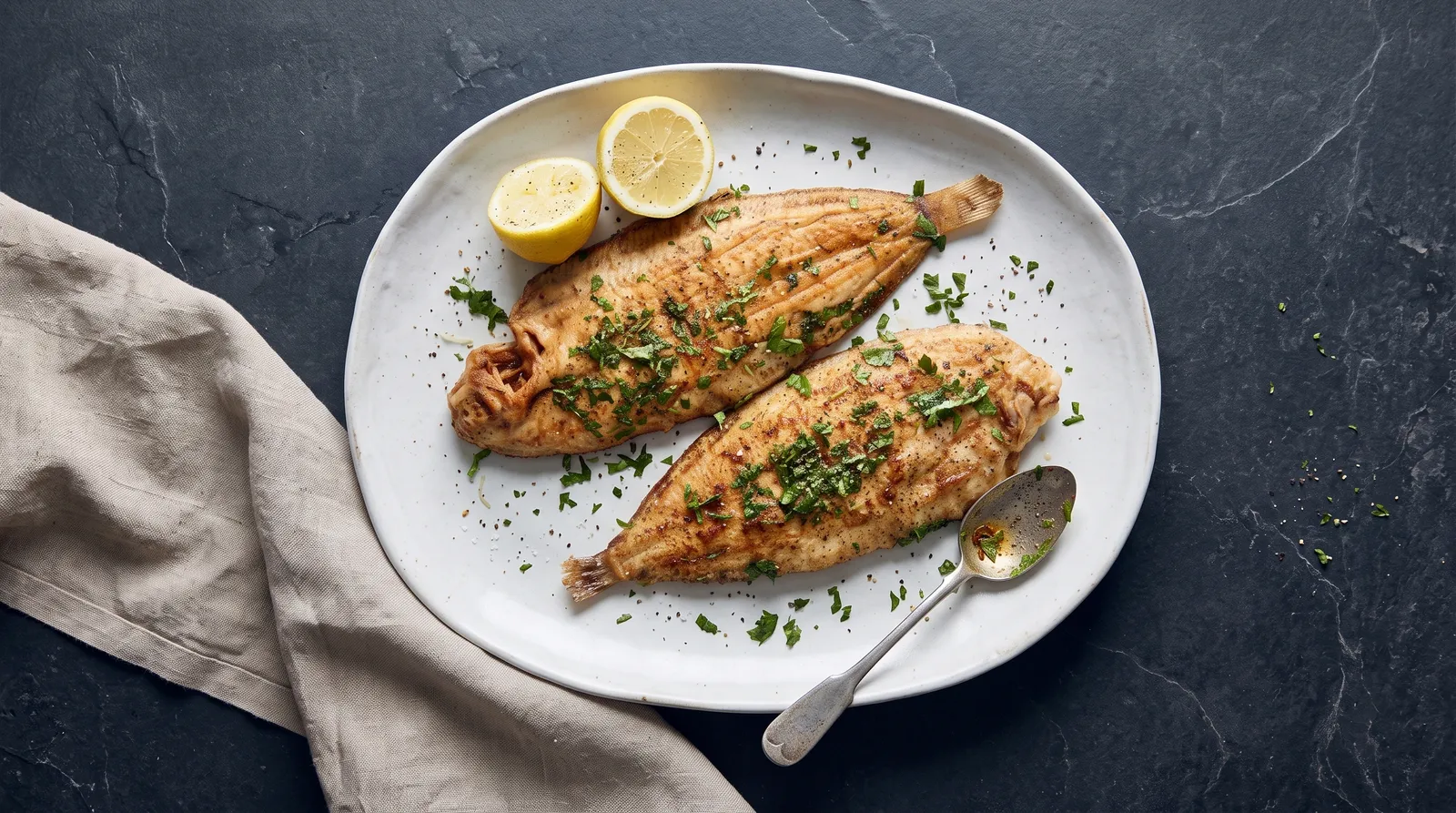
Whole sole lightly coated with flour, pan-cooked in butter and finished with nut-brown butter, lemon and parsley.

French National Dishes
Share
Sole meunière — arranged on a board
Prep 20 minutes
Cook 15 minutes
Total 35 minutes
Yield 4 whole-fish portions
Introduction and overview

Sole meunière with brown butter, lemon and parsley

Sole meunière is defined by restraint: delicate sole, a light coating of flour, butter, lemon and parsley. It is not breaded fried fish and it does not need cream. Whole cleaned sole gives the preparation its classic shape, but the edible yield is lower than the purchased weight because head and bones are not eaten.

The flour should be a thin veil, not a crust. Drying the fish first helps only about 30 g of the 60 g supplied flour adhere across four soles; excess is shaken away rather than counted as part of the meal. Cook in two batches over medium heat so the butter can brown the fish without scorching before the thickest edible section reaches 63 °C.

The final butter is taken to a hazelnut-brown stage, then moved off the heat before lemon and parsley finish the sauce. Brown specks are desirable milk solids; black specks signal burnt butter and should not be confused with the intended nutty stage. Spoon the finishing butter over the fish immediately so the flour coating absorbs the sauce without becoming soggy from prolonged holding.
Success points

Success points

  • Check the cleaned sole carefully for remaining bones and keep it cold until cooking.
  • Dry the surface before flouring and shake off every thick patch.
  • Cook in two batches so the pan temperature stays controlled.
  • Brown the finishing butter to hazelnut colour, not black.
Ingredients

Ingredients

  • 1200 g whole portion sole, 4 fish of about 300 g each, cleaned and skinned; about 720 g edible flesh after bones/head
  • 60 g plain wheat flour, for dusting; nutrition assumes 30 g adheres to the fish
  • 160 g unsalted butter, 100 g for pan-cooking and 60 g for finishing; nutrition assumes 130 g retained/served
  • 80 g lemon juice, freshly squeezed
  • 15 g flat-leaf parsley, finely chopped
  • 4 g fine salt
  • 1 g black pepper, finely ground
Method

Method

Prepare and pan-cook

  1. Dry and flour the soles. Check the four prepared soles for remaining bones, pat completely dry, season with salt and pepper, dust lightly with the 60 g flour and shake off the excess. Use tray, paper towel, shallow flour dish. Allow 10 minutes. The fish carry only a thin, even veil of flour with no thick patches or wet flour clumps. Dry fish and a thin flour coating promote even browning without a breaded crust. Keep the fish cold until immediately before flouring and cooking.

  2. Cook in two batches. Melt 50 g of the pan-cooking butter in a 30 cm frying pan. Cook two soles, turning once; transfer to a warm platter, repeat with the second 50 g butter and remaining two fish, and verify each fish reaches 63 °C. Use 30 cm frying pan, fish spatula, thermometer. Keep to medium heat. Allow 12 minutes total (two batches of 6 minutes). Each sole is lightly golden, releases from the pan without tearing and reaches 63 °C in the thickest edible section. Two batches prevent crowding and make the delicate fish easier to turn. Use a thermometer at the thickest edible section and keep raw-fish utensils separate from the cooked platter.

Finish the sauce

  1. Brown the finishing butter. Add the 60 g finishing butter to the clean or wiped pan and heat until the milk solids turn hazelnut-brown and smell nutty, not burnt; remove from the heat and add lemon juice and parsley carefully. Use small frying pan or cleaned fish pan. Keep to medium heat then off heat. Allow 3 minutes. The butter is hazelnut-brown with a nutty aroma and no black burnt specks. Controlled browning develops the defining beurre noisette character of the finish. Lemon added to hot butter can spit; add it off the heat and away from the face.

Serving

Practical

Serving

Serve one whole sole per person with its share of brown butter, lemon and parsley. Plate immediately because the light flour coating is most delicate just after saucing.

Make-ahead

The fish can be cleaned and checked for bones ahead, then kept covered and refrigerated. Flour only shortly before cooking so the coating stays dry and light.

Storage and reheating

Refrigerate leftovers within 2 hours and use within 2 days. Reheat gently until the thickest edible section reaches 74 °C; the fish will be firmer and the butter coating less delicate than when freshly cooked. Freezing is not recommended for best texture.

Substitutions

Another flatfish can be cooked meunière-style, but it should be named for that fish rather than presented as sole meunière. Margarine or cream would materially change the butter-based character.

Nutrition per serving

Nutrition per serving

  • Serving size1 whole sole portion with meunière butter
  • Calories415 kcal
  • Carbohydrate7 g
  • Protein32 g
  • Fat29 g
  • Fibre0 g
  • Sodium430 mg
Allergens and food safety

Allergens and food safety

Allergen: fish

Allergen: milk

Allergen: gluten (wheat)

Keep whole sole refrigerated and check carefully for bones.

Cook the thickest edible part to 63 °C.

Avoid cross-contamination between raw fish tools and the cooked platter.

Refrigerate leftovers within 2 hours and reheat to 74 °C when reheating.

FAQ

FAQ

Is sole meunière breaded?

No. The fish receives only a light flour coating; there is no breadcrumb crust.

What does the finishing butter look like?

It should be hazelnut-brown and nutty-smelling, with browned milk solids but no black burnt specks.

Closing

Closing

  • Result: Whole sole lightly coated with flour, pan-cooked in butter and finished with nut-brown butter, lemon and parsley.
  • Decisive technique: Check the cleaned sole carefully for remaining bones and keep it cold until cooking.