French National Dishes

Quatre-quarts breton

A Breton butter cake built from one exact rule: weigh the shelled eggs first, then use the same weight of sugar, flour and demi-sel butter for a moist, close crumb.

French National Dishes
Share
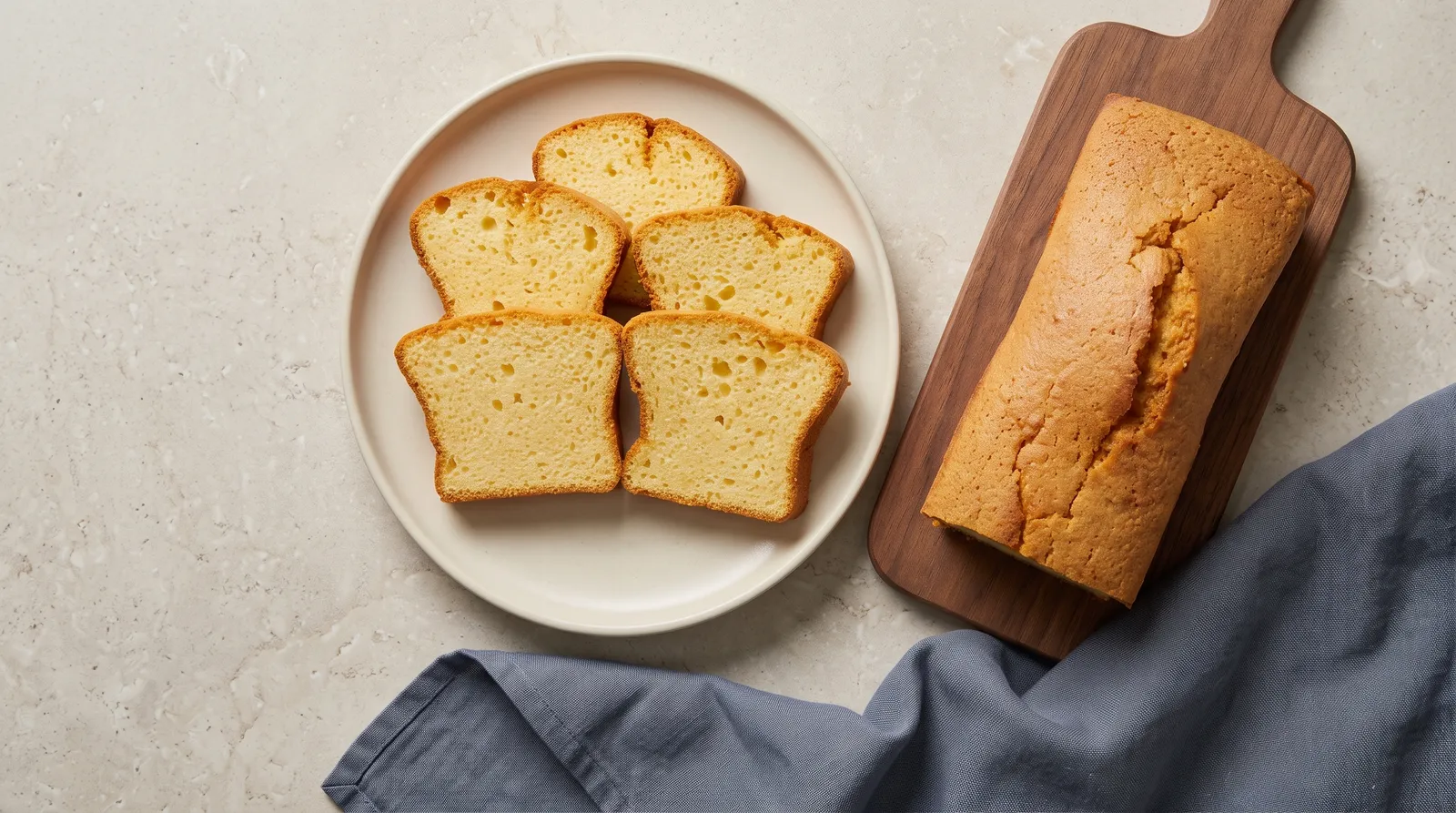
Quatre-quarts breton — shown with a cut section visible
Prep 25 minutes
Cook 50 minutes
Total 135 minutes
Yield 1 loaf from a 23 × 13 cm tin, 10 slices
Introduction and overview

Quatre-quarts breton — Breton equal-weight salted-butter cake

Quatre-quarts is named for its defining proportion rather than for a particular decoration or flavouring. The net weight of the eggs, measured after shelling, becomes the reference for the other three principal ingredients: the same weight of sugar, the same weight of wheat flour and the same weight of butter. Starting with 220 g of shelled egg therefore fixes all four at 220 g. That arithmetic is the identity of the cake, not a loose suggestion that can be replaced with unequal cups or oil.

A Breton profile is especially clear when the fat is demi-sel butter. Its salt is already part of the butter, so there is no separate salt addition to guess at. The butter should be softened to about 18–20 °C: pliable enough to become smooth and emulsify with the egg, but not melted. Excessive whipping is unnecessary. Quatre-quarts is richer and closer-textured than a foam cake, and too much incorporated air can produce an irregular rise rather than the fine, moist crumb that suits the equal-weight batter.

The mixing sequence is simple but worth controlling. Sugar is blended into the softened butter, the egg is added gradually so the emulsion stays cohesive, and the sifted flour is folded in only until dry streaks disappear. A lined 23 × 13 cm tin gives the batter enough depth for a 50-minute bake at 170 °C. The top should be deep golden and the centre fully set before the loaf comes out; then a full hour of cooling stabilises the butter-rich crumb before slicing.

Success points

Success points

  • Weigh 220 g of shelled egg first, then match it with exactly 220 g each of sugar, flour and demi-sel butter.
  • Keep the butter soft and pliable rather than melted, and add the egg in several additions so the mixture stays emulsified.
  • Fold the flour only until it disappears; prolonged mixing develops gluten and makes the crumb firmer.
  • Do not judge the cake only by crust colour: check the spring of the centre and the skewer before removing it from the oven.
Ingredients

Ingredients

  • 220 g shelled whole egg, about 4 large eggs, weighed without shells
  • 220 g caster sugar
  • 220 g plain wheat flour, sifted
  • 220 g demi-sel butter, softened to about 18–20 °C
Method

Method

Directions

  1. Prepare the tin and oven. Line the 23 × 13 cm loaf tin with baking paper and preheat the oven to 170 °C. The paper sits flat against the base and long sides.

  2. Soften the butter texture. Work the 220 g demi-sel butter with a spatula until smooth and pliable, without whipping in a large volume of air. The butter is smooth, glossy and easily spreadable.

  3. Build the emulsion. Add the 220 g sugar gradually, then mix in the 220 g shelled egg in several additions, letting the mixture come back together before adding more. The mixture is creamy and cohesive rather than visibly curdled.

  4. Fold in the flour. Add the 220 g sifted flour and fold only until it disappears. No streaks of dry flour remain, and the batter is thick and even.

  5. Fill the tin. Transfer the batter to the lined loaf tin and level it gently without compressing it. The batter is level from end to end with no large trapped air pockets.

  6. Bake through the centre. Bake on the centre rack at 170 °C for 50 minutes. The top is deep golden, the centre springs back lightly, and a skewer inserted in the middle emerges without wet batter. Do not taste raw batter.

  7. Cool before slicing. Leave the loaf in the tin for 15 minutes, then lift it onto a wire rack and continue cooling for a full 60 minutes in total. The cake is completely cool and the crumb no longer feels fragile when sliced.

Serving, storage and make-ahead

Practical

Serving, storage and make-ahead

Serve the loaf completely cool, cut into 10 even slices. It does not need frosting, filling or an extra sauce: the balance comes from the equal-weight batter and the gentle salinity of the butter. A clean serrated knife gives the neatest slices once the crumb has settled.

Serving, storage and make-ahead

For make-ahead service, bake the cake earlier the same day and leave it uncovered only until completely cool. Once no warmth remains, wrap it well so the crumb stays moist. At a cool room temperature it keeps for up to 2 days; if the room is warm, refrigerate it and let a slice lose its chill before eating. Reheating is unnecessary and can make the high-butter crumb greasy.

Serving, storage and make-ahead

If demi-sel butter is unavailable, another good salted butter keeps the intended salted-butter character more faithfully than unsalted butter followed by an estimated salt addition. Do not replace the butter with oil while calling the result quatre-quarts in this form, because both the flavour and the equal-weight structure change.

Troubleshooting

Troubleshooting

  • The batter looks curdledthe butter or eggs were too cold, or the egg was added too quickly. Stop adding egg and mix only until the emulsion becomes cohesive again before continuing.
  • The loaf is heavy or streakythe flour was worked too long or folded unevenly. Use broad folds and stop as soon as no dry pockets remain.
  • The centre sinks after bakingthe middle was not fully set before removal. Use the spring and clean-skewer cues at the centre, not just the colour of the edges.
Nutrition per serving

Nutrition per serving

  • Serving size1 slice (1 of 10)
  • Calories354 kcal
  • Carbohydrate39.0 g
  • Protein5.2 g
  • Fat20.1 g
  • Fibre0.6 g
  • Sodium173 mg
Allergens and food safety

Allergens and food safety

Allergens: Egg; Milk; Wheat/gluten.

Do not taste the raw batter. Eggs and untreated flour are raw ingredients until baked. Bake until the centre is fully set at 170 °C, then handle the hot tin carefully. Let the cake cool before unmoulding fully and slicing; this reduces burn risk and gives the crumb time to stabilise rather than tear while hot.

FAQ

FAQ

Why must the eggs be weighed without shells?

The edible egg mass is the reference quarter. Shell weight is not part of the batter, so including it would make the butter, sugar and flour too heavy relative to the egg.

Should the butter be whipped until very fluffy?

No. Smooth, pliable butter is useful, but aggressive aeration is not the aim. The cake should rise evenly while keeping a fine, moist, close crumb.

Closing

Closing

  • Result: A deep-golden Breton loaf with a moist, fine crumb and a distinct demi-sel butter finish.
  • Decisive technique: Weigh the shelled eggs first and keep egg, sugar, flour and butter at the exact 1:1:1:1 ratio.