French National Dishes

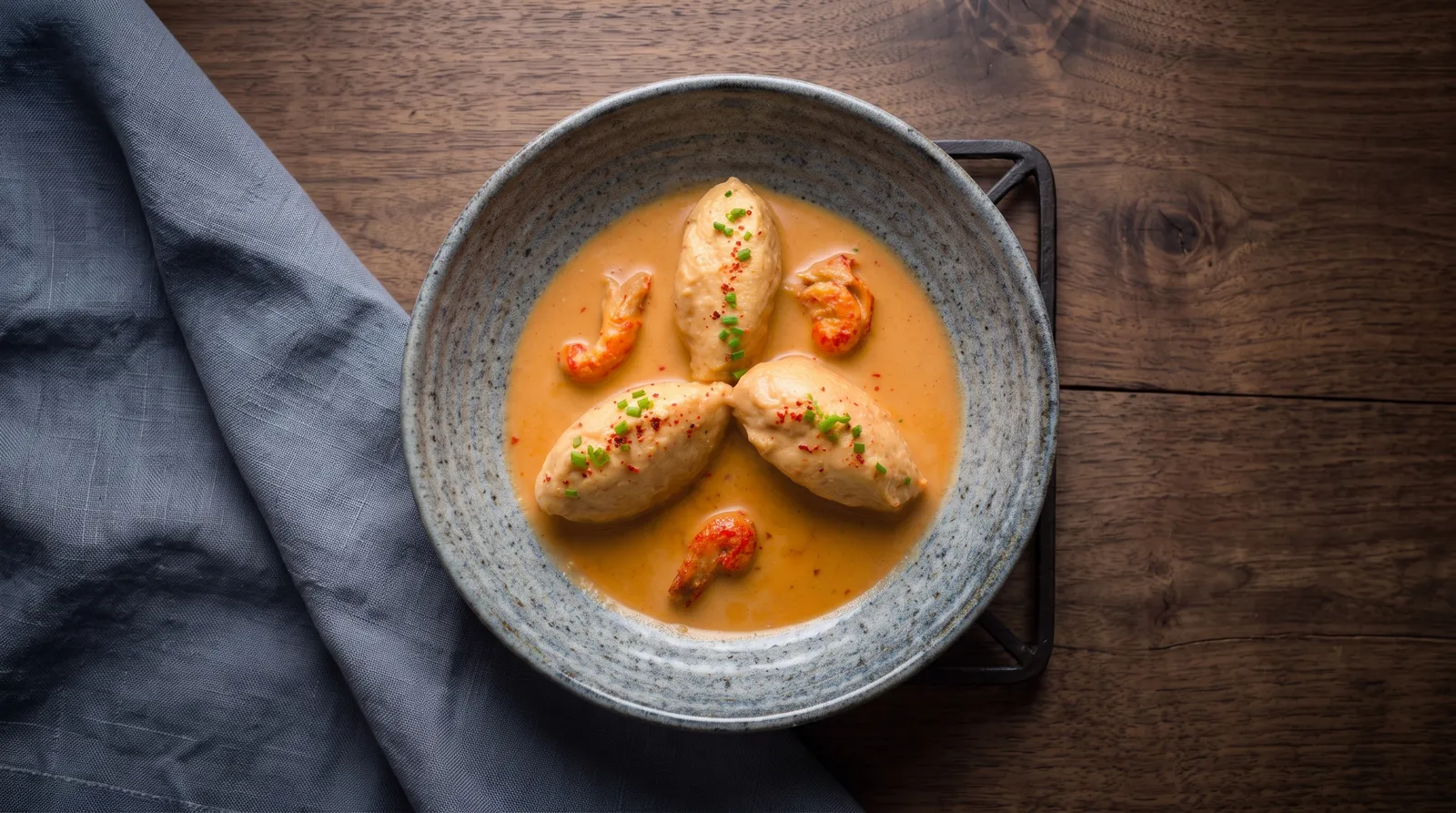
Quenelles de brochet sauce Nantua

Cold pike forcemeat lightened with panade and egg, shaped into large quenelles, gently poached to 63 °C and finished under a creamy Nantua sauce made with real crayfish butter and tail meat.

French National Dishes
Share
Quenelles de brochet sauce Nantua — served on a plate
Prep 45 minutes
Cook 55 minutes
Total 180 minutes
Yield 8 large quenelles with Nantua sauce, 4 servings
Introduction and overview

Quenelles de brochet sauce Nantua — pike quenelles with crayfish cream sauce

Quenelles de brochet bring together two regional French signatures: the Lyonnais tradition of pike quenelles and the crayfish-based sauce associated with Nantua. The quenelles are not plain flour dumplings. Their structure comes from very cold boneless pike worked with a cooked panade, egg and butter, then chilled until the paste can be shaped. Sauce Nantua, in turn, depends on a genuine crayfish element rather than on tomato sauce or plain cream.

Temperature control matters twice. The pike must stay cold while it is processed so the paste remains smooth and stable, while the panade has to be cooked long enough to dry and then cooled before the two are combined. Instead of tasting raw fish paste to judge seasoning, cook a small sample. That sample also gives an early check on texture: it should be opaque and springy, not wet or pasty. The shaped quenelles then poach in barely simmering water, where hard boiling would be more likely to split or roughen them.

The sauce is built as a light roux-thickened milk base enriched with cream and 60 g of labelled crayfish butter, with 120 g cooked crayfish tails added at the end. Every tail should be checked for shell fragments. Once the quenelles have reached 63 °C, they are transferred to a baking dish, covered with all the sauce and baked briefly at 190 °C. That final stage is for heat, expansion and integration, not for rescuing an undercooked centre.
Success points

Success points

  • Chill the pike paste for a full hour before shaping; warmth makes the forcemeat loose and difficult to handle.
  • Dry the panade until it forms a ball and leaves a film on the pan, then cool it before it touches the fish.
  • Cook a small sample instead of tasting raw fish paste, and adjust seasoning only from that cooked sample.
  • Keep the poaching water at a bare simmer so the quenelles expand without being battered by a rolling boil.
  • Use actual crayfish butter and crayfish meat in the sauce, and inspect the meat carefully for shell fragments.
Ingredients

Ingredients

Pike quenelles

  • 400 g pike fillet, commercially sourced, skinned, boneless and very cold
  • 250 ml whole milk
  • 100 g plain wheat flour
  • 75 g unsalted butter, for the panade
  • 180 g whole egg, beaten and chilled
  • 25 g unsalted butter, softened, for the fish paste
  • 6 g fine salt
  • 1 g white pepper
  • 0.5 g ground nutmeg
  • 3 l water, for poaching

Nantua sauce

  • 30 g unsalted butter
  • 25 g plain wheat flour
  • 300 ml whole milk, hot
  • 150 ml double cream
  • 60 g crayfish butter, a labelled commercial crayfish product
  • 120 g cooked crayfish tail meat, commercially sourced and checked for shell fragments
Method

Method

Directions

  1. Inspect and chill the pike. Check the 400 g pike fillet carefully for pin bones, cut it into small pieces and return it to the cold while the panade is made. The pike is uniformly cold and no pin bones are felt or seen.

  2. Cook the panade. Heat the 250 ml milk with 75 g butter, add the 100 g flour at once and work over medium heat for 6 minutes. The panade forms a smooth ball and leaves a thin film on the base of the pan.

  3. Cool the panade. Spread it in a shallow bowl and leave it for 20 minutes before mixing with fish. The panade is cool to the touch and no longer steaming.

  4. Make the cold pike paste. Process the pike with the cooled panade, 6 g salt, 1 g white pepper and 0.5 g nutmeg. Add the 180 g chilled beaten egg gradually, then blend in the 25 g softened butter. The paste is smooth, thick and cold, with no visible fish pieces.

  5. Chill until shapeable. Cover and refrigerate the paste for 60 minutes. The paste is firm enough to hold a spooned oval without slumping.

  6. Cook a test sample. Poach a small spoonful at a gentle simmer for about 3 minutes and check the centre with a thermometer. The sample is opaque, springy and reaches 63 °C at its centre. Taste only this cooked sample and adjust seasoning if needed.

  7. Shape the quenelles. Form 8 even ovals with two wet spoons, smoothing the surfaces rather than compressing them. Eight ovals are similar in size and hold their shape on the tray.

  8. Poach gently. Bring the 3 l water to a bare simmer, lower in all 8 quenelles and poach for 15 minutes without a rolling boil. The quenelles are visibly expanded, float freely and reach 63 °C in their centres.

  9. Make the Nantua sauce. Melt 30 g butter, stir in 25 g flour and cook briefly, then whisk in the 300 ml hot milk. Simmer the sauce over medium-low heat, add the 150 ml cream and 60 g crayfish butter, and fold in the 120 g crayfish tails at the end; allow 16 minutes for the sauce stage. The sauce is smooth, lightly thickened and evenly orange-pink, with no raw flour taste.

  10. Bake with the sauce. Arrange the poached quenelles in a baking dish, cover them with all the Nantua sauce and bake at 190 °C for 15 minutes. The sauce bubbles around the edges and the quenelles are hot throughout without becoming dense.

Serving, storage and make-ahead

Practical

Serving, storage and make-ahead

Serve 2 quenelles per person with one-quarter of the Nantua sauce. The sauce should remain fluid enough to spoon, while the quenelles should feel light and springy rather than compact. Because the sauce is rich in butter and cream, an additional heavy garnish is unnecessary.

Serving, storage and make-ahead

The fish paste can be prepared several hours in advance and held covered at 4 °C or below before shaping. Do not leave the paste at room temperature while other components are prepared. The sauce can be made shortly before the final bake; if it thickens while standing, warm it gently rather than boiling it hard.

Serving, storage and make-ahead

Cool leftovers promptly and refrigerate within 2 hours at 4 °C or below for up to 2 days. Reheat covered until the centre reaches 74 °C. Repeated or prolonged reheating toughens the pike paste, so reheat only the amount needed. If whole crayfish are impractical, a clearly labelled commercial crayfish butter is a practical route to the correct sauce identity; plain seafood-flavoured butter is not equivalent.

Troubleshooting

Troubleshooting

  • The quenelles spread before poachingthe paste is too warm or the panade retained too much moisture. Chill the paste fully and make sure the panade was cooked until it pulled cleanly from the saucepan.
  • The quenelles turn densehard boiling or a warm, overworked paste tightens the texture. Keep the mixture cold and the poaching liquid only gently simmering.
  • The sauce tastes flourythe roux-and-milk base needs more gentle cooking before the cream and crayfish butter are added. Simmer until the raw flour taste disappears.
Nutrition per serving

Nutrition per serving

  • Serving size2 quenelles with one-quarter of the Nantua sauce
  • Calories898 kcal
  • Carbohydrate32.1 g
  • Protein38.8 g
  • Fat68.3 g
  • Fibre0.9 g
  • Sodium950 mg
Allergens and food safety

Allergens and food safety

Allergens: Fish; Crustacean; Egg; Milk; Wheat/gluten.

Use legally sourced, traceable pike and commercially sourced crayfish products; this preparation does not require or justify wild harvesting. Check the pike meticulously for bones and the cooked crayfish for shell fragments. Keep the pike paste cold, never taste it raw, and use the cooked test sample for seasoning. Every quenelle must reach 63 °C at the centre. Refrigerate perishable components within 2 hours, and reheat leftovers to 74 °C.

FAQ

FAQ

Why is there flour in a pike quenelle?

The flour is cooked with milk and butter as a panade before it meets the fish. That panade provides structure and moisture control; it is not a substitute for the pike.

Is any cream sauce a Nantua sauce?

No. The defining flavour comes from crayfish. Here both crayfish butter and cooked crayfish tails are included, so the sauce is more than a generic béchamel or cream sauce.

Closing

Closing

  • Result: Large, springy pike quenelles under a smooth, crayfish-rich cream sauce, baked only long enough to meld and heat through.
  • Decisive technique: Keep the pike paste cold, poach gently to 63 °C and use a genuine crayfish component in the Nantua sauce.