French National Dishes

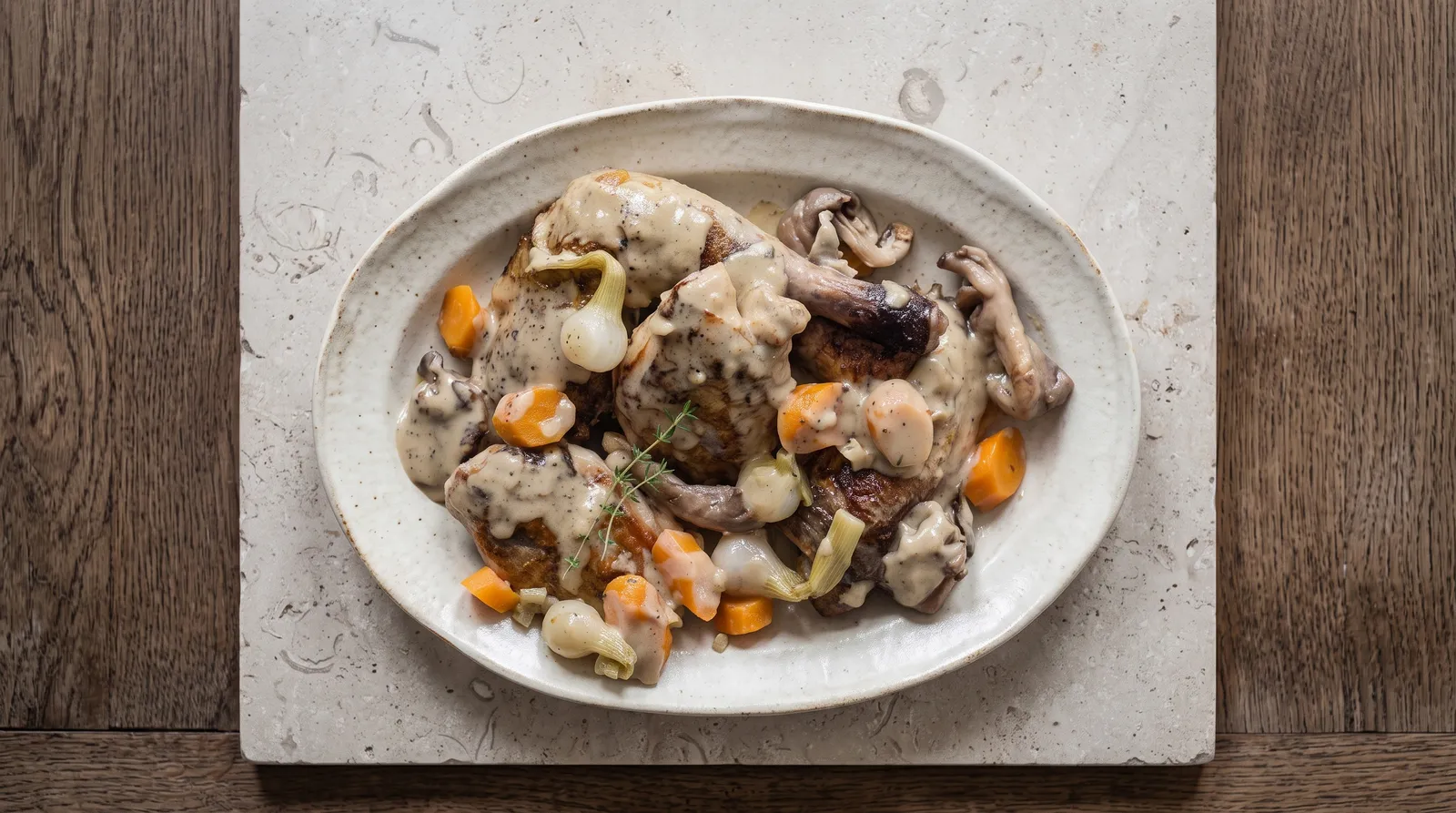
Géline de Touraine à la lochoise

A Touraine black hen cut into bone-in pieces, browned gently, cooked slowly with onion and mushrooms, then finished with Vouvray and a light cream reduction.

French National Dishes
Share
Géline de Touraine à la lochoise — arranged on a serving platter
Prep 15 minutes
Cook 99 minutes
Total 1 h 54 min (114 minutes)
Yield 6 main-course servings from 1 dressed 2 kg bird
Introduction and overview

Géline de Touraine à la lochoise — Vouvray, mushrooms and cream

Géline de Touraine à la lochoise is not simply roast chicken with a cream sauce. The defining starting point is the Géline de Touraine, the regional black hen, handled as a firm, flavourful bone-in bird. In the Lochois household profile used here, the pieces are coloured only moderately, then cooked gently with onion and seasonal mushrooms before Vouvray and cream finish the sauce.

The order protects both meat and sauce. Brown the pieces without a hard sear, soften the onion and mushrooms, then keep the casserole covered at a gentle simmer for an hour. Add the Vouvray near the end, check every piece with a thermometer, and remove the poultry before reducing the cream sauce. That last separation lets the sauce thicken without forcing already-cooked meat through extra heat.

Food safety is non-negotiable with bone-in poultry. Probe the coldest thick point of each substantial piece away from bone and require 74 °C. Colour is not a reliable substitute. The sauce also contains wine: the short simmer and reduction do not guarantee complete alcohol removal, so the finished dish should not be represented as alcohol-free.
Success points

Success points

  • Aim for light golden patches, not a hard crust, during browning.
  • Keep the covered hour at a gentle simmer so the casserole retains moisture.
  • Reduce the sauce only after the safely cooked poultry has been removed.
Ingredients

Ingredients

  • 2000 g dressed Géline de Touraine — whole bird, cut into 8 bone-in pieces; Estimated cooked edible meat yield about 1,000 g after bones and cooking loss.
  • 40 g unsalted butter
  • 180 g onion — cut into 8 wedges
  • 300 g seasonal mushrooms — cleaned and halved or quartered
  • 150 ml dry Vouvray white wine
  • 200 ml full-fat crème fraîche or pouring cream — about 30% fat
  • 8 g fine salt
  • 2 g black pepper — freshly ground
Method

Method

Directions

  1. The dressed 2 kg Géline into 8 bone-in pieces and keep raw-poultry tools separate. Cut the dressed 2 kg Géline into 8 bone-in pieces and keep raw-poultry tools separate. Use board, poultry shears or knife. Allow 15 minutes. The 2 kg dressed bird is divided into 8 bone-in pieces of broadly even cooking size. Even pieces cook more predictably. Prevent raw-poultry juices from contacting cooked food, garnish or clean utensils.

  2. 40 g butter and brown the poultry moderately. Melt 40 g butter and brown the poultry moderately. Use heavy casserole. Work at medium heat. Allow 12 minutes. The pieces are lightly golden in patches but not deeply seared. Gentle colour develops flavour without hardening the older-style bird. Turn pieces with tongs and avoid splashing hot butter.

  3. The onion and mushrooms and soften them around the poultry. Add the onion and mushrooms and soften them around the poultry. Use heavy casserole. Work at medium-low heat. Allow 8 minutes. The onion is translucent and the mushrooms have begun to soften without scorching. The vegetables add moisture before the covered cook. Keep raw poultry surfaces contained inside the casserole.

  4. And cook the poultry gently in its released juices. Cover and cook the poultry gently in its released juices. Use covered casserole. Work at low heat. Allow 60 minutes. The pieces are tendering in their own juices and the casserole remains moist, not dry. Slow covered cooking suits a firm regional hen. Keep the simmer gentle and monitor liquid so the casserole does not scorch.

  5. 150 ml Vouvray and simmer briefly. Add 150 ml Vouvray and simmer briefly. Use uncovered casserole. Work at low heat. Allow 5 minutes. The wine is simmering gently and the raw alcoholic edge has softened without the pan drying out. Adding wine late preserves its aromatic role before the sauce reduction. Wine alcohol may remain after cooking.

  6. Each poultry piece and remove it only when safely cooked. Check each poultry piece and remove it only when safely cooked. Use food thermometer and warm platter. Work at low heat. Allow 3 minutes. Keep the relevant temperature at 74 °C internal poultry temperature. Every poultry piece reaches 74 °C at the coldest thick point away from bone. Temperature, not colour, verifies safety in bone-in poultry. Probe each thick piece away from bone and keep cooked poultry separate from raw-contact tools.

  7. 200 ml cream and reduce the Vouvray cooking liquid. Add 200 ml cream and reduce the Vouvray cooking liquid. Use uncovered casserole. Work at medium-low heat. Allow 8 minutes. The sauce coats the back of a spoon in a light, even layer. Reduction concentrates the poultry juices, wine and cream without boiling hard. Avoid vigorous boiling that can split the cream.

  8. The poultry to the sauce and reheat gently. Return the poultry to the sauce and reheat gently. Use casserole. Work at low heat. Allow 3 minutes. The sauce is steaming and the poultry is hot throughout without boiling the cream. A short final reheat coats the pieces without overcooking them. Warn diners about small bones when serving.

Serving, storage and make-ahead

Practical

Serving, storage and make-ahead

Serve the pieces hot from the casserole with the Vouvray cream sauce spooned over them. Because the bird is served bone-in, tell diners to expect small bones and carve or portion carefully at the table.

Serving, storage and make-ahead

If making ahead, cool the cooked dish promptly and refrigerate it within two hours. Reheat only once, gently, until every poultry piece reaches 74 °C; hard boiling can split the cream and dry the meat.

Serving, storage and make-ahead

A large chicken or guinea fowl can use the same broad casserole logic, but the cooking time must follow the actual bird and the finished dish should not keep the Géline de Touraine name. The regional breed is part of the identity, not merely a decorative ingredient label.

Nutrition per serving

Nutrition per serving

  • Serving size1 of 6 servings
  • Calories520 kcal
  • Carbohydrate5.8 g
  • Protein47.6 g
  • Fat32.3 g
  • Fibre1.1 g
  • Sodium672 mg
Allergens and food safety

Allergens and food safety

Allergens: Milk; Sulphites from Vouvray wine.

Prevent cross-contamination from raw poultry.

Cook every bone-in piece to 74 °C at the coldest thick point away from bone.

Refrigerate leftovers within two hours and reheat leftovers to 74 °C.

Wine alcohol may remain after the short simmer and reduction.

Closing

Closing

  • Result: tender bone-in Géline with mushrooms and a lightly coating Vouvray-cream sauce.
  • Decisive technique: cook the bird gently to 74 °C, remove it, reduce the sauce separately and return the pieces only for a short final reheat.