French National Dishes

Flan pâtissier

A classic French pastry-case flan with a tall vanilla milk-and-cream custard thickened with cornstarch, baked to a dark-spotted top and chilled until sliceable.

French National Dishes
Share
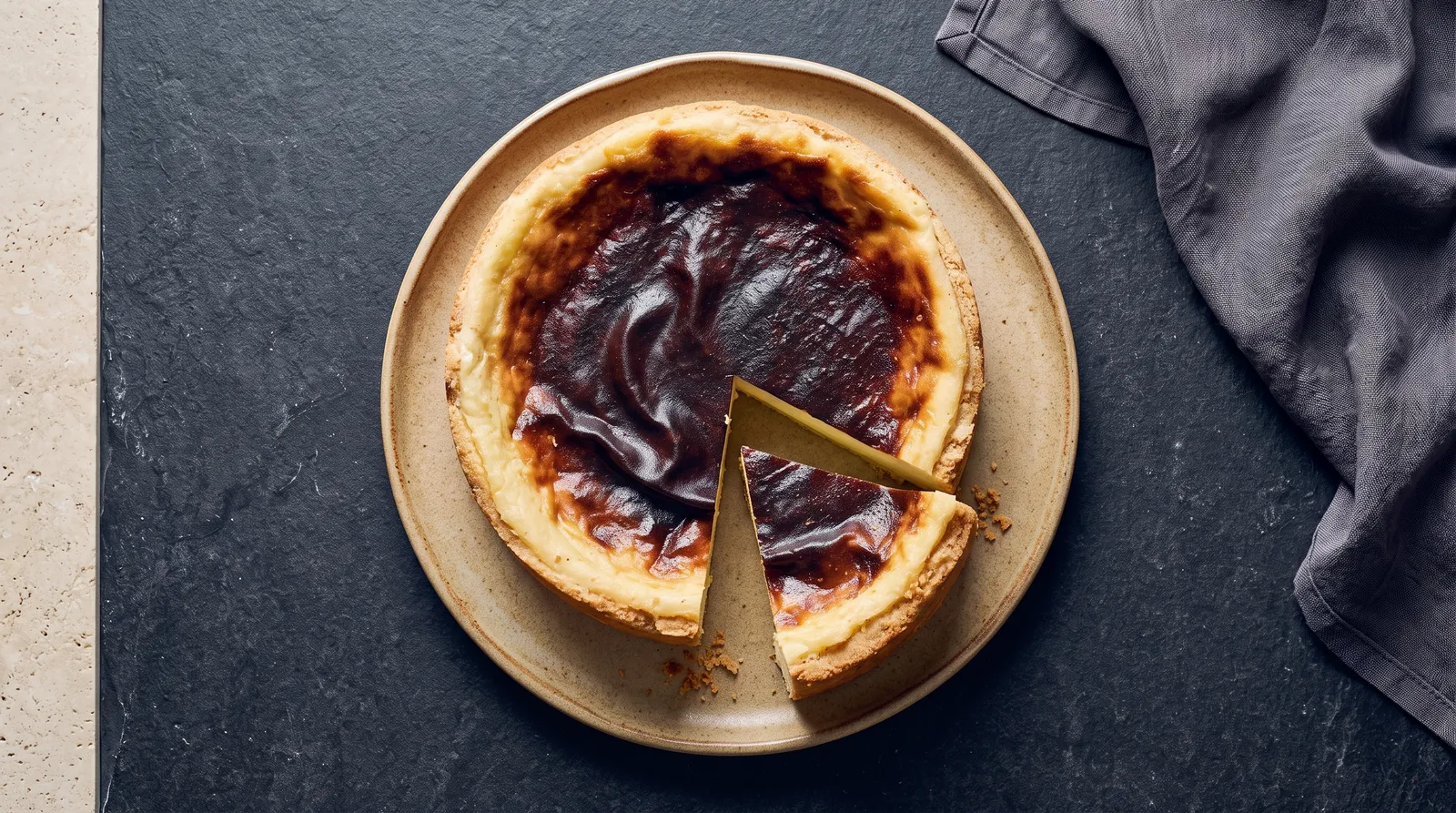
Flan pâtissier — shown with a cut section visible
Prep 35 minutes
Cook 65 minutes
Total 430 minutes
Yield 1 tall 20 cm flan, cut into 8 slices
Overview

Flan pâtissier — tall vanilla custard in a pâte brisée case

Flan pâtissier is a bakery custard defined by the meeting of two structures: a pastry case and a tall, starch-thickened egg custard. It is not crème caramel, which relies on caramel and no pastry, and it is not far breton, whose flour is dispersed through a baked batter. Here the shell is distinct, while the vanilla custard is cooked on the stove before it goes into the oven.

The 20 cm mould is deliberately at least 4.5 cm high. Roll the chilled all-butter pâte brisée to about 2.5 mm, line the sides cleanly and trim away excess dough; only the roughly 280 g that remains in the shell is counted as eaten. A 30-minute refrigerator rest firms the butter and gives the side wall more resistance when hot custard is added.

The custard is made with whole milk, cream, eggs, sugar and cornstarch. Heating the dairy with vanilla starts the flavour extraction, while whisking sugar and starch smoothly into the eggs prevents dry lumps. Once the mixtures are combined, return them to the saucepan and bring the custard to about 95 °C and a brief boil. It should look glossy and thick enough to leave whisk trails that close slowly.

Baking at 190 °C sets the filled flan and gives the top its characteristic dark spotting. The coldest centre must reach at least 71 °C and feel set without becoming dry. One hour of rack cooling is followed by four hours at 4 °C or below. That long chill is what turns a still-soft hot custard into the smooth, clean bakery-style slice expected from flan pâtissier.
Success points

Success points

  • Keep the lined pastry shell cold before filling so the tall sides hold against the hot custard.
  • Bring the custard to about 95 °C and a brief boil while whisking; undercooked starch leaves a loose centre after baking.
  • Bake until the top has genuine dark spotting and the centre is safely at 71 °C, then chill for the full four hours before slicing.
Ingredients

Ingredients

Pastry case

  • 320 g all-butter pâte brisée, chilled purchased pastry — Roll and line the mould; about 280 g remains in the finished shell and about 40 g trimming scraps are discarded and excluded from nutrition.

Vanilla custard

  • 750 ml whole milk — All retained.
  • 250 ml double or whipping cream, about 30–35% fat — All retained.
  • 200 g whole egg without shell, about 4 large eggs — All retained.
  • 180 g caster sugar — All retained.
  • 80 g cornstarch — All retained.
  • 5 g vanilla bean, 1 bean, split and scraped — Seeds are retained; the pod is removed after infusion and excluded from nutrition.
Method

Method

Directions

  1. Line the mould. Roll the chilled pâte brisée to about 2.5 mm thick and line a 20 cm round tin or ring at least 4.5 cm high. Trim the rim, keeping about 280 g pastry in the shell. Time: 15 minutes. The pastry is an even 2.5 mm thick, reaches at least 4.5 cm up the side and has no torn patches.

  2. Chill the shell. Refrigerate the lined shell for 30 minutes. Time: 30 minutes chilling. Temperature: 4 °C or below. The pastry is firm and cold, with the side standing upright rather than slumping.

  3. Heat the dairy. Combine milk, cream and the split scraped vanilla bean in a saucepan and bring just to the boil, then remove the pod. Time: 5 minutes. Temperature: 95–100 °C. The milk-and-cream mixture reaches the first boil and smells strongly of vanilla without scorching.

  4. Mix the egg base. Whisk eggs with sugar, then whisk in cornstarch until completely smooth. Time: 5 minutes. The egg mixture is pale and smooth with no visible cornstarch lumps.

  5. Pre-cook the custard. Whisk the hot dairy gradually into the egg mixture, return everything to the saucepan and cook over medium heat, whisking constantly, until the custard reaches about 95 °C and boils for 1 minute. Time: 5 minutes. Temperature: 95 °C. Boiling the starch-thickened custard develops its full thickening power before baking. Keep whisking continuously so the egg-rich custard does not scorch. The custard is thick, glossy and leaves clear whisk trails that close slowly.

  6. Fill the pastry case. Heat the oven to 190 °C. Pour the hot thick custard into the cold shell to about 5 mm below the pastry rim and smooth the surface. Time: 5 minutes. Temperature: 190 °C. The shell is filled evenly without overflowing and the custard surface is level.

  7. Bake the flan. Bake at 190 °C for 55 minutes. Time: 55 minutes. Temperature: 190 °C. The high, starch-thickened custard needs a full bake to set while remaining creamy after chilling. Verify at least 71 °C in the coldest central point. The top is deeply browned with characteristic dark spots, the centre is set but not dry, and the coldest central point reaches at least 71 °C.

  8. Cool on a rack. Set the flan in its tin on a wire rack for 60 minutes. Time: 60 minutes cooling. The flan has stopped steaming and the custard is stable enough to move without sloshing.

  9. Chill completely. Cover and refrigerate for 240 minutes at 4 °C or below before unmoulding and cutting. Time: 240 minutes refrigeration. Temperature: 4 °C or below. The flan is fully chilled, the custard cuts in smooth clean slices, and the pastry base remains distinct.

Practical guidance

Practical

Practical guidance

Cut only after the four-hour chill, using a clean sharp knife for each of the eight tall wedges.

Practical guidance

For make-ahead, prepare the flan the day before, complete the cooling and chilling schedule, and keep it covered at 4 °C or below.

Practical guidance

Use within 3 days. Do not reheat the whole flan; 15–20 minutes out of the refrigerator softens a slice without loosening the custard.

Practical guidance

A homemade pâte brisée can replace the purchased pastry if the lined shell still contains about 280 g dough at 2.5 mm thickness. Keep liquid vanilla substitutions measured rather than adding them by eye.

Troubleshooting

Custard leaks from a cut slice — the starch mixture did not boil long enough, the bake ended early or the four-hour chill was shortened.

Troubleshooting

Pastry side collapses — the shell was warm before filling or rolled too thin; maintain 2.5 mm thickness and the 30-minute chill.

Troubleshooting

Top stays pale — continue baking a little longer while protecting the pastry rim if necessary; the surface should develop dark spots without drying the centre.

Nutrition per serving

Nutrition per serving

  • Serving size1 slice, 1/8 flan
  • Calories458 kcal
  • Carbohydrate54 g
  • Protein9 g
  • Fat23 g
  • Fibre1 g
  • Sodium229 mg
Allergens and food safety

Allergens and food safety

Allergens: Egg; Milk; Gluten (wheat)

The coldest point of the baked egg custard must reach at least 71 °C.

After 60 minutes of rack cooling, refrigerate at 4 °C or below; do not leave the custard at room temperature beyond 2 hours total.

FAQ

FAQ

Why cook the custard before baking?

Cornstarch thickens reliably only after sufficient heating; the pre-cook gives the tall filling enough body before it enters the pastry shell.

Why is the top so dark?

Dark spotting is characteristic of bakery flan, but it is paired with a smooth, moist interior rather than taken as permission to overbake the centre.

Closing

Closing

  • Result: eight tall slices with a distinct pâte brisée base, smooth vanilla custard and a deeply browned, spotted surface.
  • Decisive technique: fully thicken the custard on the stove, pour it into a cold tall shell, then give the baked flan the complete four-hour chill.