French National Dishes

Dombrés aux crevettes

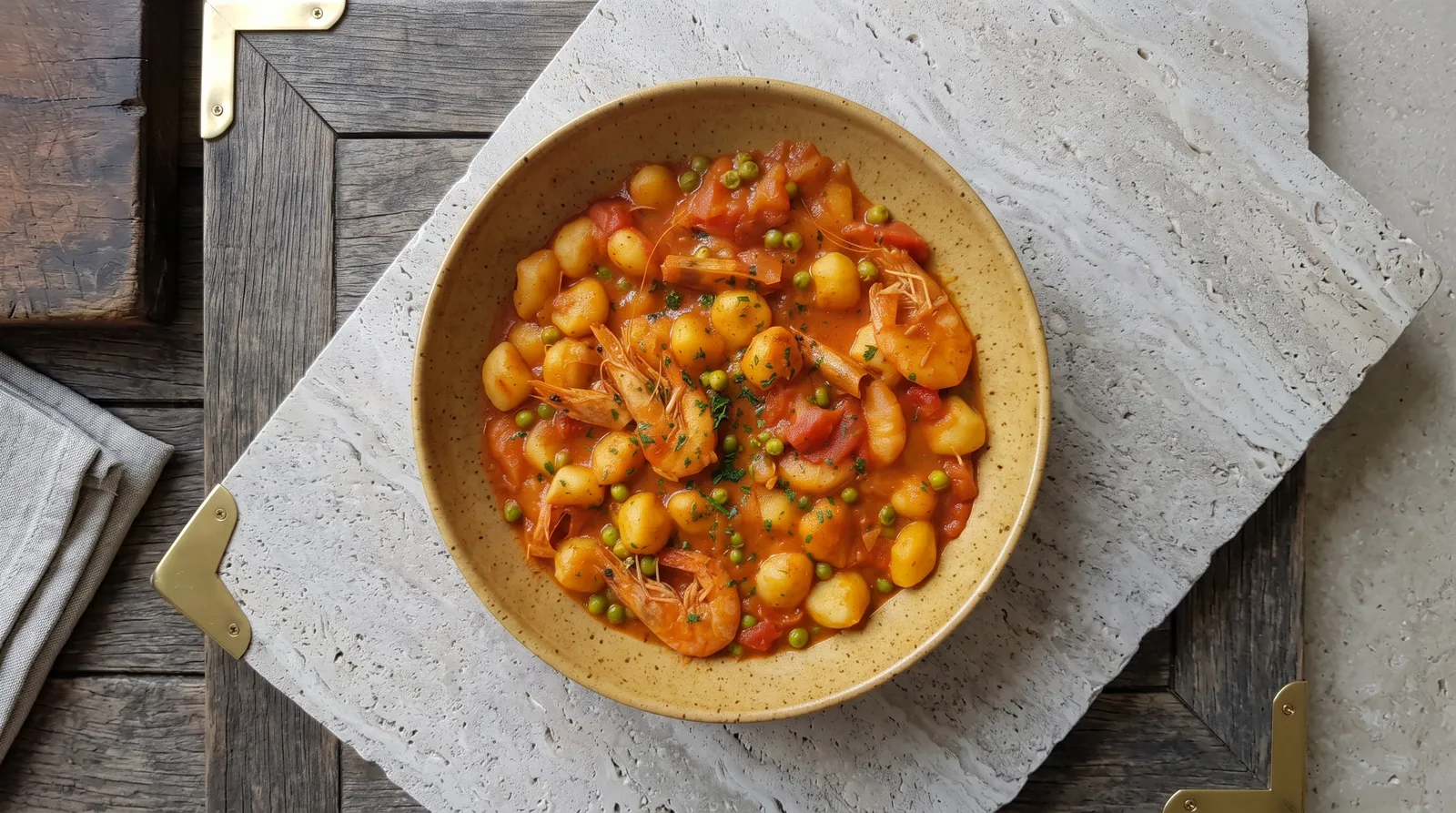
Small flour-and-water dombrés simmer directly in a seasoned tomato sauce, then peeled shrimp goes in only for the final minutes so the dumplings cook through without sacrificing the shellfish texture.

French National Dishes
Share
Dombrés aux crevettes — served on a plate
Prep 35 minutes
Cook 30 minutes
Total 85 minutes
Yield 4 main-course portions
Introduction and overview

Dombrés aux crevettes: Guadeloupean shrimp with flour dumplings in Creole tomato sauce

Dombrés aux crevettes belongs to the Guadeloupean family of dombwé preparations: small, dense flour dumplings cooked in a sauce rather than boiled separately. The dumplings are not a garnish added to shrimp; their starch and texture are part of the dish itself. As they simmer, they take on the tomato, allspice, thyme, scallion, garlic and chilli around them while giving the sauce a little body in return.

The sequencing is the decisive point. The dombrés need a full simmer until a cut centre is elastic and free of raw flour, while shrimp needs only a few minutes. Cooking the shrimp from the beginning would make it rubbery before the dumplings are ready. Here the 8–10 g balls cook first, and the peeled, deveined shrimp is added at the end and checked at 63 °C, with a pearly opaque appearance used only as the accompanying quality cue.

This household quantity uses 600 g peeled raw shrimp, so purchased weight and edible weight are the same and there is no shell-stock step hidden in the yield. The whole measured sauce is served. A whole habanero perfumes the pan without being chopped through the sauce; it can be removed before serving if its heat has developed enough.
Success points

Success points

  • Weigh the first few dough pieces so 8–10 g becomes an easy visual reference; oversized dombrés are the main cause of floury centres.
  • Keep 5 g parsley completely separate from the raw-shrimp area so the finishing herb remains ready to eat.
  • Stir the dumplings gently after they enter the sauce; aggressive stirring can roughen their surfaces and make the sauce pasty.
Ingredients

Ingredients

Dombré dough

  • 400 g plain wheat flour, unbleached
  • 220 ml water, at room temperature
  • 4 g fine salt

Shrimp and Creole sauce

  • 600 g raw shrimp, peeled and deveined; purchased weight equals edible weight — Keep at 4 °C or below until cooking.
  • 30 g neutral cooking oil
  • 150 g yellow onion, finely chopped
  • 40 g scallions, thinly sliced
  • 10 g garlic, finely chopped
  • 400 g canned chopped tomatoes, no-salt-added
  • 30 g tomato paste
  • 600 ml water, for the sauce
  • 15 g flat-leaf parsley, chopped; keep 5 g separate for clean garnish
  • 2 g dried thyme
  • 1 g ground allspice
  • 10 g whole habanero chilli, left whole and pierced once
  • 30 ml lime juice
  • 3 g fine salt
  • 1 g black pepper, ground
Method

Method

Dough

  1. Mix the dombré dough. Combine the flour, 4 g salt and 220 ml room-temperature water, kneading just until a firm, smooth dough forms. Use Mixing bowl. Allow 10 minutes. The dough is smooth, firm and no longer shows dry flour. A firm dough holds its shape during simmering. Use clean hands and a clean work surface.

  2. Rest the dough. Cover the dough and rest it before shaping. Use Covered bowl. Work under room temperature conditions. Allow 20 minutes resting. The rested dough feels slightly more supple and rolls without cracking at the edges. Resting hydrates the flour and makes small balls easier to shape. Keep the covered dough away from raw shrimp and its utensils.

  3. Shape equal dombrés. Pinch off and roll the dough into 8–10 g balls, about 2 cm across, keeping them in a single layer until the sauce is ready. Use Digital scale and tray. Allow 10 minutes. The dombrés are evenly sized, round and about 2 cm across. Even size gives the dumplings the same cooking time. Use a clean tray that has not held raw seafood.

Sauce and cooking

  1. Build the aromatic base. Heat the oil, then soften the onion and scallions; add the garlic, thyme and allspice for the final minute without browning the garlic. Use Wide 4-litre saucepan. Work at medium heat. Allow 6 minutes. The onion is translucent and tender, and the garlic smells fragrant without taking on dark colour. Gentle softening builds the aromatic base without bitterness. Keep raw shrimp refrigerated at 4 °C or below while the sauce starts.

  2. Simmer the tomato sauce. Stir in the chopped tomatoes, tomato paste, 600 ml water, 10 g parsley, whole chilli, 3 g salt, black pepper and lime juice; bring to a steady simmer. Use Same saucepan. Work at medium then medium-low heat. Allow 5 minutes. The tomato paste is fully dispersed and the liquid is at a steady, not violent, simmer. A fluid sauce is needed because the flour dumplings absorb and release starch as they cook. Do not taste with a utensil that has touched raw shrimp.

  3. Cook the dombrés through. Drop in the shaped dombrés one by one, stir gently to prevent sticking, and simmer uncovered until the centres are fully cooked. Use Same saucepan. Work at medium-low heat. Allow 15 minutes. A dombré cut through the centre is cooked and elastic with no dry or floury core, and the sauce has thickened enough to coat it lightly. The dumplings must cook before the shrimp goes in so the shellfish is not overcooked. Maintain a steady simmer and use a clean knife to check a dumpling centre.

  4. Cook the shrimp last. Add the cold peeled shrimp and cook only until the thickest pieces reach 63 °C; fold in the reserved 5 g parsley after removing the pan from the heat. Use Same saucepan and food thermometer. Work at medium-low heat. Allow 4 minutes. Target 63 °C. The thickest shrimp reaches 63 °C and is pearly and opaque, while remaining springy rather than rubbery. Late addition keeps the shrimp tender while the sauce stays thick around the dombrés. Keep raw shrimp and its plate separate from the reserved parsley and all ready-to-eat utensils; wash hands and surfaces after raw-seafood contact.

Practical guidance

Practical

Serving

Ladle the dish into four warm bowls so every serving receives shrimp, dombrés and the thick tomato sauce. It is substantial enough to stand alone. If another accompaniment is added, treat it as extra rather than stretching the four declared portions, because the cooking ratio assumes the full sauce is divided four ways.

Storage, reheating and make-ahead

For advance work, cook the tomato-aromatic base, cool it quickly and refrigerate it, but make the dough and cook the shrimp on the serving day. Leftovers thicken as the dombrés continue to absorb liquid. Reheat gently to 74 °C and loosen only with a small splash of water if necessary; vigorous boiling makes the shrimp tough. The tomato base can be prepared a day ahead and chilled promptly; shape the dombrés and cook the shrimp on the serving day.

Substitutions

- Shell-on shrimp: Not identity-preserving. Can be used only if shell-on purchased weight and edible yield are recalculated; shells may be made into a strained stock, but that is not part of this preparation.

Troubleshooting

Troubleshooting

  • Floury dombré centres.The dumplings were oversized or removed before the centres cooked through. Keep them near 2 cm and 8–10 g, then cut one open before adding the shrimp.
  • Rubbery shrimp.The shrimp went in too early or stayed on the heat after reaching the required endpoint. Add them only after the dombrés are cooked and stop once the thickest shrimp reaches 63 °C with the pearly opaque quality cue.
Nutrition per serving

Nutrition per serving

  • Serving size1 of 4 portions, including one quarter of all sauce
  • Calories621 kcal
  • Carbohydrate91 g
  • Protein43 g
  • Fat10 g
  • Fibre6 g
  • Sodium887 mg
Allergens and food safety

Allergens and food safety

Allergens: Crustacean, Gluten (wheat)

Keep raw shrimp at 4 °C or below until it enters the pan and prevent cross-contamination with the reserved parsley and ready-to-eat utensils.

Cook the thickest shrimp to 63 °C; pearly opaque flesh is a quality cue, not a substitute for the temperature requirement.

Refrigerate cooked leftovers at 4 °C or below within 2 hours and reheat to 74 °C.

FAQ

FAQ

Can I use shell-on shrimp?

Yes, but the purchased weight, edible yield and nutrition must be recalculated. Shells may be simmered into a strained stock, but that is a different measured workflow from the shell-free method here.

Why are the dumplings cooked before the shrimp?

Their centres require much longer than shrimp. Separating those endpoints is what gives cooked-through dombrés and springy shellfish in the same pan.

Closing

Closing

  • A thick Creole tomato sauce carrying tender, fully cooked dombrés and pearly shrimp in each bowl.
  • Keep the dumplings small and finish the shrimp only after their centres are no longer floury.