French National Dishes

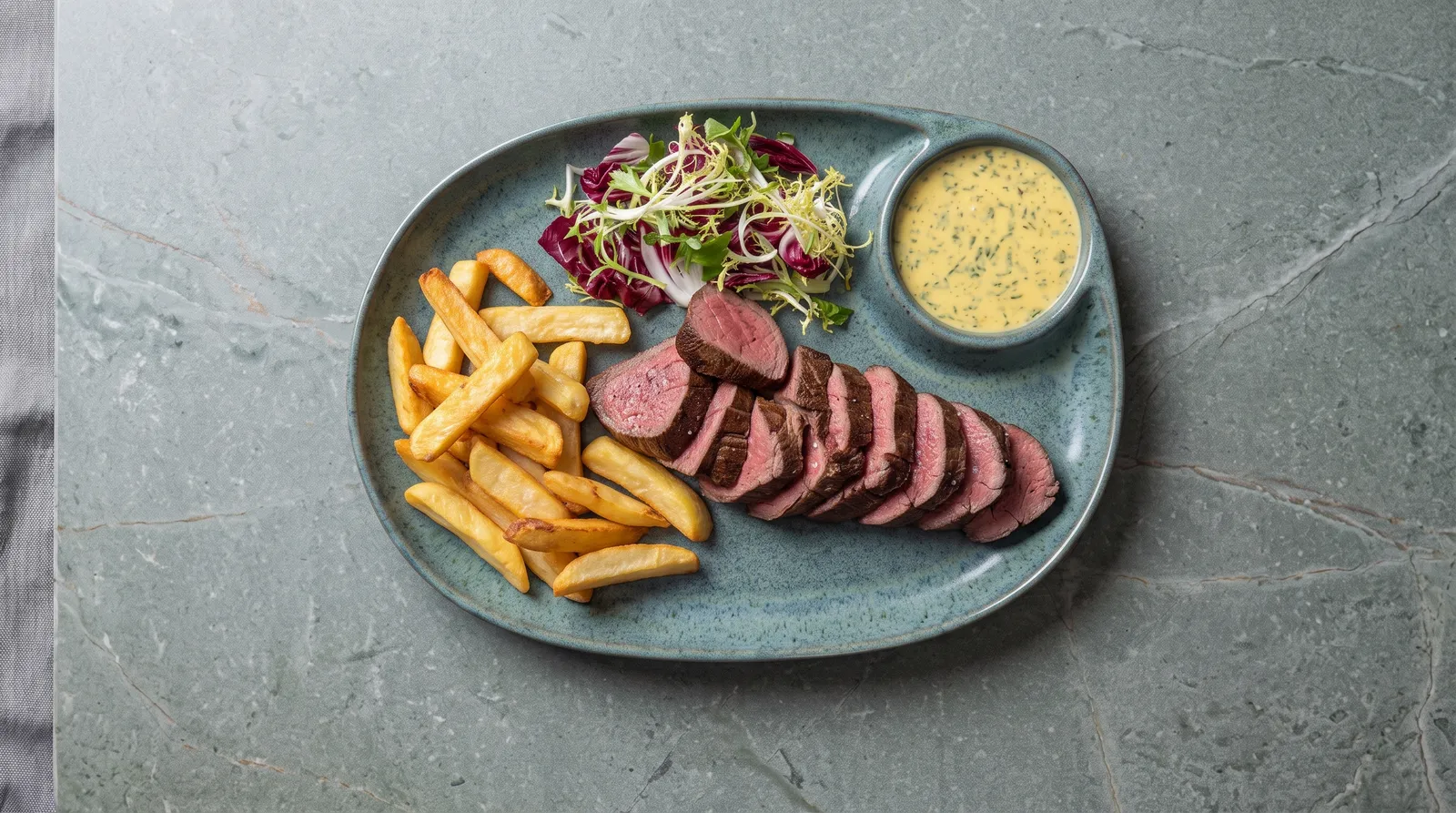
Chateaubriand sauce béarnaise

A thick 450 g centre-cut tenderloin is seared, oven-finished to 63 °C, rested and carved for two, with a pasteurised-yolk béarnaise built from shallot, vinegar, tarragon and clarified butter.

French National Dishes
Share
Chateaubriand sauce béarnaise — arranged on a board
Prep 17 minutes
Cook 31 minutes
Total 73 minutes
Yield 1 chateaubriand for 2, served with béarnaise
Introduction and overview

Chateaubriand sauce béarnaise — centre-cut beef for two with tarragon butter sauce

Chateaubriand is best treated as a culinary cut description rather than a protected specification. Butcher usage varies, so the useful instruction is concrete: choose a thick centre-cut piece of beef tenderloin, about 450 g and 5 to 6 cm thick, intended for two people. A hard pan sear followed by a short oven finish gives the exterior colour while allowing the centre to be monitored accurately with a thermometer.

Béarnaise needs a different kind of precision. Shallot, peppercorn and tarragon stems infuse a vinegar reduction that is strained before it meets pasteurised egg yolks. The yolk mixture is whisked over gentle indirect heat between 55 and 60 °C until thick and foamy, then clarified butter is incorporated gradually away from direct heat. Fresh tarragon finishes the sauce. Stable temperature, not speed, is what keeps the emulsion glossy.

For the beef, the conservative whole-cut endpoint is 63 °C followed by at least a three-minute rest. The five-minute rest here satisfies that requirement and also makes carving cleaner. Béarnaise is intentionally made with pasteurised yolks because its temperature is below a full egg-dish cooking endpoint. Serve it promptly, discard it after extended room-temperature holding, and avoid trying to rescue it through repeated reheating.
Success points

Success points

  • Dry and sear the beef hard before oven finishing.
  • Use an instant-read thermometer rather than colour to judge doneness.
  • Keep the béarnaise yolk base at 55–60 °C and use pasteurized yolks.
  • Rest the beef for at least 3 minutes after it reaches 63 °C.
Ingredients

Ingredients

Beef

  • 450 g centre-cut beef tenderloin, one thick 5 to 6 cm piece
  • 10 g neutral oil
  • 5 g fine salt
  • 1 g black pepper, freshly ground

Béarnaise

  • 40 ml white wine vinegar
  • 40 g shallot, finely chopped
  • 12 g fresh tarragon, leaves chopped; stems reserved for reduction
  • 2 g black peppercorns, lightly crushed
  • 40 g pasteurized egg yolks
  • 15 ml water
  • 90 g clarified butter, warm, about 50 to 55 °C
  • 1 g fine salt
Method

Method

Temper and reduction

  1. Take the chill off the beef. Leave the 450 g centre-cut tenderloin out only long enough to lose its refrigerator chill, then pat dry. Heat: room temperature. Timing: 20 minutes passive rest. Purpose: A short tempering period improves surface browning without prolonged room-temperature holding. The exterior no longer feels refrigerator-cold and is completely dry before searing. Safety. Do not exceed a 2-hour cumulative room-temperature limit.

  2. Make the tarragon reduction. Simmer the vinegar with shallot, crushed peppercorns and tarragon stems until about 15 ml liquid remains; strain. Heat: medium-low. Timing: 10 minutes. Purpose: A concentrated acidic reduction supplies the classic béarnaise backbone. The reduction is sharply aromatic and only about 15 ml liquid remains after straining.

Béarnaise

  1. Build the yolk foam. Whisk the 40 g pasteurized yolks with the reduction and 15 ml water over gentle heat until thick and foamy, keeping the mixture between 55 and 60 °C. Heat: gentle indirect heat. Timing: 5 minutes. Target: 55–60 °C. Purpose: Controlled heat thickens the emulsion base without scrambling the yolks. The whisk leaves visible trails and the yolk mixture is thick enough to mound briefly. Safety. Use pasteurized yolks because this sauce is held below a full egg-cooking safety endpoint.

  2. Emulsify the butter. Remove the bowl from direct heat and whisk in the 90 g clarified butter gradually, then add chopped tarragon and 1 g salt. Timing: 5 minutes. Purpose: Slow butter addition stabilises the warm emulsion. The sauce is glossy, spoonable and holds together without oily pools. Safety. Keep warm, not hot; do not reheat aggressively.

Beef

  1. Sear the tenderloin. Season the beef with 5 g salt and pepper, heat the 10 g oil, and sear all broad surfaces until deeply browned. Heat: high. Timing: 6 minutes. Purpose: Fast browning builds flavour before the centre overcooks. The exterior has an even mahogany-brown crust without burnt patches. Safety. Use tongs rather than piercing the meat.

  2. Finish in the oven. Transfer the skillet to a 180 °C oven and roast until the centre reaches 63 °C. Heat: 180 °C oven. Timing: 8 minutes. Purpose: Thermometer control is more reliable than timing alone for a thick centre cut. The centre reaches 63 °C on an instant-read thermometer while the exterior remains well browned. Safety. Measure in the geometric centre of the beef.

  3. Rest and carve. Rest the beef before slicing it across the grain into thick pieces. Timing: 5 minutes passive rest. Purpose: The safety guidance for whole beef includes at least a 3-minute rest after 63 °C. Juices remain mostly in the meat when it is carved and the slices stay moist. Safety. Rest for at least 3 minutes before carving.

Serve

  1. Sauce and serve. Spoon the béarnaise alongside the sliced beef and serve immediately. Heat: warm. Timing: 2 minutes. Purpose: Serving the sauce alongside preserves both crust and emulsion texture. The beef is hot and juicy, and the béarnaise remains glossy rather than split. Safety. Discard béarnaise that has stood at room temperature for more than 2 hours.

Serving

Practical

Serving

Carve the beef just before serving and offer the béarnaise alongside rather than flooding the crust.

Make-ahead

The vinegar-tarragon reduction can be made a day ahead and chilled. Cook the beef and emulsify béarnaise immediately before serving.

Storage and reheating

Refrigerate leftover beef promptly at 4 °C or below for up to 3 days and reheat to 74 °C if reheating. Béarnaise is best discarded rather than chilled and reheated because the emulsion and egg-safety control are poor after repeated warming.

A similarly thick centre section of beef tenderloin of the same weight.

Thickness, not the butcher's label alone, controls roasting time; check the centre temperature rather than copying minutes.

The béarnaise splits.

Cause: The yolk base became too hot or butter was added too quickly. Correction: Move off the heat and whisk in the warm clarified butter gradually.

The beef overshoots its target.

Cause: It stayed in the oven until visual colour looked right. Correction: Start checking the geometric centre early with an instant-read thermometer.

Technique in focus

Thermometer-based beef doneness and low, controlled béarnaise heat are the two independent techniques that make this plate work.

Nutrition per serving

Nutrition per serving

  • Serving size1 of 2 equal portions
  • Calories745 kcal
  • Carbohydrate3 g
  • Protein54 g
  • Fat56 g
  • Fibre0.5 g
  • Sodium1240 mg
Allergens and food safety

Allergens and food safety

Allergens: Egg; Milk.

Whole beef should reach 63 °C and rest at least 3 minutes before carving.

Use pasteurized yolks because béarnaise is emulsified at 55–60 °C rather than cooked to a full egg-dish endpoint.

Keep perishable food at 4 °C or below when stored; reheat leftover beef to 74 °C.

Discard béarnaise after more than 2 hours at room temperature. Vulnerable diners may prefer beef cooked beyond the minimum whole-cut endpoint according to their medical or local public-health guidance.

FAQ

FAQ

Does every butcher mean the same cut by chateaubriand?

No. Ask for a thick centre-cut tenderloin of the stated weight and thickness rather than relying on the name alone.

Can ordinary shell eggs be used for the sauce?

Pasteurised yolks are required here because the emulsion is held at 55–60 °C, below a full egg-cooking endpoint.

Closing

Closing

  • Result: A thick 450 g centre-cut tenderloin is seared, oven-finished to 63 °C, rested and carved for two, with a pasteurised-yolk béarnaise built from shallot, vinegar, tarragon and clarified butter.
  • Decisive technique: Thermometer-based beef doneness and low, controlled béarnaise heat are the two independent techniques that make this plate work.