French National Dishes

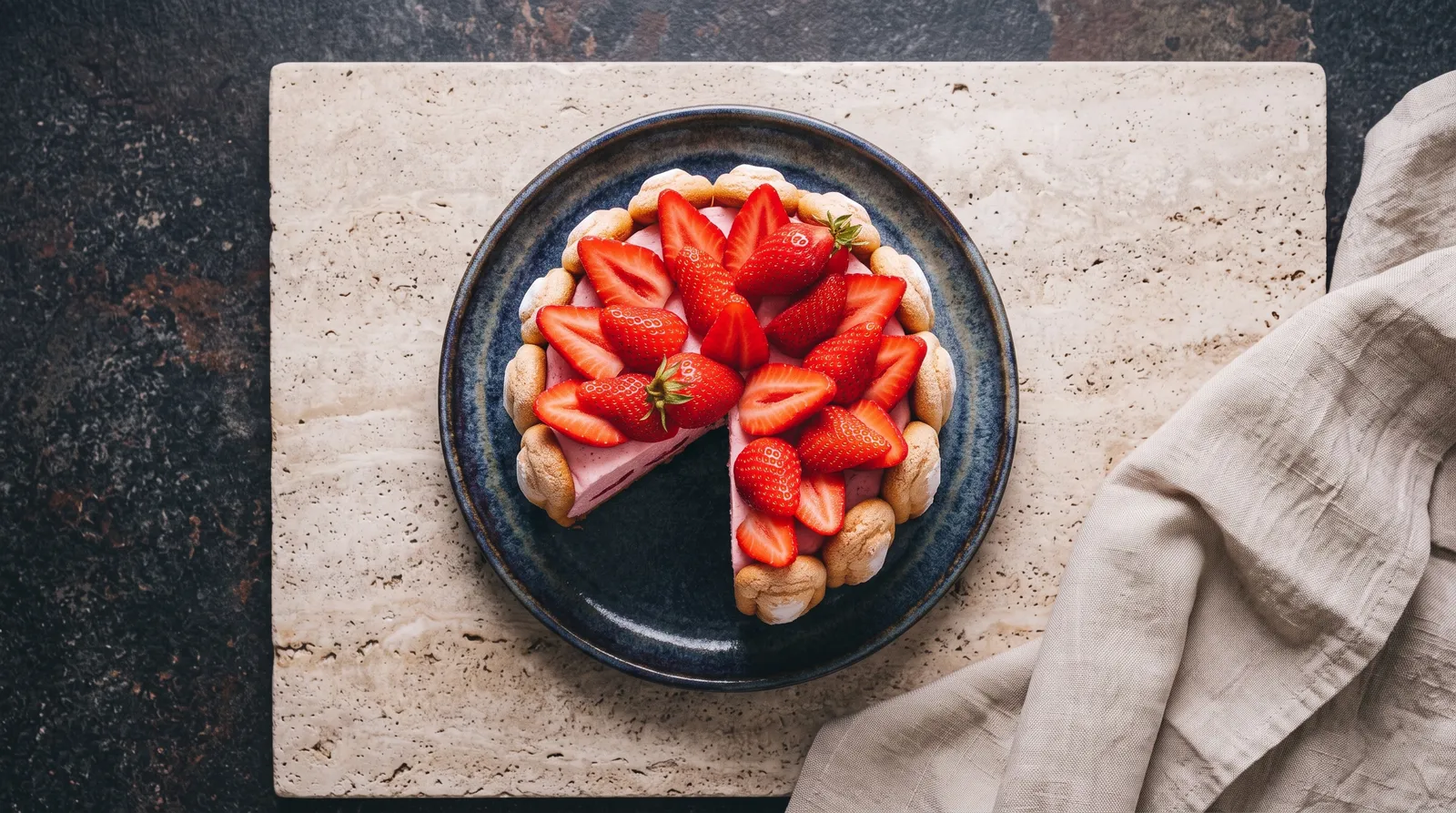
Charlotte aux fraises

A 20 cm strawberry charlotte lined with lightly syruped ladyfingers and filled with a cooked-yolk strawberry bavarois, diced berries and softly whipped cream, then chilled for a full six hours.

French National Dishes
Share
Charlotte aux fraises — served on a plate
Prep 27 minutes
Cook 11 minutes
Total 433 minutes
Yield 1 charlotte, 20 cm diameter, cut into 8 slices
Introduction and overview

Charlotte aux fraises — ladyfinger strawberry charlotte with bavarois

A strawberry charlotte succeeds because three structures work together: a close wall of ladyfingers, a filling that sets cleanly without becoming rubbery, and fresh berries that keep their identity inside the cream. The preparation uses a strawberry bavarois rather than combining unrelated no-bake fillings. The mould is fixed at 20 cm so the quantity of biscuits and filling has a clear destination and the final yield can be cut consistently into eight slices.

The bavarois begins with a cooked custard made from milk, pasteurised yolks and sugar. Gelatine dissolves into the hot custard before strawberry purée is added, and the base then cools to 25 °C. That temperature matters: warmer purée would melt the softly whipped cream, while a much colder base could begin setting before the cream is incorporated. Diced strawberries are folded in only after the mousse is formed.

The ladyfingers need only a light brushing of syrup. Saturating them creates a wet shell that can buckle when the dessert is unmoulded. Once filled, the charlotte receives a full six-hour refrigeration at 4 °C or below. A properly set centre should not ripple when the mould moves gently, and the biscuit wall should remain upright when inverted. Keep the finished dessert cold and use it within two days.
Success points

Success points

  • Fit the ladyfingers tightly and moisten them lightly.
  • Cook the custard to 82 °C with pasteurized yolks.
  • Cool the strawberry base before folding in cream.
  • Allow the full six-hour chill before unmoulding.
Ingredients

Ingredients

Strawberry bavarois

  • 350 g strawberries for purée, hulled
  • 250 ml whole milk
  • 80 g pasteurized egg yolks
  • 100 g caster sugar
  • 10 g powdered gelatine, about 200 Bloom
  • 50 ml cold water, for blooming gelatine
  • 300 g heavy cream, well chilled

Assembly

  • 250 g ladyfingers
  • 300 g strawberries, 220 g diced for filling, 80 g sliced for top
  • 70 g caster sugar, for syrup
  • 120 ml water, for syrup
Method

Method

Syrup and mould

  1. Make the light syrup. Bring 70 g sugar and 120 ml water to a brief boil until the sugar is dissolved, then cool the syrup to room temperature. Heat: medium. Timing: 3 minutes cooking + 15 minutes passive cooling. Purpose: A light syrup softens the ladyfingers without making them sodden. The syrup is completely clear with no sugar crystals visible.

  2. Line the mould. Line a 20 cm charlotte mould with ladyfingers, fitting them snugly around the sides and over the base; brush lightly with cooled syrup. Timing: 10 minutes. Purpose: A tight lining gives the chilled dessert enough structure to unmould. The ladyfingers form a continuous upright wall with no large gaps and feel damp only on the surface.

Bavarois

  1. Bloom the gelatine. Rest the 10 g powdered gelatine in 50 ml cold water until fully hydrated. Heat: cold. Timing: 5 minutes passive rest. Purpose: Full blooming prevents lumps. The gelatine has absorbed the water and looks fully swollen with no dry powder.

  2. Cook the custard. Heat the 250 ml milk. Whisk the 80 g pasteurized yolks with 100 g sugar, temper with the hot milk, then cook while stirring to 82 °C. Heat: medium-low. Timing: 8 minutes. Purpose: Controlled custard temperature thickens the yolk base without scrambling it. The custard lightly coats a spatula and remains smooth without curdled grains. Safety. Use pasteurized yolks and a thermometer.

  3. Dissolve gelatine and add strawberry. Remove from heat, dissolve the bloomed gelatine, then mix in the 350 g strawberry purée and cool the base. Timing: 15 minutes passive cooling. Target: 25 °C. Purpose: Cooling prevents the cream from melting while the gelatine remains fluid. The strawberry base is homogeneous and cooled to 25 °C before whipped cream is folded in.

  4. Whip and fold. Whip the 300 g cold cream to soft peaks and fold it into the strawberry base. Timing: 6 minutes. Purpose: Soft peaks incorporate without making the filling grainy. The mousse is airy, evenly pink and falls from the spatula in thick ribbons. Safety. Keep cream cold until whipping.

Assembly and chill

  1. Fill the charlotte. Fold the 220 g diced strawberries into the bavarois, spoon into the lined mould and level the top. Timing: 6 minutes. Purpose: Even filling gives clean slices. The filling reaches the ladyfinger wall evenly with no large air pockets.

  2. Chill until set. Cover and refrigerate until the bavarois is completely set. Heat: cold. Timing: 6 hours passive chilling. Target: 4 °C. Purpose: The full chill is necessary for gelatine setting and clean unmoulding. The centre is firm to a light touch and does not ripple when the mould is gently moved. Safety. Keep at 4 °C or below.

  3. Unmould and finish. Invert onto a cold serving plate and arrange the reserved 80 g sliced strawberries on top. Timing: 5 minutes. Purpose: A fully set filling supports the moulded form. The charlotte stands upright, the ladyfinger wall stays attached and slices hold a clean edge. Safety. Return to refrigeration promptly after serving.

Serving

Practical

Serving

Serve cold, cutting with a clean thin knife and returning the remaining charlotte to refrigeration promptly.

Make-ahead

Make the entire charlotte the day before; decorate with the reserved sliced strawberries shortly before service.

Storage and reheating

Keep covered at 4 °C or below and use within 2 days. Do not leave at room temperature for more than 2 hours. Freezing is not recommended because strawberries and bavarois can weep after thawing.

Equivalent-strength leaf gelatine by bloom strength.

Only use a conversion supplied by the manufacturer or a reliable gelatine equivalence; an unverified gram-for-gram swap can change the set.

The charlotte slumps after unmoulding.

Cause: The bavarois was not chilled long enough or the gelatine was incompletely hydrated. Correction: Bloom gelatine fully and give the assembled dessert the complete six-hour refrigeration.

The mousse looks grainy.

Cause: The custard overheated or the strawberry base was too warm when cream was folded in. Correction: Stop custard at 82 °C and cool the base to 25 °C before folding.

Technique in focus

Control the custard temperature, cool the strawberry base to 25 °C before folding in cream, and do not shorten the six-hour set.

Nutrition per serving

Nutrition per serving

  • Serving size1 of 8 equal slices
  • Calories410 kcal
  • Carbohydrate50 g
  • Protein8 g
  • Fat21 g
  • Fibre2 g
  • Sodium105 mg
Allergens and food safety

Allergens and food safety

Allergens: Gluten; Egg; Milk.

Use pasteurized egg yolks.

Cook the custard to 82 °C.

Hold the finished dessert at 4 °C or below and discard if left at room temperature for more than 2 hours.

FAQ

FAQ

Why use pasteurised yolks if the custard is heated?

They add an extra conservative control to a chilled egg-based dessert and avoid relying on a marginally cooked egg preparation.

Can liqueur be added to the syrup?

Not in the preparation. The syrup is deliberately alcohol-free so the flavour and nutrition basis remain fixed.

Closing

Closing

  • Result: A 20 cm strawberry charlotte lined with lightly syruped ladyfingers and filled with a cooked-yolk strawberry bavarois, diced berries and softly whipped cream, then chilled for a full six hours.
  • Decisive technique: Control the custard temperature, cool the strawberry base to 25 °C before folding in cream, and do not shorten the six-hour set.