
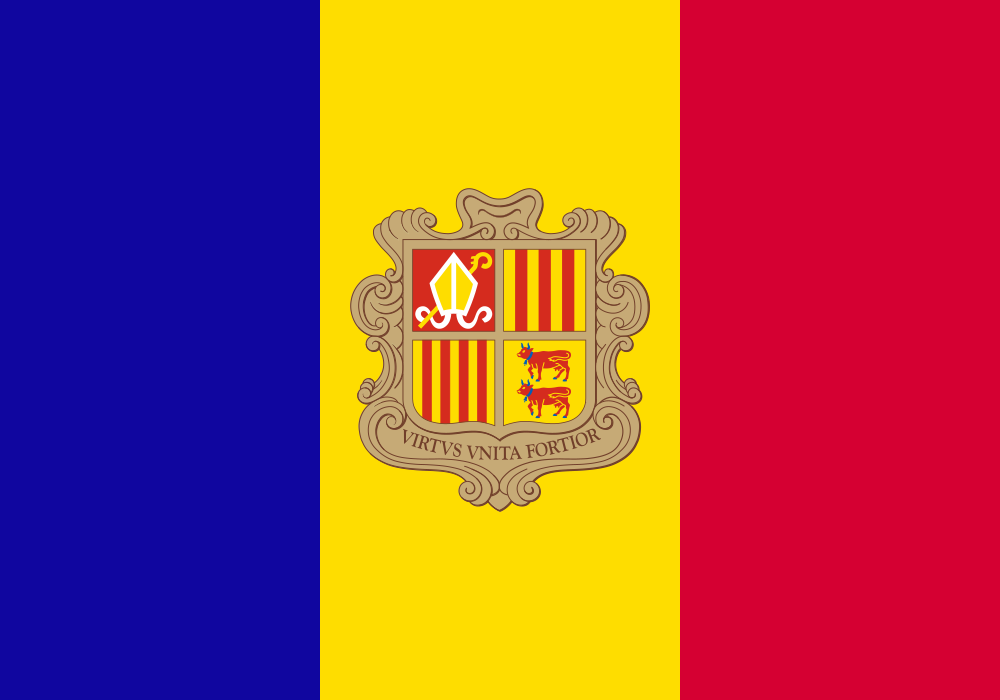

Andorra’s history is often compressed into one sentence: a small Pyrenean country survived between France and Spain because it was ruled by two co-princes. The arrangement is real, but it is only one part of a longer story. Archaeological evidence traces human use of the valleys back to the end of the last Ice Age; medieval agreements shaped shared lordship; parish communities negotiated land, taxes and political representation; and the 1993 Constitution transformed a distinctive historical system into a modern sovereign parliamentary state.
The chronology is not a straight line from ancient independence to present-day democracy. Some celebrated dates mark later recognition or institutional change rather than an organisation appearing from nothing. The Pariatge of 1278 established a framework for shared lordship, while evidence for representative assemblies reaches back to 1289 and may reflect older practices. The 1419 privilege long treated as the Consell de la Terra’s founding moment is now understood more cautiously. Reading the record this way keeps Andorra’s political distinctiveness in view without turning uncertain origins into settled fact.
Before Andorra was a state: people in the Pyrenean valleys
The earliest history of the Andorran valleys is archaeological. At the Balma de la Margineda, a rock shelter above the Valira near Aixovall, excavations have documented human occupation from the late Palaeolithic into later periods. Historian Michel Martzluff’s survey places early use near the end of the last glaciation, around 14,000 years ago. The shelter’s sequence includes hunter-gatherer occupations, changing stone-tool traditions, and later evidence for farming and pastoralism. These remains record people using a mountain corridor and its resources; they do not establish a continuous political community called Andorra in prehistoric times.S001
The terrain shaped what could be done there. Glaciers carved steep valleys and left terraces, wetlands and lakes; cultivable land was limited compared with slopes, pasture and high ground. Mobile groups hunted, fished and gathered plants, while later communities added animal husbandry and cultivation. As climate warmed and vegetation changed, patterns of movement and resource use changed too. Archaeologists read these transitions from tools, animal remains, plant evidence, hearths and settlement traces, each of which survives unevenly. The absence of a site in the record is not proof that a valley was never visited.S001
The shift to productive farming and herding was gradual rather than a single “arrival” of agriculture. Martzluff’s study describes Neolithic communities at sites including Balma de la Margineda and Juverri, where the evidence includes occupation, food production and material culture. Feixa del Moro at Juverri is notable for Neolithic burials and artefacts that help researchers reconstruct practices and exchange. High-altitude pastoral use also appears in the long archaeological sequence. The mountain was not only a barrier; it was a working landscape whose seasonal resources could be exploited at different elevations.S001
Archaeological knowledge is itself relatively recent. Modern investigation of Andorra’s prehistoric record expanded from fieldwork at Balma de la Margineda in 1960, after Pere Canturri drew attention to the site. Later excavations at the shelter and at Roc d’Enclar, together with pollen and environmental studies in Madriu, widened the evidence beyond individual finds. Urban development also prompted rescue archaeology from the 1980s onward. This means that the surviving picture depends partly on where research has been possible and which deposits escaped disturbance. A well-studied rock shelter can reveal a long sequence; it cannot stand in for every valley or community.S001
Later prehistoric settlements and finds add evidence of metalworking, burial customs and contact with communities on both sides of the Pyrenees. The valleys sat between the basins of the Ebro and Garonne, linked by routes through the mountains. Imported objects, raw materials and shared cultural forms can indicate exchange, but they do not automatically prove migration, a particular language or a unified political authority. The historical question is often how far a conclusion can travel from the object itself. A piece of imported flint shows connection; it cannot by itself tell us who carried it or what identity they claimed.S001S002
Iberian worlds and Roman influence
From the first millennium BCE, archaeological work places the region within wider Iberian and Pyrenean cultural networks. Research on the Andorran ancient period considers the Urnfield horizon, ironworking, ceramics, the Ceretani and the Andosini named in classical sources. The relationship between those labels and particular sites is a matter of interpretation. The names in ancient texts refer to peoples or political groupings across broader territories; they should not be treated as direct equivalents of modern Andorra’s borders.S002
Roman power reached the Pyrenees through conquest and integration into a much larger system of roads, settlements, administration and exchange. The evidence for Roman influence in Andorra itself is less abundant than in some neighbouring valleys. Finds and building materials at sites such as Roc d’Enclar point to contact and activity, while nearby centres such as Iulia Lybica in Cerdanya offer a regional context. The pattern does not justify describing the high valleys as a major Roman city or assuming that every Roman artefact signals a permanent settlement. Archaeological interpretation depends on context, not the prestige of an object alone.S002
The period’s significance is therefore best understood through connection. Mountain routes joined local communities to larger political and economic systems, but geography and settlement density shaped the extent of direct control. Later accounts sometimes present Andorra as naturally untouched by outside powers. The evidence suggests a more complicated relationship: the valleys were connected to neighbouring institutions and trade, while local topography and community organisation could limit how authority was exercised.S002S003
Early medieval valleys and the rise of ecclesiastical authority
Written evidence becomes more visible in the early medieval period, though the documents themselves require scrutiny. A famous account links Andorra’s origins to Charlemagne and the recovery of the Pyrenees from Muslim rule. That story became part of national memory, but it should not be presented as a contemporary eyewitness record of a founding event. The surviving evidence for early medieval Andorra is fragmentary, and later institutional narratives often draw on documents whose dating and authenticity have been reassessed by historians.S003
One important example is the so-called consecration act of the cathedral of Santa Maria d’Urgell, traditionally dated to 839 and often cited as an early reference to Andorra’s parishes. Recent medieval research on the Andorran record describes the act as a forgery dated instead to between 1016 and 1024. That does not mean the parishes or churches were invented at that time; it means that this document cannot safely be used as a contemporary ninth-century record. The distinction matters because a later text can preserve older information while still being unreliable as evidence for its claimed date.S003
By the tenth and eleventh centuries, the Bishop of Urgell’s ecclesiastical and property interests in the valleys are better documented. Churches formed a network of worship and local organisation that helped shape the parish structure. Santa Coloma, one of the valley’s notable early churches, appears in debates over patronage and jurisdiction. The emergence of the six historic parishes—Canillo, Encamp, Ordino, La Massana, Andorra and Sant Julià de Lòria—was a process involving church institutions, local communities and territorial administration, not a single act of modern boundary-making.S003
The relationship between communities and lords remained contested. Counts of Urgell and later the counts of Foix asserted rights, while local communities negotiated obligations and resisted attempts to impose stronger control. The medieval historian Carles Gascón describes Andorran communities as retaining unusual room for negotiation compared with many neighbouring communities, although that did not mean they were outside feudal structures. At times, conflict was direct: the destruction of the castle of Bragafolls near Sant Julià around the late tenth century is one example of local opposition to an imposed presence, as reconstructed from documentary evidence.S003
From the twelfth century, the Bishop of Urgell’s authority and the claims of the Foix house increasingly overlapped. Foix’s ties to the viscounts of Castellbò and the region’s complex feudal relationships created a prolonged dispute over jurisdiction and revenues. The population lived within this political contest, while pastoralism and movement across neighbouring territories remained central to economic life. The eventual co-lordship was not simply a diplomatic curiosity: it was a settlement to a real conflict over power, justice and the rights to collect revenue.S003
The Pariatges and the medieval political community
On 8 September 1278, Bishop Pere d’Urtx and Count Roger Bernat III of Foix signed the first Pariatge at the Castell del Rei in Lleida. The agreement followed years of conflict and established shared, indivisible lordship over the Andorran valleys. It dealt with the quèstia, an annual payment made by the men of Andorra to the two co-lords in alternating years, and set out judicial and administrative arrangements. The King of Aragon, Peter III, helped bring the dispute toward settlement. The document was an agreement between lords, not a declaration of popular sovereignty by the Andorrans.S004S005
A second agreement followed in 1288, addressing unresolved issues within the framework established ten years earlier. Its place in the story is important, but recent research cautions against treating the two texts as identical or equal in scope. The medieval study on historia.ad notes that the label “second Pariatge” was applied retrospectively in the nineteenth century; the 1288 agreement dealt with a more limited set of matters. The first agreement established the principal framework for shared lordship; the later agreement helped close a particular phase of conflict.S003S005
The co-lords were the Bishop of Urgell and the Count of Foix. Through dynastic succession, the Foix rights passed through the rulers of Navarre and ultimately to the French Crown. The French side’s position later passed to the head of the French state, while the episcopal co-lord remained the Bishop of Urgell. That transmission helps explain how an arrangement rooted in medieval lordship survived changes in dynasties and political regimes. It should not be described as an unchanged constitution lasting unchanged for seven centuries: the institutions, rights and political balance evolved repeatedly.S006
The Consell de la Terra—the Land Council—grew out of the need to organise common affairs, manage communal resources and negotiate with the co-lords. The date 1419 was traditionally treated as its foundation because Bishop Francesc de Tovia granted a privilege recognising representation from the parishes. The privilege established annual election of representatives, but modern research has identified an earlier assembly in 1289. An ordinance from that year, preserved in a later record book, regulated communal use and the allocation of the quèstia. It is now evidence for a representative body predating 1419, though the exact form and continuity of earlier assemblies remain subjects of historical interpretation.S007S008
That revision changes the meaning of the familiar anniversary. The 1419 privilege remains a major milestone in the documented development of the Council, but it may not mark the institution’s first existence. The archive’s own account explains that systematic surviving minutes begin after the Pariatges, while earlier evidence is scattered among parchments. Researchers have to distinguish the first preserved record, the first formal recognition and the gradual emergence of an institution. Those are not necessarily the same date.S007S008
Pastoral economies made the Council’s administrative work tangible. Andorran herds moved to seasonal pastures and crossed into neighbouring territories, where access and passage rights had to be negotiated. Communities also managed communal land and collected contributions used to meet the quèstia. Trade in necessities such as grain, salt and cloth linked the valleys to markets beyond them. These concerns help explain why local representation could matter even under lordship: agreements about pasture, tolls and movement shaped household economies.S008
The records also reveal how administrative routines grew from those practical needs. After the Pariatges, collecting the quèstia required parish-level assessments and accounts. The comuns helped determine contributions, collect payments and transfer sums to the Council, while representatives negotiated exemptions and passage rights with neighbouring authorities. Common pasture had to be regulated for local herds and for animals arriving from nearby territories in summer. The council’s documentary record therefore grows out of fiscal and land-use work, not only constitutional debate. It preserves the negotiations through which communities managed shared resources and external obligations.S008
The 1419 privilege is easier to understand against that gradual institutional background. Its provision for annual representatives from each parish formalised a representative role, but historical research warns that it also narrowed participation compared with broader assemblies: a small number of elected representatives could handle affairs without summoning a general gathering. By the fifteenth century, the Council increasingly consisted of parish consuls and councillors. From the sixteenth century, distinctions between more powerful household heads and more modest households restricted who appeared in elected office. Local self-government existed, but it did not mean equal participation by all residents.S007S008
From early modern lordship to reform
In the early modern period, the co-lordship remained the framework for Andorra’s political status, while local institutions governed many internal matters. The Council and the parish administrations—comuns—handled communal resources, taxation and local arrangements. Andorra’s geography mattered to trade: routes across the Pyrenees could be difficult and seasonal, but they also connected the valleys with France and the Iberian side. The country’s position as a borderland influenced both opportunity and vulnerability.S009
Two texts became important in how Andorrans described their institutions. Antoni Fiter i Rossell’s Manual Digest of 1748 and Antoni Puig’s Politar Andorrà of 1763/64 collected legal, political and historical material. They are essential sources for the political thought of their time, but not neutral transcripts of an unchanging ancient constitution. Recent scholarship has compared the two works and argued that the Politar drew heavily on the Manual Digest, adapting much of it stylistically rather than constituting a wholly independent account. They should be read as products of learned institutional culture and political argument.S009S010
The French Revolution disrupted the French co-lord’s relationship with Andorra. In 1793 the revolutionary authorities refused to maintain the feudal connection, and the customary exchange with the French side was interrupted. Napoleon restored the French co-lordship in 1806, re-establishing the arrangement by decree. This episode shows both the vulnerability and flexibility of the system: a change of regime in France had consequences in the valleys, but the co-principality adapted rather than disappearing.S006S011
The disruption had consequences for more than formal sovereignty. Families depended on cross-border commerce, exchange and access to markets; a refusal to recognise the old relationship could affect customs privileges and the movement of goods. Historical studies describe periods in which the French authorities’ treatment of Andorra threatened the viability of the political arrangement itself. The 1806 restoration helped re-establish the status quo, but the later nineteenth century still saw economic and institutional pressures. In this context, reform was partly a response to changing livelihoods and administrative needs, as well as a dispute about who could exercise authority.S011
The nineteenth century brought economic strain and demands for changes in political representation. In 1866 the Nova Reforma (“New Reform”) reorganised the Council and parish government. Among its changes were a new electoral system and participation in political life for male household heads beyond the restricted group that had dominated earlier councils. It also separated the roles of general councillors and parish councillors, strengthening the Consell General as an institution distinct from the parish administrations. The reform did not establish universal suffrage in the modern sense: political rights remained limited by gender, age, citizenship and household status.S011S012
The reform was followed by further conflict. The 1881 disturbances—sometimes called a revolution in later accounts—grew from political, economic and social disputes around the new arrangements, including questions over concessions and the authority of the co-princes and Council. The episode should not be reduced to a simple democratic uprising or to a single concession dispute. It reveals the continuing tension between local political claims, economic modernisation and external authority. Historical studies of the period examine these forces together rather than treating reform as a smooth path to modern institutions.S013
Infrastructure, labour and political change in the twentieth century
Road construction and hydroelectric development began to alter the valleys in the early twentieth century. The creation of Forces Hidroelèctriques d’Andorra (FHASA) in the 1920s brought large infrastructure works, workers from outside Andorra and new forms of wage labour. Electricity and roads connected the country more closely to regional economies, while the scale of the projects placed new demands on administration and labour relations. These changes did not instantly replace pastoral life; they added new economic activity and accelerated a longer transition.S014S015
The FHASA concession, signed in 1929, was unusually influential because it joined electricity production to a programme of road building. The company was formally constituted in 1930 with French and Spanish investment, while Andorran capital had only a small presence. The plans included hydroelectric installations and roads linking Andorra la Vella with Escaldes, Encamp, Canillo, Soldeu, La Massana and Ordino. Hundreds of workers arrived for the works, with the historical study estimating a peak near 1,200. The concession brought electricity and transport improvements, but it also concentrated economic power in a foreign-backed company whose role touched public order, housing, health and labour conditions. That concentration sharpened the question of how much authority rested with the Council and how much with the co-princes and concessionaire.S014
In 1933, demands for expanded political participation met labour unrest and institutional confrontation. On 5 April, a crowd interrupted a session of the Consell General and pressed for a new electoral law. The eventual settlement extended male suffrage to Andorran men over 25 and opened Council sessions to the public. The conflict was intertwined with FHASA workers’ strikes and debates over working conditions. French gendarmes entered during the confrontation at the request of the co-princes, then withdrew after the elections and restoration of the institutional status quo. The word “revolution” appears in later accounts, but the episode involved several overlapping struggles and its interpretation depends on which actors and outcomes are emphasised.S014S015
The 1933 expansion did not endure unchanged. In 1941, during the Second World War, male suffrage was restricted again to household heads; it was restored in 1947. This reversal is an important corrective to a neat story of steadily expanding rights. The political system remained shaped by the co-princes and the General Council, and wartime pressures affected both civil liberties and the lives of residents.S014
The Spanish Civil War made Andorra a place of refuge and passage. People fleeing persecution crossed into the valleys, and French gendarmes returned in 1936, remaining until 1940. Research by Pau Chica estimates that between 14,000 and 20,000 refugees passed through during the conflict, most continuing toward France; the figure is an estimate, not a complete border count. Some hundreds stayed, joining Andorran families and workers from elsewhere. During the Second World War, Andorra again served as a route through the mountains for people escaping occupied France, including Jewish families and Allied airmen, though individual journeys varied and need case-specific evidence.S014S016
The arrivals and the infrastructure economy contributed to rapid social change. Refugees, workers and immigrants brought skills, labour and new cultural influences. Trade and tourism grew as roads improved, and the Pas de la Casa shifted from a pastoral settlement toward a commercial centre. The country gradually changed from a place of emigration to one attracting people for work. These developments were not powered by Andorrans alone: migrants were integral to construction, commerce and services, while at times facing precarious conditions and limited political rights.S014S017
After the Second World War, road access and rising mobility in neighbouring countries helped tourism and retail trade expand. In the 1950s, Andorra la Vella and Escaldes became major centres for visitors and hotels; the historical study records a rapid increase in hotel capacity during the decade. In the 1960s, mass tourism consolidated as car ownership grew in France and Spain. Winter sports followed a distinct timetable: early lift infrastructure at Pas de la Casa appeared in the late 1950s, while the first Arinsal station opened later, in 1973. Tourism therefore developed through successive investments and changing visitor markets, not as an ancient feature of Andorran life.S017
This expansion altered the population as well as the economy. Immigration became a major source of labour for construction and services, and the Spanish population grew substantially during the post-war decades. Tourism, commerce and financial activities became central to the service economy, while farming and herding lost relative economic weight. Roads, accommodation, retail development and ski facilities changed the built landscape. These broad changes created opportunities, but also raised questions of political representation, citizenship and the place of newcomers in a country whose institutions had developed around parish communities and household status.S017S019
Women’s political rights expanded much later than men’s. In 1967, a group of Andorran women began a petition campaign; by 1968, 378 eligible women had signed the request for political rights. The Consell General supported voting rights in 1969, and the decree granting women the vote arrived in 1970. Eligibility to stand for election followed in 1973. The distinction between voting and being elected matters: political participation was not granted in a single step. The campaign’s named organisers and archival record challenge any account that treats democratisation as only a negotiation among male office-holders.S018
Formal rights did not translate immediately into equal representation. The first woman entered the Council as a replacement in 1984; the first was elected in 1986. Four women participated in the 1993 constituent legislature. Those milestones show the difference between a legal right and the slower change in political institutions. They also place the Constitution within a broader history of claims to citizenship and representation, rather than treating 1993 as the point at which every democratic practice began at once.S018
The Constitution and the modern state
Economic growth, immigration and the expansion of tourism and services increased pressure for institutional reform in the second half of the twentieth century. Population growth was concentrated in Andorra la Vella and Les Escaldes, while each parish continued to have equal representation in the General Council, creating representational tensions. In 1978 Escaldes-Engordany became a separate parish, and in 1981 an Executive Council headed by a Head of Government was created to separate executive responsibilities from the legislature. The limited scope of that arrangement led critics to call it the reformeta, or “little reform”.S019
The constitutional process began amid calls for a deeper reform and recommendations from international bodies. A tripartite commission brought together representatives of the Consell General and both co-princes. The General Council adopted the draft in February 1993; voters approved it in a referendum on 14 March. The Constitution entered into force on 4 May 1993. It established Andorra as a sovereign, independent, democratic and social state under the rule of law, with sovereignty vested in the Andorran people. The two co-princes remained heads of state, now acting within a constitutional framework and on an equal, personal basis.S019S020
The new order clarified institutions rather than erasing the historical co-principality. The Constitution defines the role of the co-princes, the General Council, Government, parishes, courts and Constitutional Court. The old arrangement’s continuity is visible in the co-princes’ office; its transformation is visible in popular sovereignty, constitutional rights and a parliament with legislative authority. Andorra joined the United Nations on 28 July 1993 and the Council of Europe in 1994, entering a new phase of international recognition and participation.S006S020
The modern country also reflects a transformation in its economy and society. Tourism, commerce and financial services became central to the service sector, while immigration continued to shape population and everyday life. The landscape itself changed through roads, buildings, ski development and urban growth. These changes are part of the historical record, not simply a break from it: they reflect the same long negotiation between geography, external connections and local institutions that appears in earlier periods.S017S019
Reading Andorra’s history without turning it into legend
Several dates anchor Andorra’s history, but each represents a particular kind of evidence. Archaeological layers at Balma de la Margineda document human activity; a disputed consecration act can illuminate later claims but cannot be treated as a reliable ninth-century record; the Pariatge of 1278 is a documentary settlement between lords; 1289 ordinances reveal early communal representation; 1419 records an important privilege; 1866 reshapes institutions; 1933 expands male suffrage amid labour and political unrest; and the 1993 Constitution establishes a sovereign constitutional state.S001S003S004S007S011S014S020
Those milestones matter because the records behind them differ. An archaeological site is not a written constitution; a charter is not proof of modern democracy; an institutional anniversary may simplify a longer development; and a later memoir may preserve valuable testimony while reflecting its author’s interests. Good historical writing makes those differences visible. It also leaves space for unanswered questions, especially where the archive is sparse or historical interpretation is changing.
Andorra’s political history is distinctive precisely because it evolved rather than remaining frozen. Its valleys were inhabited long before a state existed; its communities lived under layered authorities while building institutions to manage shared concerns; and a medieval co-lordship endured by adapting to changing dynasties and political systems. The 1993 Constitution did not make that history irrelevant. It gave the country’s inherited institutions a new democratic and legal framework, while putting sovereignty in the hands of its people.
Sources
La prehistòria de les Valls d’Andorra (14.000–2.500 abans d’ara) — Michel Martzluff, *Relat cronològic d’Andorra*; archaeological sequence and prehistoric settlement; accessed 24 September 2026 ↩
L’Andorra antiga: iberització i romanització — Andreu Falcó Sanchiz, *Relat cronològic d’Andorra*; Iron Age, Andosini and Roman evidence; accessed 24 September 2026 ↩
L’edat mitjana (segles VI–XIV) — Carles Gascón, *Relat cronològic d’Andorra*; early medieval records, parish structures, lordship, Pariatges and early Council evidence; accessed 24 September 2026 ↩
Els precedents — Consell General; feudal dispute, co-lordship and the *quèstia*; accessed 24 September 2026 ↩
Pariatges Andorra 1278–1288 — Consell General; publication and transcription of the two agreements; accessed 24 September 2026 ↩
Història d’Andorra — Govern d’Andorra; institutional chronology from the Pariatges through the Constitution and international membership; accessed 24 September 2026 ↩
De las vistas condales al Consell de la Terra: los antecedentes medievales del parlamentarismo andorrano (s. XII–XV) — Carles Gascón, UNED; research on the 1289 assembly and the 1419 privilege; accessed 24 September 2026 ↩
Estudi preliminar: Actes històriques del Consell General — Consell General; archival series, communal administration, pastoral movement and early minutes; accessed 24 September 2026 ↩
Pervivències del món medieval: dels Pariatges a la Guerra dels Segadors (finals del segle XIII – inici del segle XVII) — Olivier Codina and Marc Conesa, *Relat cronològic d’Andorra*; institutions and political-economic continuities; accessed 24 September 2026 ↩
El Manual digest contra el Politar andorrà: Vides paral·leles? — Albert Villaró, *Recerques: història, economia, cultura*, 2025; comparison of the two eighteenth-century works; accessed 24 September 2026 ↩
La república dels prohoms i els ferments de la contesta social i institucional (segles XVIII i XIX) — Olivier Codina and Marc Conesa, *Relat cronològic d’Andorra*; early modern and nineteenth-century context; accessed 24 September 2026 ↩
La Nova Reforma — Consell General; text summary of the 1866 reform; accessed 24 September 2026 ↩
L’auge del Consell General: de la crisi de l’Andorra tradicional als conflictes per la modernització (1866–1890) — Oliver Vergés, *Relat cronològic d’Andorra*; reforms and conflicts after 1866; accessed 24 September 2026 ↩
Andorra a la primera meitat del segle XX — Pau Chica, *Relat cronològic d’Andorra*; FHASA, 1933, refugees, war and economic change; accessed 24 September 2026 ↩
Ampliacions del sufragi — Consell General; electoral changes in 1933, 1941, 1947, 1970 and 1973; accessed 24 September 2026 ↩
L’Andorra del període entre la Guerra Civil Espanyola i la Segona Guerra Mundial (1936–1945) — Narcís Casal i Vall, Govern d’Andorra; refugee passage, population and wartime context; accessed 24 September 2026 ↩
Andorra de la segona meitat del segle XX al segle XXI — Eva Garcia Lluelles and Maria Jesús Lluelles Larrosa, *Relat cronològic d’Andorra*; post-war economic, demographic and institutional transformation; accessed 24 September 2026 ↩
Les dones al Consell General — Consell General; women’s petition, voting rights and eligibility; accessed 24 September 2026 ↩
Constitució i sobirania plena — Consell General; reforms, 1981 Executive Council and constituent process; accessed 24 September 2026 ↩
Constitution — Consell General; referendum and constitutional structure; accessed 24 September 2026 ↩